In criminal justice, suspicion alone is never enough. Even where conduct appears morally questionable, a court cannot uphold a conviction unless the exact offence charged is fully supported by the evidence presented before the court. The law demands precision. A criminal charge must correspond strictly with the facts proved in evidence. Once there is a disconnect between the allegation and the evidence, the entire foundation of the prosecution collapses.
This principle became central in the landmark Nigerian decision of The Queen v. Anyiam, a case that tested the boundaries of official corruption under section 116(1) of the Criminal Code and clarified an important rule of criminal jurisprudence: where evidence is capable of two interpretations, the interpretation favourable to the accused must prevail.The case involved a police constable accused of corruptly demanding and receiving money to prevent the prosecution of a traffic offender. At first glance, the facts appeared straightforward. A police officer allegedly demanded money in connection with a criminal prosecution.
The trial court convicted him. Yet, on closer examination, the Federal Supreme Court discovered a fatal defect hidden beneath the prosecution’s case..
The problem was not merely whether money exchanged hands. The real issue was whether the prosecution proved the specific offence charged under the law.
The judgment remains one of the most important Nigerian authorities on:official corruption,interpretation of criminal statutes,inconsistency between charge and evidence,and the principle that ambiguity in criminal proceedings must be resolved in favour of the accused person.
Full Fact of The Queen v. Anyiam (1961)
The appellant, Godwin Anyiam, was a Police Constable in Calabar. His superior officer, Assistant Superintendent of Police Ukpong, instructed him to investigate a lorry suspected to be mechanically defective. After inspection by the Vehicle Inspection Officer, the suspicion proved correct.
The appellant was thereafter directed to prepare a traffic summons against the owner of the vehicle.
A man named Okefi Azu, who was managing the lorry on behalf of the owner, later approached the appellant and pleaded that the matter should not proceed to prosecution. According to the evidence before the court, the appellant informed Azu that he personally lacked the authority to withdraw the summons because the matter originated from his superior officer.
However, the appellant allegedly stated that his senior officer had instructed him to collect £15 before the summons could be withdrawn.
Alarmed by the demand, Azu reported the matter to the Senior Superintendent of Police, Mr. Smith. The police authorities then organized a trap operation by giving Azu five marked £1 notes to hand over to the appellant.After the money was delivered, the appellant was immediately arrested with the marked notes still in his possession.
At trial, the appellant denied wrongdoing and claimed the money represented repayment of a debt. The trial Judge rejected this explanation and convicted him on two counts of official corruption contrary to section 116(1) of the Criminal Code.
The Charges Against the Appellant in The Queen v. Anyiam (1961)
The appellant faced two counts:
Corruptly asking for £15 for his senior officer in order not to prosecute a traffic offender.
Corruptly receiving £7 for his senior officer for the same purpose.
The prosecution alleged that the appellant requested and received money “on account of anything to be afterwards done by you namely, not to prosecute.”This wording later became critically important before the Supreme Court.
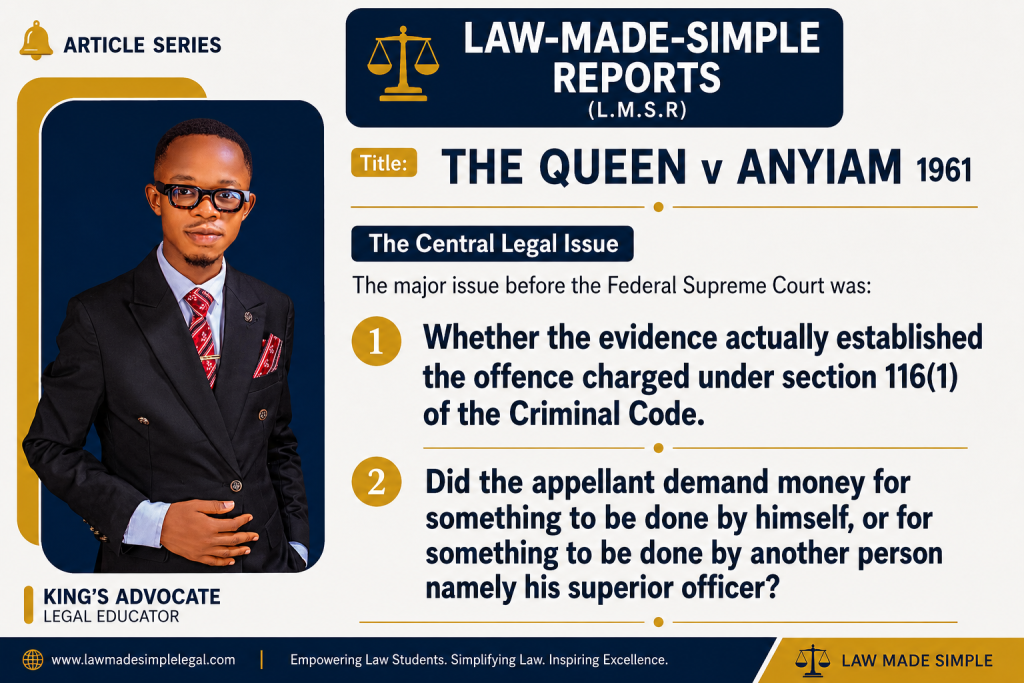
The Central Legal IssueThe major issue before the Federal Supreme Court was
whether the evidence actually established the offence charged under section 116(1) of the Criminal Code.More specifically:
Did the appellant demand money for something to be done by himself, or for something to be done by another person namely his superior officer?
This distinction was decisive because section 116(1) criminalized a public officer receiving money corruptly for an act to be done by himself.
Evidence That Created the Problem in The Queen v. Anyiam (1961)
The prosecution witness, Azu, testified that:
“He said he could not withdraw the summons as he was not the person who contravened the lorry. He said it was his senior police officer. He said the senior police officer who contravened the lorry asked him to receive £15 before the summons could be withdrawn.”
Another prosecution witness, Inspector Zaccheus Okakpu, confirmed that junior police officers lacked authority to withdraw traffic cases. Only the Assistant Superintendent of Police in charge of traffic possessed such authority.This evidence created a serious legal contradiction.
The charge alleged that the appellant collected money for something to be done by him namely, not to prosecute.But the evidence suggested that the money was allegedly meant for the superior officer who alone possessed authority to withdraw the case.That contradiction became fatal.
The Decision of the Federal Supreme Court inThe Queen v. Anyiam (1961)
The Federal Supreme Court allowed the appeal and quashed the conviction.The court held that the evidence before the trial court did not support the specific offence charged under section 116(1) of the Criminal Code.
It did not extend to a situation where the officer merely receives money for an act to be carried out by another person.The court therefore concluded that the prosecution proved facts materially different from the offence contained in the charge.Because criminal statutes must be strictly interpreted, the conviction could not stand.
Important Dictum of the Court in The Queen v. Anyiam (1961)
“If the evidence is capable of two interpretations, it is clear that the one favourable to the appellant must be adopted.”
“We are unable to agree with the learned Senior Crown Counsel that the section covers a case of a peace officer who asks for or receives money or any property corruptly for any other person on account of anything to be done or already done or omitted to be done by that other person.”
“We cannot in the circumstances sustain the conviction in this matter as the facts proved before the learned trial Judge conflicts with the charges laid in the information.”
Interpretation of Section 116(1) of the Criminal Code
The Supreme Court carefully interpreted section 116(1) and drew a distinction between:
receiving money for an act to be done by oneself; and
receiving money for an act to be done by another person.
According to the court, the section targeted a public officer who corruptly seeks benefit in exchange for improperly exercising his own official powers.The section did not apply where the requested action would actually be carried out by a different officer.
This was a classic application of the principle of strict interpretation of penal statutes.Where ambiguity exists in criminal legislation, courts must interpret the law narrowly in favour of the accused person.
In summary,The Federal Supreme Court in The Queen v. Anyiam delivered a powerful affirmation of one of the oldest safeguards in criminal justice: no person should be convicted unless the offence charged is proved exactly as required by law.
Although the allegations against the appellant appeared troubling, the court refused to sacrifice legal precision for emotional convenience. The prosecution failed because its evidence established facts different from the offence alleged under section 116(1) of the Criminal Code.
The judgment ultimately reinforced the principle that criminal justice must remain governed by legality, certainty, and strict proof not suspicion or assumption.
Accordingly, the convictions were quashed, the sentences set aside, and the appellant discharged and acquitted.
You may love to read up the following
Criminal Law: Official corruption — Section 98 Of The Criminal Code