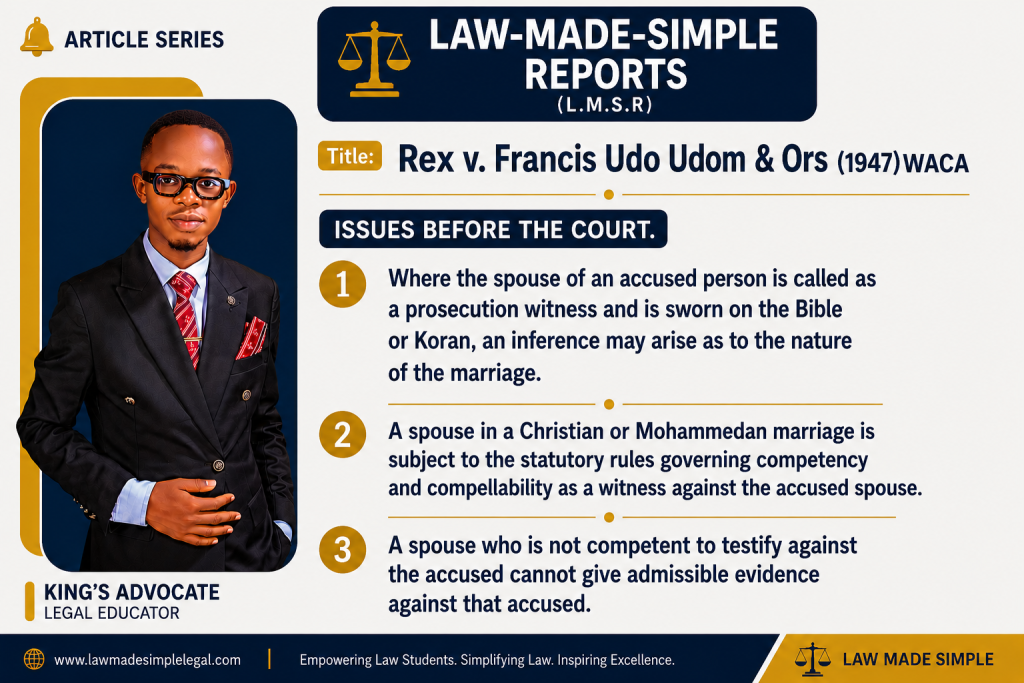
One of the fundamental questions this case of Rex v. Francis Udo Udom & Ors (1947) set to answer is this: Can the wife of an accused person give evidence for the prosecution in a criminal trial?
The answer is not always straightforward. The law historically imposed restrictions on the competency and compellability of spouses appearing as witnesses against one another, particularly where the marriage was a Christian or Mohammedan marriage.
The West African Court of Appeal considered this issue in Rex v. Francis Udo Udom & Ors (1947). The case concerned a joint trial for murder in which the wife of the first accused gave evidence for the prosecution after being sworn on the Bible.
The Court held that, in the circumstances, her evidence was inadmissible against the accused. However, the Court did not quash the convictions because, after removing her evidence from consideration, there remained sufficient independent evidence upon which the trial judge could properly convict the appellants.
The case is therefore important for two separate reasons: the competency of a spouse as a witness and the application of the proviso to section 11(1) of the West African Court of Appeal Ordinance where inadmissible evidence has been admitted but has not caused a miscarriage of justice.
WEST AFRICAN COURT OF APPEAL
Criminal Law — Murder — Joint Trial — Evidence of Spouse of Accused — Competency of Witness — Christian Marriage — Evidence Ordinance, Sections 160 and 161 — Proviso to Section 11(1) of the West African Court of Appeal Ordinance
Case: Rex v. Francis Udo Udom, Ibok Ekpo Inyang Oduk, Udo Ita & Etuk Ama Okodon
Court: West African Court of Appeal
Date: 10 November 1947
Citation: 12 WACA 227–228
Coram: Harragin, C.J. (Gold Coast); Verity, C.J. (Nigeria); Lucie-Smith, C.J. (Sierra Leone)
Appeal from: Supreme Court of Nigeria
FACTS OF THE CASE
The four appellants — Francis Udo Udom, Ibok Ekpo Inyang Oduk, Udo Ita and Etuk Ama Okodon — were jointly tried and convicted of the murder of a man named Ekpo Ntuon.
During the trial, one of the Crown witnesses, Adiaha Atat, gave evidence for the prosecution.
The witness was sworn on the Bible and stated in evidence:
“First accused is my husband.”
The first accused was also sworn on the Bible.
The admission of the woman’s evidence raised an important legal question because sections 160 and 161 of the Evidence Ordinance dealt with the competency and compellability of husbands and wives as witnesses.
The appellants challenged the admissibility of the evidence given by Adiaha Atat on the basis that she was the wife of the first accused and had been called as a witness for the prosecution.
ISSUE BEFORE THE COURT
The principal issue before the West African Court of Appeal was:
Whether the evidence of the wife of the first accused, who was called as a prosecution witness and sworn on the Bible, was admissible against the accused in the circumstances of the case.
A further question was whether the admission of that evidence was sufficient to justify allowing the appeal and setting aside the convictions.
RELEVANT LAW
Sections 160 and 161 of the Evidence Ordinance
Sections 160 and 161 dealt with the competency and compellability of husbands and wives as witnesses.
The provisions were relevant because the law recognised restrictions concerning the circumstances in which a spouse could give evidence against the other spouse in criminal proceedings.
The Court therefore had to determine whether Adiaha Atat was a competent witness for the prosecution in the circumstances.
PREVIOUS AUTHORITIES CONSIDERED BY THE COURT
The Court referred to a number of earlier decisions concerning evidence given by spouses.
1. R. v. Momodu Laoye
The Court referred to R. v. Momodu Laoye, 6 W.A.C.A. 6.
The case established that where the wife of an accused person was called by the prosecution and sworn on the Koran, a presumption could arise that the parties were spouses of a Mohammedan marriage.
The Court nevertheless emphasised that a matter of such importance should not simply be left to presumption.
2. R. v. Ajiyola & Ors.
The Court also considered R. v. Ajiyola & Ors., 9 W.A.C.A. 22.
In that case, the wife of a co-accused was called as a prosecution witness. Both she and the accused were sworn on the Bible, and she stated that the accused was her husband.
The Court treated them as husband and wife of a Christian marriage and held that the woman was only a competent witness if she was called upon the application of the person charged.
Since she had not been so called, her evidence was not competent.
The case demonstrated the importance of determining whether the statutory requirements governing evidence by spouses had been satisfied.
3. R. v. Ajibola Afonja
The Court further referred to R. v. Ajibola Afonja, a decision of the West African Court of Appeal delivered on 22 February 1947.
That decision established that it was necessary for the prosecution to show that the marriage was monogamous and that this could not simply be presumed.
The Court considered the present case to be more closely aligned with R. v. Ajibola Afonja than with R. v. Ajiyola.
DECISION OF THE COURT
The West African Court of Appeal held that the evidence of Adiaha Atat was inadmissible against the accused.
The Court reasoned that, because she had been sworn on the Bible and had identified the first accused as her husband, a presumption arose that they were husband and wife of a Christian marriage.
In those circumstances, she was not a competent witness for the prosecution unless she had been called upon the application of the person charged.
The Court therefore held:
The evidence of Adiaha Atat was inadmissible against any of the accused who were tried jointly.
However, that did not automatically mean that the convictions had to be quashed.
APPLICATION OF THE PROVISO TO SECTION 11(1)
The Court went further and considered whether the admission of the inadmissible evidence had resulted in a miscarriage of justice.
After excluding the evidence of Adiaha Atat entirely, the Court found that there was still ample evidence upon which the trial judge could have reached the conclusion that the appellants committed the murder for which they were charged.
Consequently, the Court applied the proviso to section 11(1) of the West African Court of Appeal Ordinance.
The Court concluded that the inadmissible evidence had not resulted in a miscarriage of justice.
The appeals were therefore dismissed.
RATIO DECIDENDI
The principal legal principles arising from the case are:
1.Where the spouse of an accused person is called as a prosecution witness and is sworn on the Bible or Koran, an inference may arise as to the nature of the marriage.
2.A spouse in a Christian or Mohammedan marriage is subject to the statutory rules governing competency and compellability as a witness against the accused spouse.
3.A spouse who is not competent to testify against the accused cannot give admissible evidence against that accused.
4.Where inadmissible evidence has been admitted at trial, an appellate court may nevertheless uphold the conviction where, after excluding the inadmissible evidence, there is sufficient independent evidence to support the conviction and no miscarriage of justice has occurred.
5.The prosecution cannot rely on inadmissible spousal evidence merely because the evidence has already been received by the trial court. The appellate court may examine the effect of that evidence on the conviction.
EXAM FOCUS
This case is particularly useful when answering examination questions involving:
1. Competency of witnesses
Students should distinguish between competency and compellability.
A person may be legally competent to give evidence but the law may restrict the circumstances in which that person can be compelled to testify.
2. Evidence by spouses
Where a problem question states that the wife or husband of an accused person has testified for the prosecution, students should immediately consider the statutory provisions regulating evidence by spouses.
3. Nature of the marriage
The nature of the marriage may become important in determining whether the spouse is competent to testify.
The Court’s reasoning in this case must be understood alongside the authorities of R. v. Momodu Laoye, R. v. Ajiyola & Ors., and R. v. Ajibola Afonja.
4. Inadmissible evidence and miscarriage of justice
The case also demonstrates an important appellate principle:
The admission of inadmissible evidence does not necessarily result in the automatic quashing of a conviction.
The appellate court may consider whether, after excluding the inadmissible evidence, there remains sufficient evidence to sustain the conviction.
SIMPLIFIED EXPLANATION
Imagine that A is accused of murder.
During the trial, A’s wife is called by the prosecution to testify against him. She identifies A as her husband and is sworn on the Bible.
The court must ask:
Was she legally competent to give that evidence against A?
If the applicable law makes her evidence incompetent in the circumstances, the court should not rely on it.
However, suppose there are five other strong and independent pieces of evidence proving A’s guilt. In that situation, an appellate court may conclude that although the wife’s evidence should not have been admitted, its admission did not cause a miscarriage of justice.
That is essentially the significance of Rex v. Francis Udo Udom & Ors.
IMPORTANCE OF THE CASE
Rex v. Francis Udo Udom & Ors is important because it demonstrates that questions concerning the admissibility of evidence must be carefully separated from questions concerning the ultimate effect of that evidence on a conviction.
The Court recognised that the prosecution witness’s evidence was inadmissible. Nevertheless, the Court did not allow the appellants to benefit from the error because the remaining evidence was sufficient to support their convictions.
The case therefore illustrates the balance between:
(1) enforcing the rules of evidence; and
(2) preventing an otherwise valid conviction from being overturned where the evidential error has not occasioned a miscarriage of justice.
CASE PRINCIPLE TO REMEMBER
Where the spouse of an accused person is called as a prosecution witness and the circumstances establish that the spouse is subject to the statutory restrictions governing spousal evidence, the spouse may be incompetent to testify against the accused. However, where sufficient independent evidence remains after excluding that testimony, an appellate court may uphold the conviction where no miscarriage of justice has occurred.
CONCLUSION
Rex v. Francis Udo Udom & Ors (1947) remains a useful authority for understanding the historical law relating to the evidence of spouses in criminal proceedings.
The West African Court of Appeal held that the evidence of Adiaha Atat, the wife of the first accused, was inadmissible against the accused. However, because there was ample other evidence supporting the convictions, the Court applied the proviso to section 11(1) of the West African Court of Appeal Ordinance and dismissed the appeals.
The case therefore teaches two central lessons:
First, the rules governing the competency and compellability of spouses must be respected.
Second, an error involving inadmissible evidence will not necessarily lead to the reversal of a conviction where the remaining evidence establishes guilt and no miscarriage of justice has occurred.
Criminal Law|COMMERCIAL LAW/ Law of Torts R. v. Momodu Laoye
AUTHORITIES REFERRED TO
- R. v. Momodu Laoye, 6 W.A.C.A. 6.
- R. v. Ajiyola & Ors., 9 W.A.C.A. 22.
- R. v. Ajibola Afonja, W.A.C.A., 22 February 1947 (unreported).
ABOUT THE PUBLISHER
LAW-MADE-SIMPLE is a growing African academic resource network and a centre for academic growth, dedicated to making complex academic and legal knowledge easier to understand, access and apply.
Founded and published by Kingsley Omenyi, popularly known as KING’S ADVOCATE, the platform provides simplified case analysis, legal principles, statutes, academic resources and student-focused legal education.
Our goal is simple: to make law easier to understand, remember and apply.
LAW-MADE-SIMPLE — Making Law Easier.
Contact the Publisher: Contact Kingsley Omenyi
