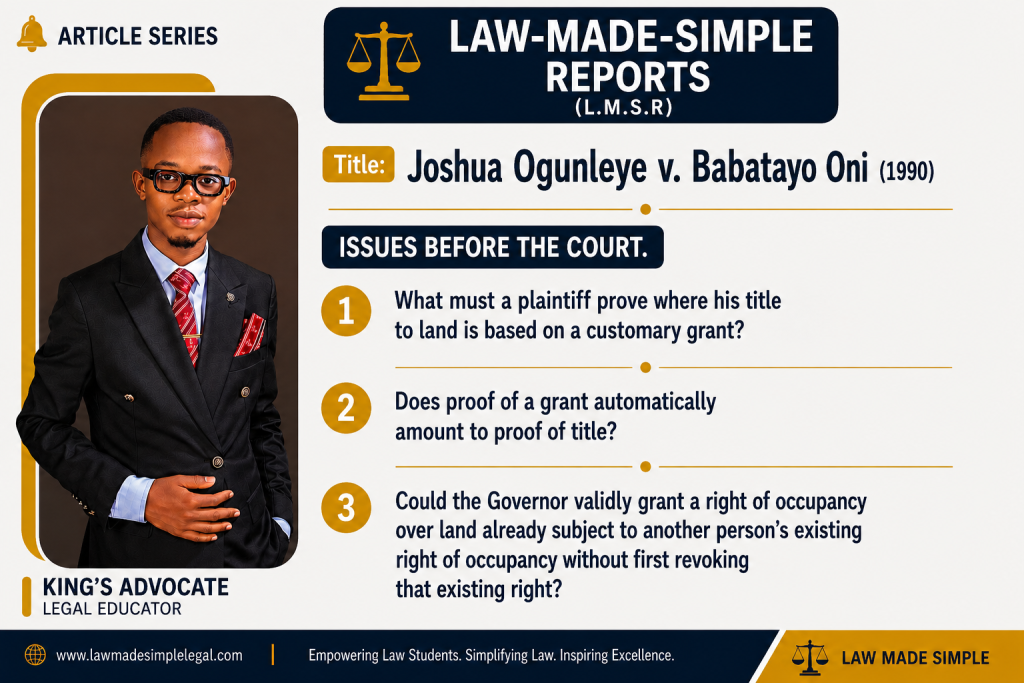
A Landmark Supreme Court Decision on Customary Land Title, Deemed Rights of Occupancy and the Land Use Act
There is a dangerous assumption in Nigerian land law:
“If I have a Certificate of Occupancy, the land is automatically mine.”
Joshua Ogunleye v. Babatayo Oni demonstrates why that assumption can be legally wrong.
A Certificate of Occupancy may look authoritative. It may carry the name of a Governor or other competent authority. It may be registered in the Lands Registry. It may even appear to place the holder in a stronger position than someone relying on an older customary title.
But the Supreme Court made an important distinction:
A Certificate of Occupancy does not, by itself, create a title where the person to whom it was issued had no title or better right to the land in the first place.
The case therefore goes far beyond a dispute between two individuals over a parcel of land.
It brings together some of the most important principles in Nigerian land law:
Customary title.
Grant and proof of title.
Trespass to land.
Burden of proving a better title.
Deemed rights of occupancy under the Land Use Act.
Certificate of Occupancy.
Revocation of existing rights of occupancy.
Nemo dat quod non habet.
And perhaps most importantly:
A certificate of occupancy cannot be used to cure a defective root of title.
This is why Ogunleye v. Oni remains an important authority for every student studying Nigerian Property Law, Land Law, Conveyancing and the Land Use Act.
CASE INFORMATION
Case: Joshua Ogunleye v. Babatayo Oni
Citation: (1990) 2 NWLR (Pt. 135) 745; (1990) All N.L.R. 341
Case Number: S.C. 193/1987
Court: Supreme Court of Nigeria
Date: 27 April 1990
Area of Law: Land Law, Property Law, Customary Law, Land Use Act
Key Legislation: Land Use Act 1978
Principal Issues: Certificate of Occupancy, customary grant, proof of title, deemed right of occupancy, trespass, better title and revocation of rights of occupancy.
Lead Judgment: Belgore, J.S.C.
Other Justices: Obaseki, Ag. C.J.N.; Nnaemeka-Agu, J.S.C.; Agbaje, J.S.C.; Wali, J.S.C.
THE STORY BEHIND THE DISPUTE IN Joshua Ogunleye v. Babatayo Oni (1990)
The dispute concerned a parcel of land situated along Ife Road, Isale-Oni Area (Arikese), Osu, in the then Atakumosa Local Government Area of Oyo State.
Joshua Ogunleye, the appellant, claimed that the Osu Community granted the land to him under native law and custom on 16 January 1978.
A document evidencing the alleged grant was tendered as Exhibit A.
Ogunleye later obtained a Certificate of Occupancy from the Oyo State Government dated 27 June 1983.
That document became Exhibit B.
The appellant subsequently claimed that Babatayo Oni had trespassed on the land.
He therefore commenced an action seeking damages for trespass and a perpetual injunction restraining Oni, his servants, agents and privies from further acts of trespass.
At first glance, the appellant appeared to have a strong case.
He had:
- a document of customary grant;
- possession asserted by him; and
- a Certificate of Occupancy issued by the State Government.
But there was a fundamental problem.
Did the person or community that purported to grant the land to Ogunleye actually own the land?
That question eventually became decisive.
THE RESPONDENT’S CLAIM IN JOSHUA OGUNLEYE V. BABATAYO ONI (1990)
Babatayo Oni did not accept Ogunleye’s claim.
He traced his own interest in the land much further back.
According to him, the land originally belonged to the Ahere/Arikese people of Osu, who granted it to his father, Ezekiel Oni Aro Ifaturoti, under native law and custom in 1936.
The grant was said to have been for valuable consideration.
His father then went into possession and exercised acts of ownership over the land.
Among other things, there was a building on the land comprising shops and living rooms, although the structure had subsequently fallen into ruins.
When his father died in 1947, the land formed part of the property inherited by the respondent.
The respondent therefore maintained that his title was older than the appellant’s alleged 1978 grant.
More importantly, he challenged the very foundation of Ogunleye’s title.
He contended that the Osu Community as a whole was not the owner of the land and therefore could not validly grant it to Ogunleye.
WHAT HAPPENED AT THE HIGH COURT IN JOSHUA OGUNLEYE V. BABATAYO ONI (1990) ?
The High Court found in favour of Ogunleye.
The trial Judge considered the evidence and concluded that the appellant had established his grant.
The Judge also considered the fact that Ogunleye had produced the document evidencing the grant.
The respondent, on the other hand, had not called the original grantor to prove his father’s grant.
The trial Court therefore concluded that Ogunleye had established the better title.
The appellant was awarded damages for trespass.
But the decision did not survive the appeal.
THE COURT OF APPEAL INTERVENES
The Court of Appeal, Ibadan Division, took a different view.
The Court emphasised that the question was not simply:
Who proved a grant?
The real question was:
Who proved a better title?
Ogundare, J.C.A., observed in substance that the trial Judge had concentrated on the comparison between the two alleged grants instead of determining which party had the better title to the land.
The Court of Appeal therefore allowed the appeal and dismissed Ogunleye’s claim.
The matter eventually reached the Supreme Court.
THE SUPREME COURT: WHAT WAS REALLY IN ISSUE IN JOSHUA OGUNLEYE V. BABATAYO ONI (1990)?
The Supreme Court was confronted with several interconnected questions.
ISSUE ONE
What must a plaintiff prove where his title to land is based on a customary grant?
ISSUE TWO
Does proof of a grant automatically amount to proof of title?
ISSUE THREE
What is the legal effect of a Certificate of Occupancy issued under the Land Use Act?
ISSUE FOUR
Can a Certificate of Occupancy confer title upon a person whose grantor had no title to the land?
ISSUE FIVE
What happened to the respondent’s pre-existing interest when the Land Use Act came into force?
ISSUE SIX
Could the Governor validly grant a right of occupancy over land already subject to another person’s existing right of occupancy without first revoking that existing right?
These questions transformed what appeared to be an ordinary trespass action into a major authority on Nigerian land law.
THE SUPREME COURT’S REASONING IN JOSHUA OGUNLEYE V. BABATAYO ONI (1990)
1. A GRANT IS NOT THE SAME THING AS TITLE
This is one of the most important lessons from the judgment.
The appellant relied on a customary grant.
But the Supreme Court explained that although a grant is one of the recognised methods by which title may be proved, the mere production of a document of grant does not automatically establish title where the title of the grantor itself is disputed.
Nnaemeka-Agu, J.S.C., put the distinction sharply:
“Proof of a grant is one of the five ways of proving title.”
But that does not end the inquiry.
If the person who purported to grant the land had no title to it, the recipient cannot simply rely on the document and stop there.
The claimant must establish the root of the grantor’s title where that title is challenged.
THE ROOT OF TITLE MATTERS
Imagine this situation:
A claims that B granted land to him.
B’s ownership is challenged.
A cannot simply say:
“Here is my document from B.”
The next question is:
“How did B acquire the land?”
If B never owned the land, B could not transfer a better title to A.
This is the logic behind the maxim:
Nemo dat quod non habet.
In simple terms:
No one can give what he does not have.
That principle became crucial in Ogunleye v. Oni.
THE FIVE WAYS OF PROVING TITLE
The Supreme Court’s reasoning must also be understood against the established Nigerian principle that title to land may be proved through recognised methods.
The leading authority commonly associated with these methods is:
IDUNDUN v. OKUMAGBA (1976)Definitive Guide to Proof of Land Ownership in Nigeria
Among the recognised methods is proof of title by traditional evidence or grant.
But the important lesson from Ogunleye v. Oni is that the method selected by the claimant does not remove the evidential burden attached to it.
Where title is claimed through a grantor whose own title is challenged:
the claimant must establish the grantor’s root of title.
THE PLAINTIFF CANNOT SUCCEED MERELY BECAUSE THE DEFENDANT’S CASE IS WEAK
This is another examination point.
In a claim for trespass and injunction, the plaintiff generally places his title or exclusive possessory right in issue.
The plaintiff therefore carries the burden of establishing the better title.
The Supreme Court emphasised that the appellant could not simply succeed because he had produced Exhibit A while the respondent had failed to call the respondent’s father’s original grantor.
The court must examine the competing claims.
The question is not:
“Which party produced the prettier document?”
It is:
“Which party has established the better legal title or right to possession?”
THE IMPORTANCE OF THE LOJA’S EVIDENCE
One of the most damaging pieces of evidence against Ogunleye came from his own witness.
The appellant’s star witness was the Loja of Osu and Head of the Osu Community.
The witness admitted that he did not know how people originally settled at Osu.
He also admitted that the defendant’s father had previously had a structure or stall on the land.
Most importantly, the witness admitted:
“I have no land of my own at Osu.”
The Supreme Court regarded these admissions as significant.
They supported the respondent’s case that his father had been in possession of the land before the appellant’s alleged grant.
The evidence also weakened the claim that the Osu Community itself possessed the proprietary interest necessary to make the grant.
THE CRITICAL ERROR OF THE TRIAL COURT IN JOSHUA OGUNLEYE V. BABATAYO ONI (1990)
The trial Judge treated the production of the grant document as sufficient proof of the appellant’s title.
The Supreme Court rejected that approach.
Nnaemeka-Agu, J.S.C., explained the problem in substance:
“It would be wrong to assume … that all that a person who resorts to a grant as a method of proving his title to land needs to do is to produce the document of grant and rest his case.”
That is a powerful examination quotation.
The crucial point is this:
Where the grantor’s title is challenged, the claimant must go behind the grant.
He must establish the root of the grantor’s title.
ENTER THE LAND USE ACT
The case becomes even more important when the Land Use Act enters the picture.
The appellant argued that his Certificate of Occupancy issued in 1983 strengthened his title.
This argument required the Supreme Court to determine:
What exactly does a Certificate of Occupancy do?
Is it:
a certificate of title?
Or is it:
evidence of a right of occupancy?
The Supreme Court’s answer is fundamental.
WHAT IS A CERTIFICATE OF OCCUPANCY?
The Court drew an important distinction between title and right of occupancy.
The Land Use Act gives a right of occupancy.
It does not automatically transform a person with no valid underlying title into the owner of the land merely because a Certificate of Occupancy has been issued in his name.
As Nnaemeka-Agu, J.S.C., explained:
“A certificate of occupancy only gives the right to use and occupy land. It neither confers nor is it necessarily an evidence of title.”
This is one of the most important passages to remember from the case.
A CERTIFICATE OF OCCUPANCY IS NOT A MAGIC DOCUMENT
This case should therefore destroy the misconception that:
Certificate of Occupancy = unquestionable ownership.
The legal position is more nuanced.
A Certificate of Occupancy may carry significant evidential weight.
But it does not automatically defeat a prior and superior title or right of occupancy.
If another person can establish a better pre-existing right, the court may inquire into the foundation upon which the Certificate of Occupancy was issued.
THE LAND USE ACT DID NOT SIMPLY ERASE EXISTING RIGHTS
Another major lesson concerns the commencement of the Land Use Act.
The Act did not simply wipe away every existing interest in land.
Instead, the Act created transitional mechanisms under which certain existing interests were preserved through deemed grants of rights of occupancy.
The Supreme Court referred particularly to sections 34(2) and 36(2).
In the circumstances of the case, the respondent and his predecessor-in-title were found to have had an existing interest in the land when the Land Use Act came into force.
Their existing interest therefore had legal significance under the Act.
WHY THE 1978 DATE MATTERED
The chronology is crucial.
1936
The respondent’s father was said to have acquired the land under customary law and entered into possession.
1947
The respondent’s father died and the respondent claimed the land through inheritance.
16 January 1978
Ogunleye claimed that the Osu Community granted the land to him.
29 March 1978
The Land Use Act came into force.
27 June 1983
Ogunleye obtained his Certificate of Occupancy.
The sequence matters.
If the respondent already possessed a recognised interest in the land when the Land Use Act came into force, the later Certificate of Occupancy issued to Ogunleye could not simply erase that interest.
SECTION 28 AND REVOCATION
The Supreme Court also considered the statutory power of revocation.
The Land Use Act provides mechanisms through which a right of occupancy may be revoked in appropriate circumstances, including overriding public interest.
But the relevant right must first be dealt with according to the statutory procedure.
The State cannot simply treat an existing right as though it never existed.
Belgore, J.S.C., expressed the principle powerfully:
“The state has no right to dispossess a person of his property lawfully acquired without reason.”
Where compulsory acquisition occurs under the Land Use Act, the statutory requirements must be complied with, including the applicable provisions concerning compensation.
THE CRITICAL LAND USE ACT PRINCIPLE
The reasoning can be simplified as follows:
Existing lawful interest
Land Use Act commences
Existing interest may become a deemed right of occupancy
Later applicant seeks Certificate of Occupancy
Later certificate cannot automatically extinguish the earlier right
Proper statutory revocation must occur where the State seeks to terminate the existing right
This is one of the most useful ways to understand the case for examination purposes.
THE MAXIM: NEMO DAT QUOD NON HABET
The principle appears with particular force here.
Nemo dat quod non habet means:
No one can give what he does not have.
If the Osu Community did not own the disputed land, it could not validly transfer ownership of that land to Ogunleye.
And if the original grantor had no title to transfer, a subsequent Certificate of Occupancy could not magically manufacture the missing root of title.
The certificate could not repair the foundational defect.
WHAT DID THE SUPREME COURT DECIDE IN JOSHUA OGUNLEYE V. BABATAYO ONI (1990)?
The Supreme Court unanimously dismissed the appeal.
The appellant failed to establish a better title to the land.
The Court accepted the essential reasoning that the respondent’s predecessor had a prior interest in the land and that the appellant had failed to establish that the Osu Community possessed the title necessary to make the 1978 grant to him.
The later Certificate of Occupancy did not cure that defect.
The appeal was therefore dismissed, with costs awarded against the appellant.
RATIO DECIDENDI JOSHUA OGUNLEYE V. BABATAYO ONI (1990)
The central principles emerging from Joshua Ogunleye v. Babatayo Oni include the following:
1. A claimant relying on a customary grant must prove the title of the grantor where that title is disputed.
2. Proof of a grant is not automatically equivalent to proof of title.
3. In a claim for trespass and injunction, the plaintiff bears the general burden of establishing a better title or right to possession.
4. A Certificate of Occupancy does not necessarily confer title on a person who had no valid title or better right to the land.
5. Existing rights and interests recognised under the Land Use Act cannot simply be ignored because a later Certificate of Occupancy has been issued to another person.
6. A later grant of a right of occupancy cannot validly override an existing right of occupancy that has not been lawfully revoked.
7. The Land Use Act must be read as preserving and regulating existing rights rather than treating every pre-existing interest as automatically extinguished.
DISTINGUISHING TITLE FROM CERTIFICATE OF OCCUPANCY
This distinction deserves special attention.
| CONCEPT | BASIC MEANING |
|---|---|
| Title | The legal basis upon which ownership or a proprietary interest in land is claimed. |
| Grant | One method by which title may be established. |
| Right of Occupancy | A statutory or deemed legal right to use and occupy land under the Land Use Act. |
| Certificate of Occupancy | Documentary evidence of a right of occupancy; it does not automatically create a better title where none existed. |
| Possession | Physical possession or the legal right to possess, depending on the context. |
The student who understands these distinctions is already ahead of the student who simply memorises:
“C of O is prima facie evidence of title.”
The real question is:
What is the root of the interest behind the certificate?
EXAMINATION TRAP
A lecturer may present a problem like this:
A claims ownership of land based on a customary grant and produces a Certificate of Occupancy issued several years later. B claims that his family had owned and possessed the land before the Land Use Act came into force. Who has the better title?
Do not immediately answer:
“A, because A has a Certificate of Occupancy.”
That is precisely the trap.
Instead, ask:
- Who originally owned the land?
- From whom did A derive his title?
- Did A’s grantor actually own the land?
- What was B’s interest before the Land Use Act?
- Was B’s interest preserved as a deemed right of occupancy?
- Was B’s right ever lawfully revoked?
- Was A’s Certificate of Occupancy issued over land already subject to another person’s superior right?
- Who has established the better title or right to possession?
That is the Ogunleye v. Oni method of analysis.
RELATED LOCUS CLASSICUS AUTHORITIES CITED IN JOSHUA OGUNLEYE V. BABATAYO ONI (1990)
Students studying this case should connect it with other leading authorities.
IDUNDUN v. OKUMAGBA
Important for the recognised methods of proving title to land.
AMAKOR v. OBIEFUNA
Important in understanding claims involving trespass and the plaintiff’s need to establish a better title or right to possession.
KPONUGLO v. KODADJA
Relevant to the principle that a claim for trespass and injunction places the claimant’s title or possessory right in issue.
Dzungwe v. Gbishe
Important on the operation of deemed rights of occupancy under the Land Use Act.
A foundational authority on customary land tenure and communal ownership.
THE DEEPER PROPERTY LAW LESSON
The deepest lesson from Ogunleye v. Oni is not merely:
“A Certificate of Occupancy does not confer title.”
The broader lesson is that land rights must be traced to their legal foundation.
A document cannot be stronger than the legal interest it represents.
A grant cannot transfer more than the grantor possesses.
A Certificate of Occupancy cannot automatically cure a defective root of title.
And the State’s statutory powers over land must themselves be exercised according to law.
Therefore, when analysing a land dispute, always move backwards:
Certificate → Right of Occupancy → Grant → Grantor → Root of Title → Original Interest
That is where the real question of ownership begins.
BROADER LESSON: HOW TO ANALYSE LAND TITLE IN NIGERIA
When faced with a Nigerian land law problem, use this sequence.
STEP 1 — IDENTIFY THE CLAIM
Is the claimant seeking:
- declaration of title?
- damages for trespass?
- injunction?
- possession?
- specific performance?
- declaration concerning a right of occupancy?
STEP 2 — IDENTIFY THE ROOT OF TITLE
Ask:
Where did the claimant’s title originate?
STEP 3 — TEST THE GRANTOR’S TITLE
Ask:
Did the person, family or community that granted the land actually own it?
STEP 4 — TRACE DEVOLUTION
If the land passed through inheritance, succession, family or communal ownership, establish how the interest moved from one person to another.
STEP 5 — CONSIDER THE LAND USE ACT
Determine what happened to the interest when the Land Use Act came into force.
STEP 6 — EXAMINE ANY CERTIFICATE OF OCCUPANCY
Do not stop at the existence of the certificate.
Ask:
What right did the holder possess before the certificate was issued?
STEP 7 — COMPARE THE COMPETING RIGHTS
The ultimate question may be:
Who has the better title or right to possession?
WHY THIS CASE MATTERS IN THE AI ERA
Modern legal research is increasingly becoming a search for quick answers.
“Does a Certificate of Occupancy confer title?”
A shallow answer might simply say:
“Yes, a Certificate of Occupancy is evidence of title.”
But legal analysis cannot end there.
The better question is:
What did the claimant possess before the Certificate of Occupancy was issued, what was the root of that interest, and was there already a superior right over the land?
That is why case law still matters.
A good legal resource should not merely provide the conclusion.
It should expose the reasoning that produced the conclusion.
That is the purpose of this case analysis.
COMMON MISTAKES STUDENTS MAKE
MISTAKE 1: Treating a Certificate of Occupancy as absolute proof of ownership
Correction: Examine the root of title and competing rights.
MISTAKE 2: Assuming a grant automatically proves title
Correction: Where the grantor’s title is disputed, prove the grantor’s root of title.
MISTAKE 3: Ignoring pre-Land Use Act interests
Correction: Consider the transitional provisions and deemed rights of occupancy.
MISTAKE 4: Forgetting the burden of proof
Correction: In a claim for trespass and injunction, the claimant must establish the better title or right to possession.
MISTAKE 5: Memorising the case without understanding the chronology
Correction: Remember:
1936 → 1947 → 1978 → 1983 → litigation → Supreme Court.
The chronology explains the legal reasoning.
ONE-MINUTE CASE REVISION
Case: Joshua Ogunleye v. Babatayo Oni
Court: Supreme Court of Nigeria
Year: 1990
Core Area: Land Law
Key Issue: Whether a later Certificate of Occupancy could strengthen or create title where the claimant’s underlying customary grant was defective and another person had a pre-existing right in the land.
Decision: Appeal dismissed.
Core Principle: A Certificate of Occupancy does not automatically confer title upon a person who had no valid title or better right to the land. Where a claimant relies on a grant and the grantor’s title is challenged, the claimant must establish the grantor’s root of title.
Key Maxim: Nemo dat quod non habet.
Remember:
Certificate ≠ automatic title.
EXAMINATION FORMULA
If asked to discuss the legal effect of a Certificate of Occupancy in Nigerian land law, a strong answer can begin:
The issuance of a Certificate of Occupancy does not, without more, confer an indefeasible title on the grantee where another person possesses a prior and superior right to the land. The Supreme Court’s decision in Joshua Ogunleye v. Babatayo Oni illustrates that the court may investigate the root of the grantee’s title and the existence of competing rights notwithstanding the subsequent issuance of a Certificate of Occupancy.
Then proceed to:
Root of Title → Grant → Deemed Right → Certificate → Competing Interest → Revocation → Better Title.
CONCLUSION
Joshua Ogunleye v. Babatayo Oni is one of those decisions that every serious Nigerian land law student should understand rather than merely memorise.
Its importance lies in the Court’s refusal to treat a Certificate of Occupancy as an independent source of unquestionable ownership.
The decision teaches that land title must have a legal foundation.
Where title is derived through a grant, the grantor’s title may have to be established.
Where an earlier interest existed before the Land Use Act, that interest may have been preserved as a deemed right of occupancy.
Where the State seeks to interfere with an existing right of occupancy, it must act within the statutory framework.
And where two parties claim the same land, the ultimate question remains:
Who has the better title or right to possession?
The enduring lesson can therefore be reduced to one sentence:
A Certificate of Occupancy may evidence a right of occupancy, but it cannot manufacture a title that the grantee never possessed.
ABOUT THE PUBLISHER
LAW-MADE-SIMPLE is a growing African academic resource network and a centre for academic growth, dedicated to making complex academic and legal knowledge easier to understand, access and apply.
Founded and published by Kingsley Omenyi, popularly known as KING’S ADVOCATE, the platform provides simplified case analysis, legal principles, statutes, academic resources and student-focused learning materials for learners across Nigeria, Africa and the wider Common Law community.
Through LAW-MADE-SIMPLE, Kingsley Omenyi seeks to bridge the gap between complex legal materials and practical understanding by presenting Nigerian and African legal materials in a clear, accessible and academically useful manner, while connecting them with broader principles of the Common Law tradition.
As a finalist law student, legal educator and digital content creator, Kingsley Omenyi has a strong interest in legal education, legal research, advocacy and the use of technology to make academic knowledge more accessible. LAW-MADE-SIMPLE is being developed as a central digital resource for teachers, students, learners and every legal person seeking reliable, simplified and practical academic materials, with Nigerian legal education at its core and a growing focus on African legal education and the wider Common Law tradition.
Published by:
KINGSLEY OMENYI — KING’S ADVOCATE
Founder & Publisher, King’s Advocate Network
Making Law Made Simple.