When exactly does a mortgage become a mortgage under Nigerian land law?
Is it when the parties agree to the loan and security? When the mortgage deed is signed? When the Governor gives consent? Or only when the deed is delivered and becomes operative?
Those questions place Awojugbagbe Light Industries Ltd v. Chinukwe at an important intersection of Land Use Act compliance, mortgage transactions and the law of deeds.
The importance of this decision goes beyond the familiar statement that “Governor’s consent is required before a statutory right of occupancy can be mortgaged.” The deeper question is what happens where parties have already reached an agreement to create a mortgage while the required consent of the Governor is still being processed.
That distinction is crucial. It prevents us from treating negotiation, agreement, execution, delivery, Governor’s consent and registration as though they were all the same legal event.
CASE DETAILS
- Case: Awojugbagbe Light Industries Ltd v. P. N. Chinukwe & Anor
- Court: Supreme Court of Nigeria
- Suit No.: SC.243/1992
- Date: 7 April 1995
- Lead Judgment: Mohammed Bello, C.J.N.
- Other Justices: Idris Legbo Kutigi, Michael Ekundayo Ogundare, Emanuel Obioma Ogwuegbu, Sylvester Umaru Onu, Yekini Olayiwola Adio and Anthony Ikechukwu Iguh, JJ.S.C.
THE LEGAL QUESTION OR PROBLEM IN ONE SENTENCE IN AWOJUGBAGBE LIGHT INDUSTRIES LTD V CHINUKWE (1995)
The Supreme Court had to determine the legal effect of an agreement and mortgage transaction entered into before the Governor’s consent was obtained, particularly in light of sections 22 and 26 of the Land Use Act and the principles governing delivery of deeds and delivery in escrow.
THE FACTS: HOW THE DISPUTE STARTED IN AWOJUGBAGBE LIGHT INDUSTRIES LTD V CHINUKWE
Between 1979 and 1987, N.I.D.B. Limited granted financial accommodation of N215,000 to Awojugbagbe Light Industries Limited.
The loan was intended to be secured by a first legal mortgage over the company’s property at No. 60–64 Ijebu Road, Ibadan.
The important chronology began with the approval of the loan on 11 October 1979. The borrower subsequently received and used the facility.
On 20 November 1979, N.I.D.B. forwarded a draft Loan and Mortgage Agreement to the appellant for consideration. The appellant approved the draft and returned it.
On 13 February 1980, the bank again forwarded the mortgage documentation for execution. The appellant returned the documents duly executed under cover of a letter dated 11 March 1980.
But there was a problem: the Governor’s consent required by section 22 of the Land Use Act had not yet been obtained.
Indeed, in a letter dated 26 July 1982, N.I.D.B. expressly complained that the Loan and Mortgage Agreement had not been registered because the necessary consent of the Oyo State Government had not been obtained.
The borrower eventually applied for the required consent, and the Governor’s consent was obtained in September 1985.
The mortgage deed itself bore the date 8 October 1985.
Years later, when the borrower’s indebtedness had risen to N364,142.08, the mortgagee exercised its rights under the mortgage and appointed P. N. Chinukwe as receiver.
The receiver eventually took possession of the mortgaged premises.
The appellant challenged the validity and enforceability of the mortgage and sought, among other reliefs, declarations that the mortgage was invalid under the Land Use Act.
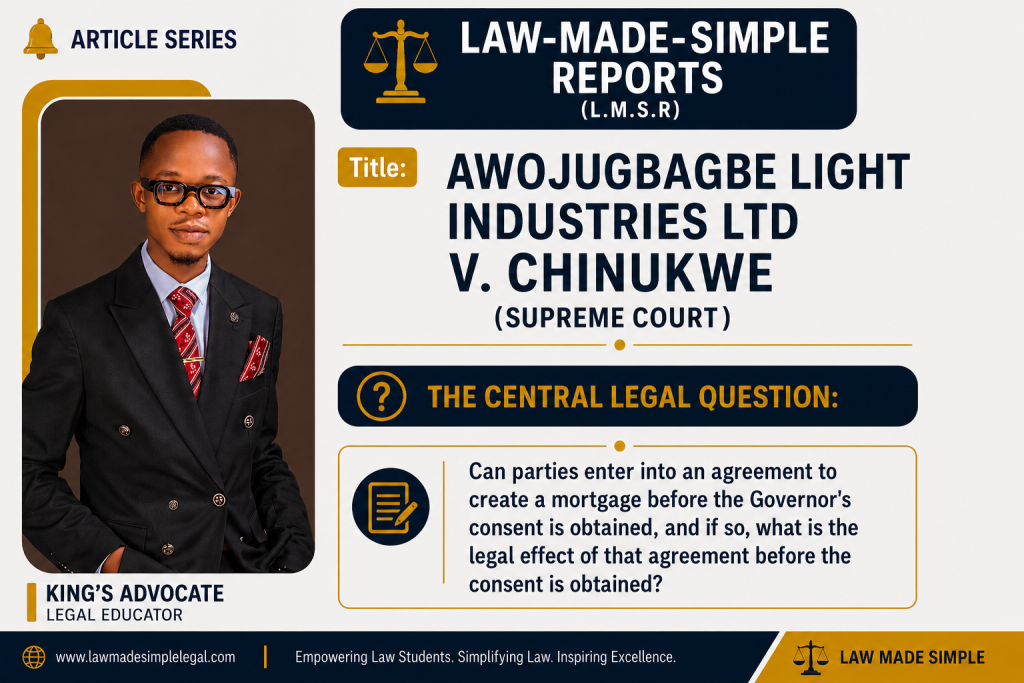
THE CENTRAL LEGAL QUESTION IN AWOJUGBAGBE LIGHT INDUSTRIES LTD V CHINUKWE
The dispute ultimately turned on a deceptively simple question:
Can parties enter into an agreement to create a mortgage before the Governor’s consent is obtained, and if so, what is the legal effect of that agreement before the consent is obtained?
That question required the Supreme Court to consider the relationship between sections 22 and 26 of the Land Use Act, as well as the principles governing deeds.
ON IMPORT OF SECTION 22 OF THE LAND USE ACT 1978
Section 22 generally prohibits the holder of a statutory right of occupancy granted by the Governor from alienating the right by assignment, mortgage, transfer of possession, sublease or otherwise without the Governor’s consent first being obtained, subject to the statutory exceptions.
At first glance, the provision appears straightforward: no Governor’s consent, no valid mortgage.
But that formulation is not enough to resolve Awojugbagbe.
The Court had to examine what the parties had actually done and, more importantly, when the mortgage transaction became legally operative.
Per IGUH, J.S.C. Succinctly captured it as follows:
“A contravention of the requirement of section 22 of the Land Use Act occurs in the case of alienation of a statutory right of occupancy carried out by deed at a time when the relevant deed is delivered and not at a time when it is executed or sealed. There is therefore no contravention of section 22 of the Land Use Act in this case and, in the circumstance, the effect of the contravention of the section does not now arise in the present case for consideration”.
“I am of the settled view that the consent of the Governor obtained subsequent to the execution of the deed, Exhibit E is not contrary to the provisions of section 22(1) of the Land Use Act and does not render the transaction unenforceable, null and void. In the circumstance, I am of the opinion that the basis on which the appellant is challenging the validity of Exhibit E is ill- founded and misconceived. I agree with the two courts below that Exhibit E is not in contravention of section 22(1) of the Act and that it is entirely valid and enforceable. The 2nd defendant/respondent was therefore entitled under the law to foreclose the mortgage in issue as it did. In the same vein, the 1st respondent’s entry into the mortgaged premises is, in my view, lawful.”
SECTION 26: THE STATUTORY CONSEQUENCE
Section 26 provides the consequence for a transaction or instrument that purports to confer or vest an interest or right over land contrary to the provisions of the Land Use Act.
This provision is significant because the appellant relied heavily on the argument that the mortgage was caught by the statutory prohibition and was therefore void.
The Court therefore had to distinguish between an agreement to create a mortgage and a transaction or instrument that had actually operated to alienate or vest an interest in land contrary to the Act.
AGREEMENT TO MORTGAGE IS NOT NECESSARILY THE SAME AS THE OPERATIVE MORTGAGE
Let me pause here, because this is where the case becomes particularly important.
If I simply tell you, “Governor’s consent must be obtained before a mortgage,” you may remember the rule but miss the legal reasoning.
The better approach is to ask:
- Had the parties merely agreed that a mortgage would be created?
- Had the mortgage deed already become operative?
- Was the deed delivered?
- Was it delivered absolutely or in escrow?
- When did the legal effect of the deed arise?
- When was the Governor’s consent obtained?
Those questions help separate the contractual arrangement from the completed conveyancing transaction.
DELIVERY OF A DEED: THE IMPORTANT CONVEYANCING PRINCIPLE
One of the important features of this case is the Supreme Court’s consideration of the concept of delivery in relation to a deed.
In conveyancing law, delivery does not necessarily mean physically handing a document from one person to another.
The important question is whether the person executing the deed intended it to become legally operative.
Consequently, a document may be physically signed but not yet legally delivered in the sense required to make the deed operative.
ON ISSUES OF WHEN A DEED TAKES EFFECT –
Per OGWUEGBU, J.S.C.
“A deed takes effect from the time of its delivery and not from the day on which it is therein stated to have been made or executed. Any other written instrument takes effect from the date of execution. Extrinsic evidence is, however, admissible to prove the date of delivery of a deed, or the execution of any other written instrument. The final and absolute transfer of a deed properly executed, to the grantee or to some person for his use in such a manner that it cannot be recalled by the grantor constitutes delivery. It is also not necessary that the person executing should part with physical possession of the instrument“
On When a deed is deemed delivered
Per IGUH, J.S.C.
“I am in agreement -with the above statement of the law and must, with respect, fully endorse the same. The law as to the delivery of a deed seems to me crystal clear and this is that a transaction created by deed does not come into effect or become effective prior to the delivery. A. deed is binding on the maker of it, even though the parts have not been exchanged, as long as it has been signed, sealed and delivered. It has to be stressed however that the term delivery, in law, is not synonymous with the physical exchange of signed and sealed documents between the parties thereto. It does not also mean the handing over of a document to the other side. It does mean and has been judicially interpreted to connote an act done so as to evince an intention to be bound. Even though the possession of such deed still remains with the maker, or his solicitor, he is bound by it if he has had it delivered in law by doing some unequivocal act whether by words or action evincing an intention to be bound.”
WHAT DOES “ESCROW” MEAN?
A deed delivered in escrow is delivered conditionally. It is not intended to become operative immediately as an absolute deed. Its legal effectiveness depends upon the happening of the specified condition.
This becomes particularly relevant where the parties are waiting for a statutory requirement—such as the Governor’s consent—to be satisfied.
Therefore, when analysing a transaction of this nature, do not stop at the date written on the document. Ask about the intention, delivery and circumstances surrounding the instrument.
THE ARGUMENT BEFORE THE SUPREME COURT
The appellant argued that the mortgage had been executed before the Governor’s consent and was therefore caught by section 22 of the Land Use Act. Reliance was placed particularly on SAVANNAH BANK OF NIGERIA LTD v. AJILO (1989)—S.C
The respondents, on the other hand, argued that the transaction was not invalid merely because an agreement concerning the mortgage existed before the Governor’s consent. They relied on the distinction between an agreement and the operative effect of the mortgage deed.
The litigation also raised questions concerning the date appearing on the mortgage deed and whether the surrounding documentary evidence could establish when the deed was actually executed or became effective.
WHY THE COURT HAD TO CONSIDER SAVANNAH BANK v. AJILO
The appeal was important enough that the Supreme Court considered an apparent tension between its earlier decision in Savannah Bank (Nig.) Ltd. v. Ajilo and the earlier Federal Supreme Court decision in Solanke v. Abed.
The Court therefore sat as a full Court and invited eminent counsel to assist as amici curiae.
This is one reason the case deserves careful reading: it was not merely an ordinary mortgage dispute. It required the Court to examine the operation of the Land Use Act alongside established principles concerning contracts and deeds.
THE SUPREME COURT’S REASONING
The Supreme Court’s reasoning requires careful attention to the nature of the transaction rather than a mechanical application of the phrase “prior consent.”
The existence of an agreement between the parties to create security does not automatically mean that an interest in land has already been transferred or vested in the mortgagee.
The Court therefore considered the legal significance of the deed itself, its delivery, the intention of the parties and the circumstances in which the instrument was to become operative.
The real inquiry is not merely: “When was the document signed?” The more important inquiry is: “When did the instrument become operative as a deed?”
This is the point at which the law of conveyancing becomes essential to understanding the Land Use Act issue.
JUDGMENT
The Supreme Court considered the circumstances surrounding the loan, the mortgage arrangement, the Governor’s consent and the mortgage deed. It upheld the validity and enforceability of the transaction and dismissed the appellant’s challenge.
The decision demonstrates that the existence of an agreement preceding Governor’s consent should not automatically be confused with an unlawful alienation of land. The legal effect depends upon the nature and stage of the transaction and whether the instrument had become operative as a deed.
THE PRINCIPLE TO TAKE AWAY
- Governor’s consent remains a statutory requirement in transactions falling within section 22 of the Land Use Act.
- An agreement to create a mortgage must be distinguished from the completed and operative mortgage transaction.
- The execution of a document does not necessarily answer the question of when a deed became legally operative.
- Delivery of a deed depends substantially upon the intention that the instrument should become operative.
- A deed may be delivered in escrow, meaning that its operation is conditional upon the happening of a specified event.
- The date appearing on a document should not always be treated as conclusive of the date on which the instrument became legally operative.
- Sections 22 and 26 of the Land Use Act must be understood in the context of the actual transaction before the court.
DO NOT CONFUSE THIS CASE WITH SAVANNAH BANK v. AJILO
This is particularly important when revising Nigerian Land Law.
Savannah Bank v. Ajilo is famous for the question whether the requirement of Governor’s consent under section 22 applies to a person deemed to hold a statutory right of occupancy under section 34 of the Land Use Act.
Awojugbagbe presents a different and more refined problem. Its importance lies in the legal effect of an agreement and mortgage instrument in circumstances where Governor’s consent had not yet been obtained, together with the principles of delivery and escrow.
So, when you encounter the two cases together, do not reduce both of them to the same proposition: “Governor’s consent is required.” Their factual and doctrinal questions are different.
WHY THIS CASE MATTERS IN LAND LAW
This decision is useful because it forces us to look beyond isolated sections of the Land Use Act.
Land transactions do not operate in a vacuum. A mortgage transaction may simultaneously involve contract law, conveyancing principles, equity, the Land Use Act and the law governing deeds.
That is why this case remains valuable when dealing with questions on mortgage, Governor’s consent, validity of land transactions, delivery of deeds and the legal consequences of agreements made in anticipation of statutory approval.
EXAMINATION AND PROBLEM-QUESTION ANGLE
If I were teaching this case through a problem question, I would not begin by asking you to recite section 22.
I would give you a mortgage transaction in which:
- the loan was approved before consent;
- the parties negotiated the mortgage before consent;
- documents were signed before consent;
- the Governor later gave consent;
- the mortgage deed bears a later date; and
- the mortgagee subsequently seeks to enforce the security.
Then I would ask: At what point did the mortgage become legally operative?
Your answer should lead you into section 22, section 26, the distinction between an agreement and a deed, delivery, escrow and the circumstances surrounding the particular transaction.
FINAL LAND LAW LESSON
Awojugbagbe Light Industries Ltd v. Chinukwe teaches an important lesson in Nigerian land law: statutory requirements cannot be analysed properly without first identifying what transaction actually occurred, when it occurred and when it became legally operative.
Governor’s consent is important. But knowing that rule alone is not enough. In a difficult mortgage problem, the real work begins when we ask what happened before the consent, what happened after the consent, what the parties intended, and whether the deed had actually been delivered or was still conditional.
That is the deeper value of this case.
IDUNDUN v. OKUMAGBA (1976)Definitive Guide to Proof of Land Ownership in Nigeria
ABOUT THE PUBLISHER
LAW-MADE-SIMPLE is a growing African academic resource network and a centre for academic growth, dedicated to making complex academic and legal knowledge easier to understand, access and apply.
Founded and published by Kingsley Omenyi, popularly known as KING’S ADVOCATE, the platform provides simplified case analysis, legal principles, statutes, academic resources and student-focused learning materials for learners across Nigeria, Africa and the wider Common Law community.
Through LAW-MADE-SIMPLE, Kingsley Omenyi seeks to bridge the gap between complex legal materials and practical understanding by presenting Nigerian and African legal materials in a clear, accessible and academically useful manner, while connecting them with broader principles of the Common Law tradition.
As a finalist law student, legal educator and digital content creator, Kingsley Omenyi has a strong interest in legal education, legal research, advocacy and the use of technology to make academic knowledge more accessible.LAW-MADE-SIMPLE is being developed as a central digital resource for teachers ,students,learners and every legal person seeking reliable, simplified and practical academic materials, with Nigerian law legal education at its core and a growing focus on African legal education and the wider Common Law tradition.
Published by:
KINGSLEY OMENYI -KING’S ADVOCATE
Founder & Publisher, King’s Advocate network
Making Law Made Simple.
Contact the Publisher: Contact Kingsley Omenyi