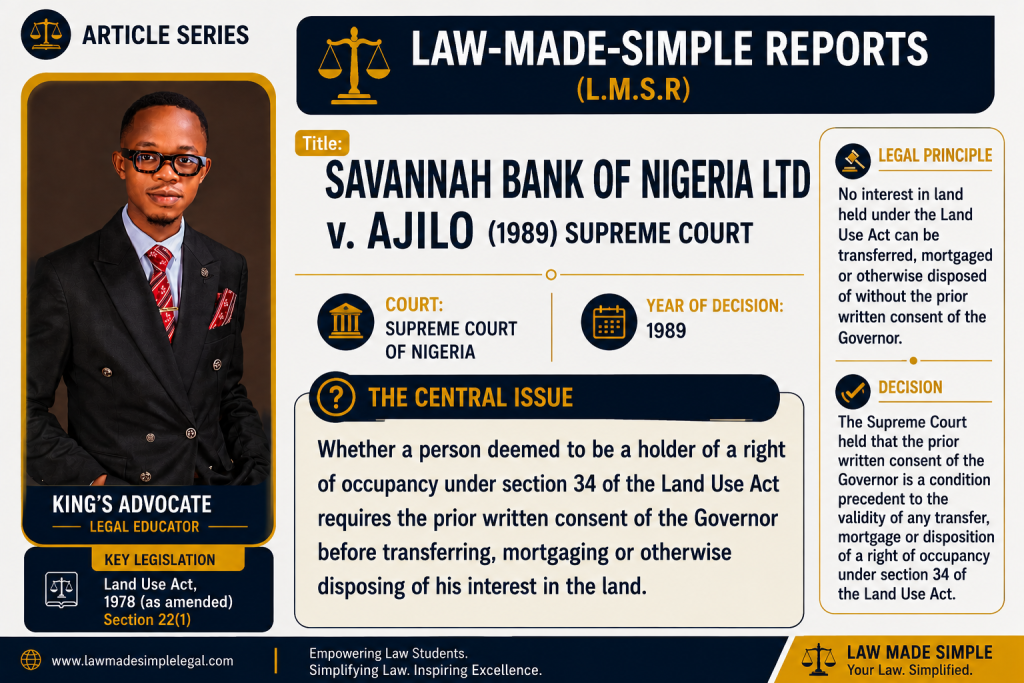
What happens when a person acquired land long before the Land Use Act came into force, but later discovers that the law has fundamentally changed the nature of the interest he holds?. Can a person who once held land in fee simple mortgage that property freely after the Land Use Act? This is what Savannah Bank Of Nigeria Ltd v. Ajilo (1989) set to answer and we shall dissesct all the principles established with respect to Property law and land Use Act in Nigeria.
And, most importantly, we shall analyse wether the requirement of the Governor’s prior consent apply only to people who received an express grant from the Governor, or does it also apply to persons whose pre-existing interests were converted into statutory rights of occupancy by the operation of the Act?
These were not merely technical questions of land conveyancing.
They went to the heart of one of the most significant changes ever introduced into Nigerian land law.
In Savannah Bank of Nigeria Ltd. v. Ajilo (1989), the Supreme Court confronted the revolutionary effect of the Land Use Act, 1978 and held that a person whose pre-existing interest had become a deemed statutory right of occupancy was still subject to the statutory control imposed by the Act, including the requirement of the Governor’s consent before alienation.
The case therefore became a major authority on Governor’s consent, deemed grants, statutory rights of occupancy and the interpretation of the Land Use Act.
COURT DETAILS
Court: Supreme Court of Nigeria
Suit No.: SC.188/1987
Date: Friday, 27 January 1989
Lead Judgment: Andrews Otutu Obaseki, J.S.C.
Coram:
- Andrews Otutu Obaseki, J.S.C.
- Augustine Nnamani, J.S.C.
- Adolphus Godwin Karibi-Whyte, J.S.C.
- Saidu Kawu, J.S.C.
- Salihu Modibbo Alfa Belgore, J.S.C.
- Abdul Ganiyu Olatunji Agbaje, J.S.C.
- Ebenezer Babasanya Craig, J.S.C.
Area of Law: Land Law, Land Use Act, Interpretation of Statutes, Mortgage
THE FACTS
The dispute concerned property situated at No. 1 Oyekanmi Street, off Itire Road, Mushin, Lagos.
The property had originally been acquired by the first respondent, Ammel O. Ajilo, before the commencement of the Land Use Act.
By a deed of conveyance dated 23 December 1965, the property had been vested in him in fee simple.
The Land Use Act subsequently came into force in 1978.
Under section 34(2) of the Act, persons who held certain interests in land before the commencement of the Act were treated as continuing to hold their land as if they were holders of statutory rights of occupancy granted by the Military Governor.
In other words, the Act transformed the legal character of the pre-existing interest.
Ajilo later mortgaged the property to Savannah Bank of Nigeria Ltd. on 5 September 1980 as security for credit facilities granted to Ammels Photo Industries Ltd.
The crucial problem was that the prior written consent of the Military Governor had not been obtained.
When the borrower defaulted, the bank attempted to exercise its power of sale under the mortgage and advertised the property for public auction.
Ajilo went to court.
His argument was straightforward:
The mortgage and proposed sale could not validly be enforced because the Governor’s prior consent required by section 22 of the Land Use Act had not been obtained.
The bank disagreed.
Its argument raised the central question in the case:
Does section 22 apply to a person whose right of occupancy was “deemed” to have been granted under section 34, or only to a person who received an actual grant from the Governor?
THE JOURNEY THROUGH THE COURTS
The Lagos State High Court, presided over by Hotonu, J., found in favour of Ajilo.
The court held that the failure to obtain the required consent rendered the mortgage transaction null and void and restrained the bank from exercising its power of sale.
The bank appealed to the Court of Appeal.
The Court of Appeal dismissed the appeal and affirmed the decision of the High Court.
The matter therefore proceeded to the Supreme Court.
The Supreme Court was consequently called upon to determine the proper relationship between sections 22 and 34 of the Land Use Act.
THE CENTRAL ISSUE
The principal question was:
Whether a person deemed to be a holder of a right of occupancy under section 34 of the Land Use Act requires the prior written consent of the Governor before transferring, mortgaging or otherwise disposing of his interest in the land.
Put simply:
Does “deemed grant” carry the same restrictions as an actual grant?
That was the real battle before the Supreme Court.
THE ARGUMENT OF THE BANK
The appellants argued that section 22 referred to a person holding a statutory right of occupancy granted by the Governor.
According to the argument, Ajilo was not an ordinary grantee.
His interest arose from land he already owned before the Land Use Act.
Therefore, the bank argued, the Governor’s consent requirement in section 22 should not apply to him merely because section 34 deemed him to be a holder of a statutory right of occupancy.
The bank also relied on the principle that statutes should not be interpreted as destroying vested property rights unless the intention to do so is clear.
THE ARGUMENT FOR AJILO
Ajilo’s argument was broader.
The Land Use Act had to be read as a whole.
Its objective was to place land under a unified system of control and administration.
Therefore, allowing holders of deemed rights of occupancy to freely alienate their interests without complying with section 22 would undermine the statutory scheme.
The respondents argued that the expression:
“holder of a statutory right of occupancy granted by the Military Governor”
should be understood broadly enough to include a deemed holder under sections 34(2) and 36(2).
THE SUPREME COURT’S REASONING
1. THE LAND USE ACT WAS REVOLUTIONARY
One of the most important features of the judgment is the way Obaseki, J.S.C. described the effect of the Land Use Act.
The Court did not approach the legislation as an ordinary statute regulating land transactions.
It recognised that the Act fundamentally reorganised the Nigerian landholding system.
Obaseki, J.S.C. explained that the Act had swept away the previous unlimited interests in land and subjected landholding to the statutory control of the Governor and Local Governments.
The Court therefore approached the disputed provisions within the wider structure and purpose of the Act.
LAW-MADE-SIMPLE
The important lesson is this:
Do not study section 22 alone.
To understand section 22, you must understand the larger system created by the Land Use Act.
2. SECTION 1 IS THE FOUNDATION
Section 1 of the Land Use Act is fundamental to understanding the decision.
It vests land comprised in each State in the Military Governor to be held in trust and administered for the use and common benefit of Nigerians, subject to the Act.
This demonstrates the central philosophy of the legislation:
Landholding is no longer governed solely by the traditional idea of absolute private ownership.
The interest of the individual operates within the statutory framework created by the Land Use Act.
3. ACTUAL GRANT AND DEEMED GRANT
This is one of the most examinable aspects of the case.
Actual Grant
An actual grant occurs where the appropriate authority expressly grants a right of occupancy under the statutory framework.
Deemed Grant
A deemed grant arises by operation of the Act.
Section 34(2) protected certain pre-existing interests by treating the holders as if they had been granted statutory rights of occupancy.
The crucial question was whether a deemed holder could say:
“My land was originally mine before the Land Use Act, so the restrictions applicable to a statutory grantee do not apply to me.”
The Supreme Court rejected that approach.
The deemed right was still brought within the statutory scheme of the Land Use Act.
4. SECTION 22 — GOVERNOR’S CONSENT
Section 22 requires the prior written consent of the Governor before a holder of a statutory right of occupancy can alienate the right by assignment, mortgage, transfer of possession, sublease or otherwise.
The Supreme Court adopted an interpretation which brought deemed statutory rights within this control.
The effect was that the fact that the original interest existed before the Land Use Act did not place the holder outside the statutory restrictions applicable to statutory rights of occupancy.
5. SECTION 26 — CONSEQUENCE OF NON-COMPLIANCE
Section 26 was also crucial.
The section provides the statutory consequence for transactions or instruments purporting to confer or vest interests in land contrary to the provisions of the Act.
The Supreme Court applied this provision to the mortgage transaction in question.
Because the required consent had not been obtained, the mortgage was held to be null and void under the law as interpreted in the case.
The Court consequently dismissed the bank’s appeal and affirmed the decisions of the lower courts.
6. THE ACT MUST BE READ AS A WHOLE
This is an important principle of statutory interpretation arising from the case.
The Court rejected an interpretation of section 22 that isolated the words of that provision from the rest of the Land Use Act.
Sections 1, 2, 22, 26, 34, 36, 39 and other relevant provisions had to be understood together.
The Court relied on the established principle that provisions of a statute should, as far as possible, be interpreted together so that the legislation operates as a coherent whole.
PRINCIPLE
A statute should not ordinarily be interpreted by taking one section in isolation while ignoring the scheme and purpose of the legislation as a whole.
7. BENEFICIAL CONSTRUCTION
The judgment also illustrates the principle of beneficial construction.
Where competing interpretations are available, the court may prefer an interpretation that better advances the apparent purpose and object of the legislation.
The Court therefore considered the broader purpose of the Land Use Act rather than adopting a narrow interpretation which would effectively place deemed holders outside the Governor’s statutory control.
8. THE MISCHIEF RULE
The decision also demonstrates the use of purposive statutory interpretation.
The court considered the problem which the Land Use Act was designed to address and interpreted the provisions in a manner consistent with the legislative scheme.
The question is not merely:
“What does this isolated word mean?”
The better question is:
“What interpretation makes the statutory scheme work according to its purpose?”
9. THE COURT’S ANSWER TO THE CENTRAL QUESTION
The Supreme Court answered the central question in the affirmative.
A deemed holder under section 34 is not outside the statutory control imposed by section 22.
The Court held that the expression referring to a holder of a statutory right of occupancy granted by the Governor includes the deemed statutory right created by the Act.
Consequently, the mortgage executed without the required prior consent was held to be null and void, and the appeal was dismissed.
THE RATIO DECIDENDI
The central principle established by the decision may be stated as follows:
A person whose pre-existing interest in land has become a deemed statutory right of occupancy under section 34 of the Land Use Act is subject to the statutory conditions governing statutory rights of occupancy, including the requirement of the Governor’s prior consent under section 22 before the interest can be mortgaged, transferred or otherwise alienated.
Failure to comply with the statutory requirement attracted the consequence provided by section 26 under the law as applied in the decision.
KEY STATUTORY PROVISIONS
| Provision | Principle / Judicial Significance |
|---|---|
| Section 1 | Establishes the statutory framework under which land in each State is vested in the Governor to be held in trust and administered for the use and common benefit of Nigerians. |
| Section 2 | Establishes governmental control and management of land within the statutory framework. |
| Section 22 | Requires prior written Governor’s consent for specified dealings in a statutory right of occupancy. |
| Section 26 | Provides the statutory consequence for transactions or instruments contrary to the Act. |
| Section 34(2) | Converts qualifying pre-existing interests into deemed statutory rights of occupancy. |
| Section 36 | Deals with deemed rights in relation to customary rights of occupancy and forms part of the wider statutory scheme considered by the Court. |
| Section 39 | Relevant to the statutory treatment and control of rights of occupancy and assisted the Court’s interpretation of the Act. |
JUDICIAL PRINCIPLES TO REMEMBER
1. DEEMED GRANT IS NOT OUTSIDE THE LAND USE ACT
A deemed holder cannot rely merely on the fact that his original title existed before 1978 to escape the statutory controls applicable to the deemed statutory right of occupancy.
2. GOVERNOR’S CONSENT
The requirement of prior written consent under section 22 applies to the deemed statutory right of occupancy as interpreted in this decision.
3. STATUTE MUST BE READ AS A WHOLE
Individual sections must be interpreted in their context and in harmony with the wider provisions and purpose of the Act.
4. BENEFICIAL CONSTRUCTION
Where competing interpretations exist, the court may prefer the interpretation which better advances the purpose of the legislation.
5. PURPOSE OF THE LAND USE ACT
The Act fundamentally reorganised the legal framework governing landholding in Nigeria.
6. PRE-1978 TITLE IS NOT IMMUNE FROM THE NEW STATUTORY REGIME
The fact that an interest in land was acquired before the commencement of the Land Use Act does not, by itself, place the subsequent statutory right outside the operation of the Act.
WHY THIS CASE IS A LOCUS CLASSICUS
Savannah Bank v. Ajilo is important because it brings together several major areas of Nigerian law in one decision.
LAND LAW & ISSUES OF GOVERNOR’S CONSENT UNDER THE LAND USE ACT: WHAT EXACTLY DOES THE LAW REQUIRE?
Our mission on LAW-MADE-SIMPLE is to make law simple, and I can’t conclude this case without giving you a deep knowledge on issues of governor’s consents. So we shall fully appraise this in line with current judicial authorities in this for the sake of proper clarity.
Firstly the Land Use Act does not simply ask whether parties have agreed to deal with land. The critical question is whether the transaction has reached the stage of alienating the right of occupancy.
That distinction is extremely important.
Let us take it step by step.
1. The Statutory Foundation — Section 22
Section 22(1) of the Land Use Act provides, in substance, that a holder of a statutory right of occupancy granted by the Governor cannot alienate that right, or any part of it, by assignment, mortgage, transfer of possession, sublease or otherwise without the Governor’s consent first being obtained.
The provision is therefore directed at alienation.
The word “alienate” is important because it means more than merely discussing a transaction or entering into preliminary negotiations. The law is concerned with the stage at which an interest in the right of occupancy is being transferred, mortgaged, assigned or otherwise dealt with as a proprietary interest.
This is why Governor’s consent has become one of the most important statutory controls in Nigerian land transactions.
2. Why Savannah Bank v. Ajilo Became a Landmark
The starting point for understanding the strict approach is:
Savannah Bank of Nigeria Ltd. v. Ajilo (1989) 1 NWLR (Pt. 97) 305.
The Supreme Court considered whether a person whose interest in land existed before the commencement of the Land Use Act, and whose interest became a deemed statutory right of occupancy under section 34(2), was also subject to the requirement of Governor’s consent.
The Supreme Court answered in the affirmative.
The importance of the decision is that the requirement was not limited merely to people who received an express grant from the Governor. The Court treated the deemed statutory right of occupancy within the statutory framework and held that the relevant restriction applied.
Thus, the old argument that pre-1978 landowners stood completely outside the consent regime could not be maintained.
3. Section 26 — The Consequence of an Unlawful Transaction
Section 26 is the provision that gives real force to the consent requirement.
It provides that any transaction or instrument which purports to confer or vest an interest or right over land in a manner inconsistent with the Land Use Act is null and void.
This explains why Governor’s consent is not merely a bureaucratic formality.
Where the law requires consent for the alienation in question and the transaction is completed in a manner prohibited by the Act, section 26 may render the transaction ineffective.
But there is an important qualification.
Do not automatically conclude that every agreement made before consent is obtained is itself void.
The later cases make this distinction very important & make some little mitigation for commercial workability in land transactions in Nigeria.
4. The Important Refinement was first made in: Awojugbagbe v. Chinukwe
This is where the law becomes more interesting.
In Awojugbagbe Light Industries Ltd. v. Chinukwe (1995) 4 NWLR (Pt. 390) 379, the Supreme Court examined the relationship between section 22 and the process of obtaining Governor’s consent.
The Court recognised that section 22(2) itself contemplates that an instrument evidencing an assignment, mortgage or sublease may exist and subsequently be submitted for the Governor’s consent.
Therefore, the existence of an agreement or instrument before consent does not automatically mean that the parties have committed an unlawful transaction.
The crucial question is:
Has the transaction actually operated to alienate the interest before the necessary consent was obtained, or was it intended to become effective only after consent?
The Supreme Court treated the latter situation differently.
In other words, the parties may enter into an arrangement which is conditional upon obtaining the Governor’s consent.
Until the required consent is obtained, the transaction does not operate to pass the relevant interest in the land.
This is the important distinction between an agreement to transact and the actual alienation of the proprietary interest.
5. The Two-Stage Approach
A useful way to understand the cases is to think of land transactions as having two stages.
Stage One — Agreement or Negotiation
The parties may negotiate and reach an agreement concerning a proposed sale, mortgage, assignment or sublease.
At this stage, the parties may structure the agreement so that it is conditional upon obtaining the necessary consent.
Governor’s consent is not necessarily required merely because the parties have reached an agreement to pursue the transaction.
Stage Two — Alienation
The position changes when the transaction is intended to operate as an actual transfer, assignment, mortgage, sublease or other alienation of the right of occupancy.
Where the Act requires Governor’s consent, that consent must be obtained before the transaction can validly operate in the manner contemplated by the Act.
This distinction was emphasised in Owoniboys Technical Services Ltd. v. Union Bank of Nigeria Ltd., where the Supreme Court explained the difference between entering into an agreement concerning land and proceeding to the actual transfer or alienation of the interest.
6. A Simple Example
Let me put it this way.
Suppose A owns a statutory right of occupancy and agrees to sell the property to B.
If their agreement clearly provides that the transaction will become effective only after the necessary Governor’s consent is obtained, the agreement may constitute an arrangement towards the eventual transaction rather than an immediate alienation of the right.
But if A proceeds as though the proprietary interest has already been transferred to B without obtaining the consent required by law, section 22 becomes directly relevant, and section 26 may operate against the transaction.
So, whenever you see a problem involving Governor’s consent, do not stop at:
“Was there consent?”
Ask the deeper questions:
- What type of right of occupancy is involved?
- What transaction did the parties enter into?
- Was the transaction merely an agreement to transact?
- Was the agreement conditional upon Governor’s consent?
- Had the interest actually been alienated?
- Does the particular transaction fall within section 22?
- What is the consequence under section 26?
That is where the real legal analysis begins. And encourage you to Read up the case on this site.
7. Governor’s Consent and Mortgage Transactions
Mortgages are particularly important because section 22 expressly mentions mortgage.
A mortgage of a statutory right of occupancy is therefore not something to treat casually.
The cases show that the court will examine:
- whether the property is held under a statutory right of occupancy;
- whether the transaction amounts to an alienation;
- whether Governor’s consent was required;
- whether consent was obtained;
- the stage at which consent was obtained;
- and whether the transaction was structured to take effect only upon consent.
The Supreme Court’s decision in Awojugbagbe v. Chinukwe is particularly important here because it prevents an overly simplistic interpretation of section 22. The provision must be read together with section 22(2), rather than treating every pre-consent document as automatically void.
8. The Law Developed Beyond Savannah Bank v. Ajilo
This is an important point when teaching the subject.
Savannah Bank v. Ajilo remains a major authority, but it should not be treated as though it answers every Governor’s-consent problem by itself.
The later decisions refined the doctrine.
The position emerging from the cases is that:
Governor’s consent is required where the Land Use Act makes it a condition for the alienation of the relevant right of occupancy; however, an agreement entered into in anticipation of the transaction is not necessarily itself an unlawful alienation where the parties contemplate that the transaction will become effective only after the required consent is obtained.
That is the significance of Awojugbagbe v. Chinukwe and the later cases applying its reasoning.
9. Important Authorities to Keep Together
When I am teaching Governor’s consent, I would not isolate Savannah Bank v. Ajilo. I would put the authorities together because each contributes something different to the doctrine.
Savannah Bank (Nig.) Ltd. v. Ajilo (1989)
Core principle: A deemed statutory right of occupancy under section 34 is subject to the statutory regime governing statutory rights of occupancy, including the requirement of Governor’s consent under section 22.
Awojugbagbe Light Industries Ltd. v. Chinukwe (1995)
Core principle: Section 22 does not necessarily invalidate every agreement made before consent. An arrangement may be conditional upon obtaining the Governor’s consent, and the court must distinguish an agreement leading to an alienation from the completed alienation itself.
International Textile Industries (Nig.) Ltd. v. Aderemi (1999)
Core principle: The Land Use Act does not prohibit agreements or arrangements concerning future alienation which are intended to become effective only after the necessary approval or consent has been obtained.
Owoniboys Technical Services Ltd. v. Union Bank of Nigeria Ltd. (2003)
Core principle: There is an important distinction between entering into a contract concerning land and actually transferring or alienating the right of occupancy. Consent becomes critical at the stage of actual alienation.
Brossette Manufacturing (Nig.) Ltd. v. Ola Ilemobola Ltd. (2007)
Core principle: Sections 22(2) and 26 must be considered together when determining the effect of non-compliance with the statutory requirements governing alienation.
10. A Teaching Point I Want You to Remember
If you encounter Governor’s consent in a Land Law question, resist the temptation to write:
“No Governor’s consent = transaction automatically void.”
That may be too broad.
Instead, pause and identify what transaction has occurred and at what stage.
The better analytical approach is:
Right of Occupancy – Nature of Transaction – Is there Alienation? – Is Consent Required? – Was Consent Obtained? – When Was Consent Obtained? -Effect under Section 26.
That structure will prevent you from confusing a preliminary agreement with an actual alienation.
THE CORE RULE
The safest way to carry the doctrine in your head is this:
Governor’s consent is a statutory control over the alienation of a statutory right of occupancy. The courts, however, distinguish between an agreement or arrangement made in contemplation of a transaction and an actual alienation of the proprietary interest. Where the parties intend the transaction to become effective only upon the necessary consent being obtained, the agreement is not necessarily void merely because consent had not yet been obtained.
That is the more mature way to understand Governor’s consent under the Land Use Act.
And that is why Savannah Bank v. Ajilo should be studied together with Awojugbagbe v. Chinukwe and the later authorities,not as isolated cases, but as stages in the development of one doctrine.
INTERPRETATION OF STATUTES
It demonstrates:
- contextual interpretation;
- purposive interpretation;
- beneficial construction;
- reading legislation as a whole;
- avoidance of interpretations that defeat the statutory scheme.
EXAM FOCUS
If an examination question asks:
“Discuss the requirement of Governor’s consent under the Land Use Act.”
Think of:
Savannah Bank v. Ajilo.
If the question asks:
“Distinguish between an actual grant and a deemed grant under the Land Use Act.”
Think of:
Savannah Bank v. Ajilo.
If the question asks:
“Explain the effect of section 34(2) on pre-existing interests in land.”
Think of:
Savannah Bank v. Ajilo.
If the question asks:
“Explain the principle that a statute must be interpreted as a whole.”
This case is also useful.
If the question concerns the validity of a mortgage or alienation of a statutory right of occupancy without the required consent, this case is a major authority to consider.
COMMON EXAM MISTAKE
Do not reduce the case to:
“Governor’s consent is required before land can be mortgaged.”
That is too shallow.
The real intellectual issue in the case was:
Does the Governor’s consent requirement extend to a person whose interest became a deemed statutory right of occupancy under section 34 even though the person originally acquired the land before the Land Use Act?
That is the question that makes the case academically important.
THE BIG LESSON
The significance of Savannah Bank v. Ajilo goes beyond one mortgage.
It demonstrates the enormous effect of the Land Use Act on the Nigerian concept of land ownership.
The individual may have acquired land before the Act, but the legal consequences of subsequent dealings with that land must be considered within the statutory regime created by the Act.
The case therefore teaches a broader lesson:
In land law, the history of how land was acquired is important, but the current statutory character of the interest is equally important.
CASE AT A GLANCE
| Principle | Authority |
|---|---|
| Deemed statutory rights fall within the statutory regime governing statutory rights of occupancy | Section 34(2) |
| Prior written consent required for specified alienation of statutory right of occupancy | Section 22 |
| Statutory consequence of non-compliant transactions | Section 26 |
| Pre-existing interests transformed into deemed statutory rights | Section 34 |
| Statute should be interpreted as a coherent whole | Principle of statutory interpretation |
| Interpretation should advance the object and purpose of legislation | Beneficial / purposive construction |
| Land Use Act fundamentally reorganised landholding in Nigeria | Sections 1–2 and overall statutory scheme |
IDUNDUN v. OKUMAGBA (1976)Definitive Guide to Proof of Land Ownership in Nigeria
LAW-MADE-SIMPLE FINAL NOTE
The easiest way to remember Savannah Bank v. Ajilo is this:
The land may have been acquired before the Land Use Act, but the dealing with the resulting statutory interest cannot simply ignore the Act.
The case is therefore not merely about a bank, a mortgage or a piece of land in Mushin.
It is about the transformation of Nigerian land law by the Land Use Act.
DEEMED GRANT + GOVERNOR’S CONSENT + STATUTORY INTERPRETATION = SAVANNAH BANK v. AJILO.
IMPORTANT NOTE ON THE CASE’S LATER LEGAL HISTORY
Students should be careful not to treat every proposition from Savannah Bank v. Ajilo as the final statement of Nigerian land law today. Subsequent Supreme Court decisions have considered and developed the law concerning Governor’s consent, mortgage transactions and the consequences of non-compliance with the Land Use Act.
Accordingly, when using this case in an advanced research paper, it should be read together with later authorities rather than treated as an isolated statement of the law.
EKPENDU & ORS. v. ERIKA & ORS. (1959)Family Land Law Explained
IDUNDUN v. OKUMAGBA (1976)Definitive Guide to Proof of Land Ownership in Nigeria
Nelson & Ors v. Nelson (1931) FULL REPORT
ABOUT THE PUBLISHER
LAW-MADE-SIMPLE is a growing African academic resource network and a centre for academic growth, dedicated to making complex academic and legal knowledge easier to understand, access and apply.
Founded and published by Kingsley Omenyi, popularly known as KING’S ADVOCATE, the platform provides simplified case analysis, legal principles, statutes, academic resources and student-focused learning materials for learners across Nigeria, Africa and the wider Common Law community.
Through LAW-MADE-SIMPLE, Kingsley Omenyi seeks to bridge the gap between complex legal materials and practical understanding by presenting Nigerian and African legal materials in a clear, accessible and academically useful manner, while connecting them with broader principles of the Common Law tradition.
As a finalist law student, legal educator and digital content creator, Kingsley Omenyi has a strong interest in legal education, legal research, advocacy and the use of technology to make academic knowledge more accessible.LAW-MADE-SIMPLE is being developed as a central digital resource for teachers ,students,learners and every legal person seeking reliable, simplified and practical academic materials, with Nigerian law legal education at its core and a growing focus on African legal education and the wider Common Law tradition.
Published by:
KINGSLEY OMENYI -KING’S ADVOCATE
Founder & Publisher, King’s Advocate network
Making Law Made Simple.
Contact the Publisher: Contact Kingsley Omenyi