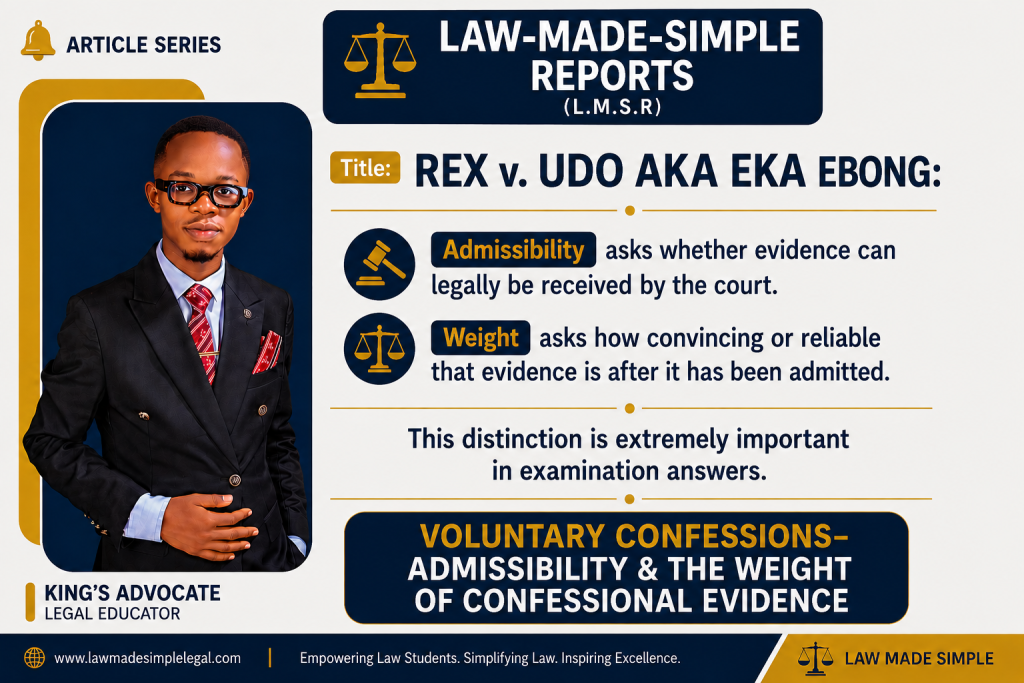
Rex v. Udo Aka Eka Ebong is an important Nigerian criminal evidence case on confessions, voluntariness and the weight that a court should attach to a confession where it constitutes the principal evidence against an accused person.
The case is particularly significant because the alleged confession arose in unusual circumstances involving a traditional belief in “Juju” and an investigation into a suspected murder. The appellant argued that his statement was not voluntary because he had been subjected to psychological pressure arising from his belief in Juju.
The appellate court rejected the argument that the confession was legally involuntary and held that the confession was admissible under the applicable provisions of the Nigeria Evidence Ordinance.However, admissibility was not the end of the matter.
The court went further to examine the evidential weight that should be attached to the confession. Having considered the contradictions surrounding the alleged confession, the appellant’s subsequent denial, the weakness of the corroborative evidence and the absence of a convincing motive, the court concluded that the appellant was entitled to the benefit of the doubt.
The conviction was therefore quashed and the sentence set aside.This case provides an important lesson in Evidence Law:A confession may be admissible in law, yet the court must still determine what weight it deserves.
CASE INFORMATION
Case: Rex v. Udo Aka Eka EbongCourt: West African Court of Appeal
Coram: Harragin, C.J. (Gold Coast)Verity, C.J. (Nigeria)Lucie-Smith, C.J. (Sierra Leone)
Area of Law: Criminal Law and Evidence
Principal Issues:• Confessions• Voluntariness of confession• Admissibility of confession evidence• Weight of confession evidence• Benefit of doubt
Relevant Legislation: Nigeria Evidence Ordinance, sections 26 and 27Case Referred To: R. v. Baldry, 5 Cox C.C. 523; 21 L.J.M.C. 130; 19 L.T.O.S. 146; 16 J.P. 276.
Nature of Proceeding: Appeal from the Supreme Court of Nigeria
BACKGROUND TO THE CASE REX v. UDO AKA EKA EBONG.
The deceased was murdered sometime in November 1944.The matter was reported to the police, but the initial police investigation did not produce a successful result.The local Chief, Ibritam, subsequently invited representatives from eighteen villages in the surrounding area to investigate the circumstances surrounding the deathThe investigation took an unusual form.There was apparently a suspicion that the death might not have been accidental or straightforward. A traditional practice involving “Juju” was invoked in an attempt to determine whether the deceased had been killed by what was described as a “bush leopard” or a “man leopard”.
The purpose, according to the evidence, was that if a human being had committed the killing, the Juju would cause the person responsible to become mad and confess.
Approximately eleven months after the death, the appellant, Udo Aka Eka Ebong, went to the house of the Chief.According to the Chief, the appellant was shaking and said that he had killed the girls.The Chief became the principal witness concerning the alleged confession.
The appellant was subsequently prosecuted and convicted.He appealed against the conviction.
THE CENTRAL ISSUE REX v. UDO AKA EKA EBONG
The central evidential question was whether the statement allegedly made by the appellant was a confession that was legally admissible.The appellant argued that the statement was not voluntary.His argument was based on the circumstances surrounding the traditional investigation.
It was submitted that the belief in Juju had placed pressure upon him and that his alleged confession was therefore not the product of a free and voluntary mind.
THE LAW ON CONFESSIONS
The case was considered under sections 26 and 27 of the Nigeria Evidence Ordinance.Section 27(1) defined a confession as an admission made at any time by a person charged with a crime, stating or supporting the inference that he committed that crime.
Section 27(2) provided that confessions, if voluntary, were relevant facts against the person who made them.The importance of the word “voluntary” cannot be overstated.A confession is not automatically admissible simply because it contains an admission of guilt.The circumstances in which the statement was obtained must also be considered.
WHAT IS A CONFESSION?
A confession is essentially an admission by an accused person which expressly or impliedly acknowledges that he committed the offence charged.
A confession may be direct. For example:”I committed the offence.”It may also be expressed in circumstances from which guilt can reasonably be inferred.The legal significance of a confession lies in the fact that it comes from the accused person himself.
However, the fact that a statement amounts to a confession does not automatically resolve every evidential question.The court must still consider whether it was voluntary and, where admitted, what weight should ultimately be attached to it.
ADMISSIBILITY AND WEIGHT ARE DIFFERENT QUESTIONS
This distinction is one of the most important lessons from Rex v. Udo Aka Eka Ebong.There are two separate questions:
1. Is the confession legally admissible?
2. If admissible, how much weight should the court give it?
A confession may pass the first test but fail to persuade the court on the second.Therefore:
Admissibility asks whether evidence can legally be received by the court.Weight asks how convincing or reliable that evidence is after it has been admitted.
This distinction is extremely important in examination answers.
THE APPELLANT’S ARGUMENT ON VOLUNTARINESS
The appellant argued that his alleged confession was not voluntary.The argument was based on the traditional belief in Juju.
The theory was that the investigation had created a situation in which the appellant feared that the Juju would identify him as the person responsible for the killing.The appellant therefore argued that his statement should not be treated as a free and voluntary confession.
THE COURT’S DECISION ON VOLUNTARINESS
The appellate court rejected this argument.The court held that the confession was voluntary from the legal point of view and was properly admitted.The court referred to R. v. Baldry in considering the question of voluntariness.
The court was unwilling to accept the proposition that a person’s belief in witchcraft or Juju automatically transformed a statement into an involuntary confession.The court observed that accepting such an argument too broadly could produce the dangerous result of treating belief in witchcraft as a possible defence to murder.
The legal test remained whether the confession was voluntary within the meaning of the applicable law.
IMPORTANT LESSON: BELIEF DOES NOT AUTOMATICALLY DESTROY VOLUNTARINESS
The case should not be misunderstood as saying that psychological pressure can never affect voluntariness.Rather, the important point is that the mere existence of a cultural or supernatural belief does not automatically make a confession legally involuntary.The court must examine the circumstances in which the statement was made.The relevant question is whether the accused’s statement was legally voluntary under the applicable evidential rules.
THE COURT THEN CONSIDERED THE WEIGHT OF THE CONFESSION.
After finding that the confession was admissible, the court had to consider another question:What evidential value should be attached to it?
This was particularly important because the conviction appeared to rest principally, if not solely, on the alleged confession.A confession may be admissible and still require careful scrutiny.The court therefore examined the evidence surrounding the alleged confession.
THE EVIDENCE SUPPORTING THE CONFESSION
The Chief was the principal witness who testified that the appellant came to him trembling and said that he had killed the girls.Other witnesses were called to provide corroboration.However, the appellate court noted that there were substantial discrepancies in the evidence.
The trial Judge had himself treated much of the supporting evidence with caution.The appellate court therefore regarded the corroborative evidence as being of limited value.
THE APPELLANT’S VERSION
The appellant admitted that he went to the Chief.However, he disputed the Chief’s account of what he said.According to the appellant, he did not say:
“I killed the girls.”Instead, his position was that he said:”It is said that I killed the two girls.”
That distinction became important.The first statement is an admission of personal responsibility.The second statement merely reports an accusation being made against the speaker.
Although some witnesses did not regard the distinction as significant, the appellate court considered the surrounding circumstances in determining whether the alleged confession was sufficiently reliable to sustain a conviction.
THE APPELLANT’S STATEMENT TO THE POLICE
The court also considered the appellant’s subsequent conduct.After his arrest, the appellant denied making the confession.He maintained that what he had said was that people were saying that he had killed the two girls.He also indicated his willingness to take an oath to establish his innocence.This subsequent denial was relevant to the court’s assessment of the reliability and weight of the alleged confession.
THE IMPORTANCE OF CORROBORATION
The case demonstrates the practical importance of corroborative evidence where the prosecution’s case depends heavily upon a disputed confession.A confession does not become unreliable merely because there is no corroboration in every case.However, where the confession is disputed and the surrounding evidence contains serious inconsistencies, the absence of convincing independent evidence may become highly significant when the court evaluates whether guilt has been proved beyond reasonable doubt.
THE QUESTION OF MOTIVE in REX v. UDO AKA EKA EBONG
The court also noted that the crime appeared to be practically motiveless.The absence of motive does not ordinarily mean that an accused person cannot be convicted.
A person can commit a crime without an obvious motive.However, where the prosecution’s evidence is already uncertain, the absence of a discernible motive may become one of the circumstances considered by the court in determining whether reasonable doubt exists.
THE BENEFIT OF DOUBT
After considering all the circumstances, the appellate court concluded that the appellant was entitled to the benefit of the doubt.The court therefore allowed the appeal.The conviction was quashed.The sentence was set aside.
THE FINAL DECISION in REX v. UDO AKA EKA EBONG
The appeal was allowed.The conviction was quashed.The sentence was set aside.The appellant was therefore entitled to the benefit of the doubt.
KEY LEGAL PRINCIPLES IN REX v. UDO AKA EKA EBONG
1. VOLUNTARY CONFESSIONS
Under the applicable law, a confession must be voluntary before it can be treated as relevant against the accused.
2. A CONFESSION MAY BE ADMISSIBLE WITHOUT BEING CONCLUSIVE
Admissibility does not automatically determine the weight that the court must give to the confession.
3. ADMISSIBILITY AND WEIGHT ARE DISTINCT
The court must distinguish between whether evidence can be received and whether the evidence is sufficiently reliable and convincing to establish guilt.
4. CULTURAL OR SUPERNATURAL BELIEF DOES NOT AUTOMATICALLY MAKE A CONFESSION INVOLUNTARY
The circumstances surrounding the statement must be examined under the applicable legal test.
5. A DISPUTED CONFESSION REQUIRES CAREFUL EVALUATION
Where the accused denies making the confession or gives a materially different account of the statement, the court must assess the competing evidence carefully.
6. CORROBORATIVE EVIDENCE MAY BE IMPORTANT
Where the prosecution’s case substantially depends on a confession, weaknesses and inconsistencies in supporting evidence may affect the weight of the confession.
7. THE PROSECUTION BEARS THE BURDEN OF PROOF
The ultimate burden remains on the prosecution to establish the accused’s guilt beyond reasonable doubt.
8. BENEFIT OF DOUBT
Where the evidence leaves a reasonable doubt as to guilt, the accused is entitled to the benefit of that doubt.
CONFESSION: ADMISSIBILITY VS WEIGHT
This case is particularly useful for remembering the following examination distinction:
ADMISSIBILITY
The question is:”Can the court legally receive this confession in evidence?”
WEIGHT
The question is:”Having admitted the confession, how much reliance should the court place upon it?”
A student who simply writes “the confession was admissible” without discussing its evidential weight has not fully captured the reasoning in Rex v. Udo Aka Eka Ebong.
The appellate court admitted the confession but nevertheless examined whether it was sufficiently reliable to sustain the conviction.That distinction is one of the strongest lessons from the case.
COMMON MISTAKES STUDENTS SHOULD AVOID
Mistake 1: Saying that every confession automatically proves guilt.Wrong.A confession is evidence. The court must still assess its reliability and weight.
Mistake 2: Confusing admissibility with weight.Evidence may be admissible but ultimately given little or no significant weight.
Mistake 3: Saying that the absence of corroboration automatically makes a confession inadmissible.That is too broad.The question of corroboration and the question of admissibility should not be confused.
Mistake 4: Assuming that cultural or supernatural belief automatically makes a confession involuntary.The court must examine whether the statement was legally voluntary.
Mistake 5: Ignoring contradictions.Where the prosecution’s principal evidence is a disputed confession, inconsistencies in the surrounding evidence can become extremely important.
Mistake 6: Forgetting the burden of proof.The prosecution bears the burden of proving guilt beyond reasonable doubt.
EXAM FOCUS Students should remember Rex v. Udo Aka Eka Ebong for:
• Voluntary confessions.• The distinction between admissibility and weight.
• The meaning and treatment of confessional statements.
• The importance of examining the circumstances in which a confession was made.
• The effect of contradictions surrounding a confession.
• The importance of assessing corroborative evidence.
• The prosecution’s burden of proving guilt beyond reasonable doubt.
• The benefit of doubt.
HOW TO ANSWER AN EXAMINATION QUESTION
Let’s have our regular practical lessons:
QUESTION:
“Discuss the admissibility and evidential value of confessional statements with reference to Rex v. Udo Aka Eka Ebong.”A strong answer may follow this structure:
INTRODUCTION
Define a confession and explain that the law distinguishes between admissibility and evidential weight.
LEGAL RULE
State the relevant statutory rule governing voluntary confessions.
APPLICATION
Explain that the appellant argued that his confession was involuntary because of the pressure created by his belief in Juju.
DECISION ON ADMISSIBILITY
Explain that the appellate court found the confession voluntary and admissible.
DECISION ON WEIGHT
Explain that the court nevertheless examined the reliability of the confession, the contradictions in the supporting evidence, the appellant’s subsequent denial and the lack of convincing evidence connecting him to the offence.
CONCLUSION
Explain that the prosecution had failed to eliminate reasonable doubt and that the appellant was therefore entitled to the benefit of the doubt.
POSSIBLE EXAMINATION QUESTIONS
1. What constitutes a confession in evidence law?
2. Explain the difference between admissibility and weight of evidence.
3. Discuss the requirement that a confession must be voluntary.
4. Can an admissible confession be rejected as insufficiently reliable to sustain a conviction? Discuss.
5. Discuss Rex v. Udo Aka Eka Ebong in relation to confessional evidence.6. What factors should a court consider when determining the weight to be attached to a confession?
7. Discuss the effect of contradictions in evidence relating to an alleged confession.
8. Explain the significance of the burden of proof in a case substantially dependent upon a confession.
9. Does the absence of motive necessarily establish innocence? Discuss.
10. Discuss the principle that an accused person is entitled to the benefit of reasonable doubt.
RELATED EVIDENCE LAW PRINCIPLES.
Rex v. Udo Aka Eka Ebong can be studied alongside the broader principles of:
• Confessions• Admissions• Voluntariness• Relevance and admissibility• Weight of evidence• Burden of proof• Proof beyond reasonable doubt• Corroborative evidence• Credibility of witnesses• Benefit of doubt
These principles are interconnected and should not be studied in isolation.
WHY THIS CASE REX V. UDO AKA EKA EBONG MATTERS.
The importance of Rex v. Udo Aka Eka Ebong goes beyond the unusual circumstances involving Juju. Its real academic value lies in showing students how appellate courts evaluate evidence.
The court did not stop after answering the question:
“Was the confession admissible?
“It proceeded to ask:”Is this evidence sufficiently reliable to justify a conviction?”
That is a much deeper approach to evidence analysis.In an examination, this distinction can separate a basic answer from an excellent one.
PRACTICAL LESSON
Imagine that a prosecution case depends almost entirely on an alleged confession.The accused denies making the confession.The principal witness insists that the accused confessed.Other witnesses provide inconsistent supporting accounts.There is no strong independent evidence connecting the accused with the offence.In such a situation, the court must not simply say:”There is a confession, therefore there must be a conviction.”The court must evaluate the whole evidence.
The question remains whether the prosecution has proved guilt beyond reasonable doubt.That is the deeper lesson from this case.
CASE IN ONE SENTENCE
Rex v. Udo Aka Eka Ebong establishes that although a confession may be legally admissible where it is voluntary, the court must still carefully assess its reliability and weight, and where the totality of the evidence leaves reasonable doubt, the accused must receive the benefit of that doubt.
CONCLUSION
Rex v. Udo Aka Eka Ebong is an important authority for understanding the relationship between confessions, admissibility and the weight of evidence.The appellate court held that the alleged confession was voluntary from the legal point of view and was therefore properly admitted.
However, admissibility did not automatically make the confession sufficient to sustain the conviction.The court carefully examined the circumstances surrounding the alleged confession, the discrepancies in the supporting evidence, the appellant’s subsequent denial, the alternative account of what he had said and the absence of a convincing motive.
Ultimately, the court concluded that the evidence left sufficient doubt to entitle the appellant to the benefit of that doubt.The conviction was therefore quashed and the sentence set aside.The enduring lesson is simple:A confession may enter the courtroom, but admissibility is only the beginning of the court’s evaluation. The real question remains whether the evidence, considered as a whole, proves guilt beyond reasonable doubt.
You can check more criminal cases & note summary on Criminal Law
EDITORIAL NOTE
This article is prepared as a simplified educational explanation of the historical case for students and learners of Nigerian and African law. Because historical law reports may contain outdated terminology and statutory references, readers should consult the original report and the current applicable legislation when using the case for formal professional or litigation purposes.
ABOUT THE PUBLISHER
LAW-MADE-SIMPLE is a growing African academic resource network and a centre for academic growth, dedicated to making complex academic and legal knowledge easier to understand, access and apply.
Founded and published by Kingsley Omenyi, popularly known as KING’S ADVOCATE, the platform provides simplified case analysis, legal principles, statutes, academic resources and student-focused learning materials for learners across Nigeria, Africa and the wider Common Law community.
Through LAW-MADE-SIMPLE, Kingsley Omenyi seeks to bridge the gap between complex legal materials and practical understanding by presenting Nigerian and African legal materials in a clear, accessible and academically useful manner, while connecting them with broader principles of the Common Law tradition.
As a finalist law student, legal educator and digital content creator, Kingsley Omenyi has a strong interest in legal education, legal research, advocacy and the use of technology to make academic knowledge more accessible.LAW-MADE-SIMPLE is being developed as a central digital resource for teachers ,students,learners and every legal person seeking reliable, simplified and practical academic materials, with Nigerian law legal education at its core and a growing focus on African legal education and the wider Common Law tradition.
Published by:
KINGSLEY OMENYI -KING’S ADVOCATE
Founder & Publisher, King’s Advocate network
Making Law Made Simple.
Contact the Publisher: Contact Kingsley Omenyi