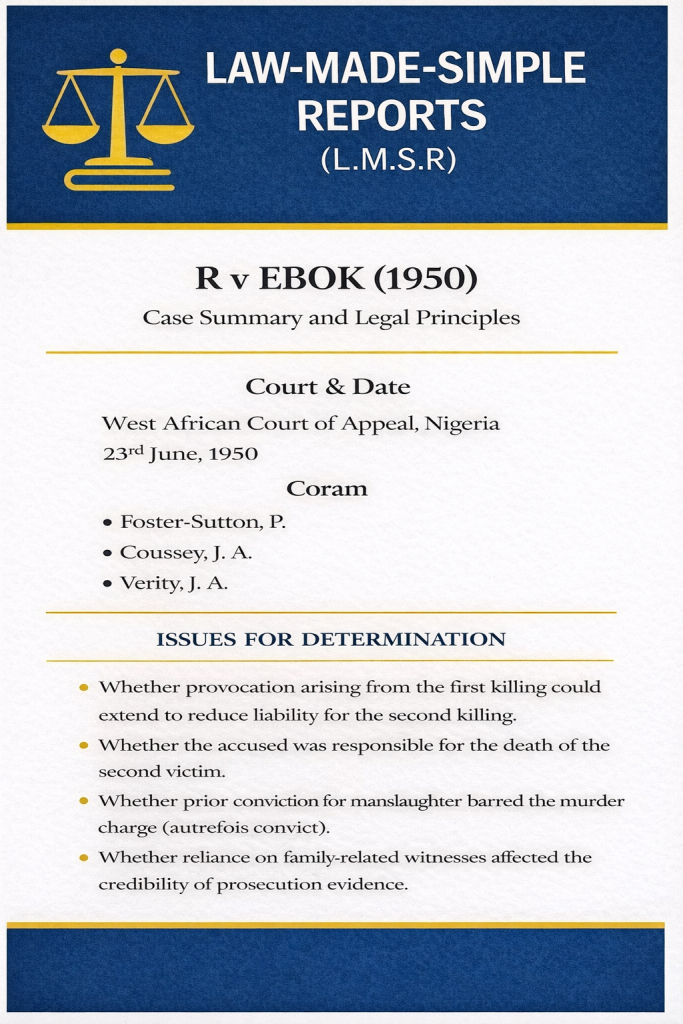
The case of R v Ebok is a significant authority in criminal law, particularly on the limits of the defence of provocation and the principle that each criminal act must be independently assessed. The decision clarifies that provocation affecting one killing cannot automatically extend to justify or reduce liability for a separate killing of another person who gave no provocation.
Facts of the Case R v Ebok
The accused, Ebok, went to a swamp to gather palm fruits where he encountered four women, including his former wife or partner, who had left him and married another man.
Upon seeing her, he demanded the return of a cloth he claimed he had purchased for her. As she began to remove it under pressure from the other women, Ebok suddenly stabbed her in the chest and subsequently inflicted further fatal injuries with a machete.
The remaining women fled. One of them, Okwereke Diya Oguine, was chased by the accused, overtaken, and also killed with a machete.
The accused later surrendered to the police, admitting the killing of his former wife but claiming that the second woman was killed by another person (“Udo”), a defence the court rejected.
Procedural History
The accused was earlier tried and convicted of manslaughter for killing his former wife on the ground of provocation.He was later separately charged with the murder of the second woman, who had given no provocation.The defence argued mistaken identity and denied responsibility, but the court found the accused guilty.
Issues for Determination in R v Ebok
1.Whether provocation arising from the first killing could extend to reduce liability for the second killing.
2.Whether the accused was responsible for the death of the second victim.
3.Whether prior conviction for manslaughter barred the murder charge (autrefois convict).
4.Whether reliance on family-related witnesses affected the credibility of prosecution evidence.
Arguments of the Defence
The accused claimed the second woman was killed by another individual.He relied on alleged provocation by his former wife, including insults and emotional disturbance.He challenged the credibility of witnesses, noting that they were related to the deceased.
Judgment R v Ebok
The court rejected the defence and held that the prosecution’s evidence was credible and consistent. It found that:
The accused had indeed killed the second woman.The second victim had given no provocation whatsoever.Even if provocation existed in the first killing, it could not legally extend to the second killing.
The accused was therefore convicted of murder.
Key Legal Principles Established in R v Ebok
1. Provocation is Personal and Specific
The court held that provocation must relate directly to the victim in question. Even if the accused was provoked by one person, it cannot justify the killing of another innocent person.
“Provocation by one person cannot extend to reduce liability for the killing of another.”
2. Separate Acts of Homicide Are Independently Assessed
Each killing must be examined separately in law. A reduction in liability for one homicide does not automatically affect another.
3. Credibility of Related Witnesses
The court noted that in isolated rural or customary settings, it is normal for witnesses to be related. This does not automatically discredit their testimony.
4. Autrefois Convict Not Applicable
The plea of autrefois convict failed because:The offences were different victims.Murder and manslaughter in separate incidents are not the “same offence”.
Ratio Decidendi Established R v Ebok
The defence of provocation is strictly confined to the act and victim directly connected to the provoking conduct. It cannot be extended to excuse or mitigate a separate killing of another person who played no role in the provocation.
R v Ebok remains an important authority in Nigerian criminal law for the following reasons:
It clarifies the limits of provocation.It reinforces the principle of individual criminal responsibility for each act.It distinguishes between multiple homicides arising from one emotional episode.It supports judicial caution in expanding defences beyond their legal boundaries.
In summary,The decision in R v Ebok firmly establishes that emotional disturbance or provocation affecting one act of violence cannot legally justify or reduce liability for a separate and independent act of killing. The law requires that each homicide be treated on its own facts, ensuring accountability for every unlawful death.