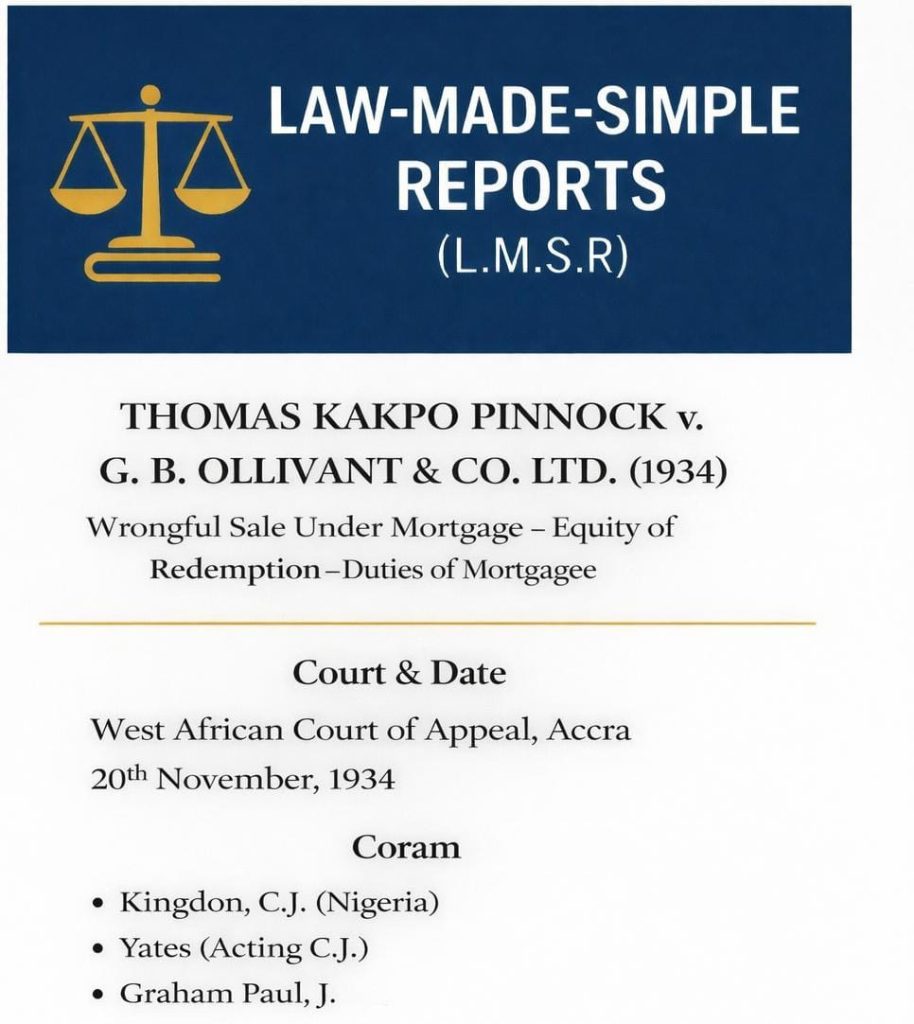
The case of Thomas Kakpo Pinnock v. G. B. Ollivant & Co. Ltd. is a foundational authority in mortgage law, particularly on the duty of a mortgagee exercising a power of sale and the equitable protection of a mortgagor, especially where the mortgagor acts as a surety.
It establishes that a mortgagee must act reasonably, fairly, and in good faith, and that equity will intervene where a sale is conducted in an oppressive or unconscionable manner.
Facts of the CaseThe plaintiff (Pinnock)
executed a mortgage deed in favour of the defendants (G. B. Ollivant & Co. Ltd.) as security for his brother’s financial dealings with the company. Thus, the plaintiff was a surety-mortgagor.
FACTS OF THE CASE KAKPO PINNOCK v. OLLIVANT & CO. LTD. (1934)
The plaintiff (Pinnock) executed a mortgage deed in favour of the defendants (G. B. Ollivant & Co. Ltd.) as security for his brother’s financial dealings with the company. Thus, the plaintiff was a surety-mortgagor.
A notice dated 21st April 1927 was issued demanding payment, failing which the mortgagee would exercise its power of sale.
However:The defendants waited over six years after issuing the notice.During that period, they accepted payments on the mortgage debt.No fresh notice was issued to reflect the updated outstanding balance.
The property was eventually sold privately through an auctioneer.The sale was made to the auctioneer’s own client (Fred Khoury).
The property was sold for £40, despite evidence showing its market value was £140.
The plaintiff sued:To set aside the sale and redeem the property; or
Alternatively, for damages for wrongful sale.
ISSUES FOR DETERMINATION KAKPO PINNOCK v. OLLIVANT & CO. LTD. (1934)
1.Whether the mortgagee’s failure to give fresh notice after a long lapse of time invalidated the sale.
2.Whether a surety-mortgagor is entitled to notice of the exact amount due before sale.
3.Whether the sale conducted at a gross undervalue constituted wrongful sale.
4.Whether the conduct of the mortgagee was unreasonable and inequitable.
5.Whether the plaintiff was entitled to damages.
DECISION OF THE COURT IN KAKPO PINNOCK v. OLLIVANT & CO. LTD. (1934)
The Court of Appeal allowed the appeal.It held that:The sale was wrongful.
The plaintiff was entitled to damages.The case was remitted to the lower court to determine the exact amount owed, after which damages would be assessed as:
Market Value (£140) – Outstanding Debt at Date of Sale
Ratio Decidendi
Duty to Act Reasonably
A mortgagee exercising a power of sale must act bona fide and reasonably, taking steps to obtain a fair price.
Notice Must Reflect Current Debt
Where time has elapsed and payments have been made, a mortgagee must give fresh notice stating the actual amount due before selling.
Protection of Surety-Mortgagor
A mortgagor who is merely a surety is entitled to be clearly informed of the exact liability before being deprived of the right to redeem.
Sale at Gross Undervalue is Evidence of Wrongful Sale
Selling property at significantly below market value, especially without advertisement or competitive bidding, is evidence of bad faith or unreasonable conduct.
OBITER DICTA KAKPO PINNOCK v. OLLIVANT & CO. LTD. (1934)
Kingdon, C.J. emphasized the equitable jurisdiction of courts, stating that equity will:
Protect mortgagors from harsh and oppressive conductIntervene where mortgagees act in a manner that defeats the equity of redemption
In a clear Summary,This case is a leading authority demonstrating that legal rights under a mortgage are not absolute. Even where a mortgagee has a contractual power of sale, such power must be exercised fairly, reasonably, and in accordance with equitable principles.
The decision reinforces the idea that the court will not allow a mortgagee to exploit technical rights to produce injustice, particularly against a surety-mortgagor.
Akoshile v Ogidan (1950): Recovery of Price Paid for Stolen Goods & Sale of Goods Act Principles
Permitted Clauses in a Hire Purchase Agreement (Nigeria) – Section 4 Hire Purchase Act Explained
Equity of Redemption Explained
Accra Perfumery Co. Ltd. v. Alan Radlay Thomas & Anor (1947) Full Summary | L.M.S.R
YOU CAN CHECK MORE CASES USING THE WEBSITE SEARCH BAR ABOVE.