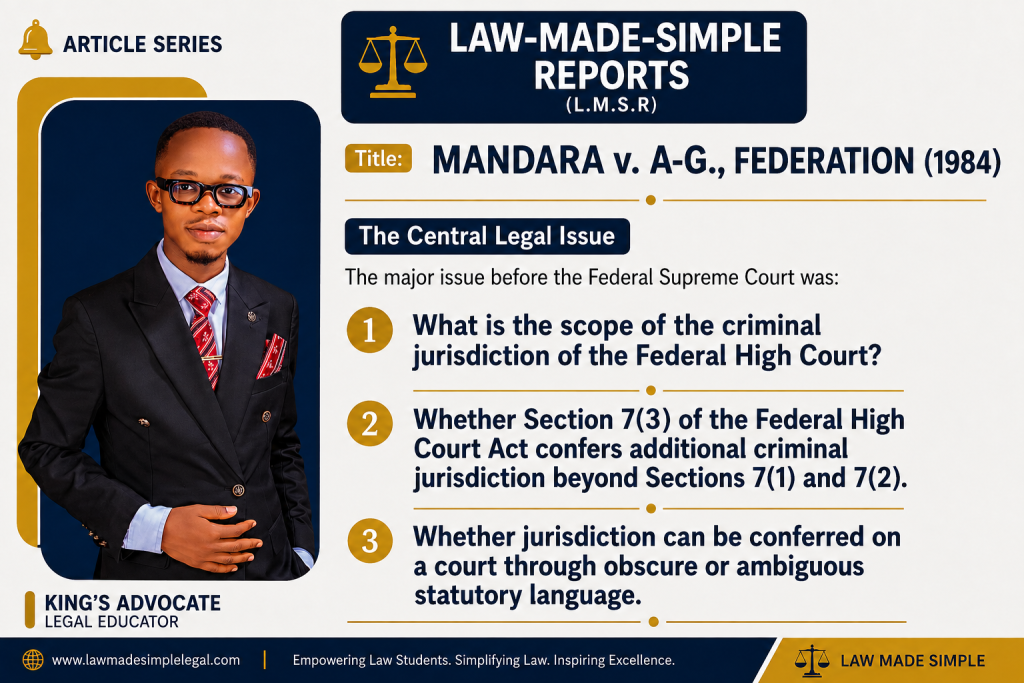
Mandara v. A-G., Federation (1984) is one of the leading Nigerian authorities on the criminal jurisdiction of the Federal High Court and the principles governing statutory interpretation. In this landmark decision, the Supreme Court clarified that the Federal High Court does not possess unlimited jurisdiction over all federal criminal offences and emphasized that jurisdiction must be expressly conferred by law. This case summary examines the facts, issues, decision, ratio decidendi, legal principles, practical significance, and examination relevance of Mandara v. A-G., Federation, making it an essential resource for Nigerian law students, legal practitioners, and anyone studying Constitutional Law and Criminal Procedure.
Case Information
Case: Mandara v. Attorney-General of the Federation
Suit No.: SC.152/1983
Court: Supreme Court of Nigeria
Date Decided: 6 April 1984
Coram:
- Sowemimo, CJN
- Irikefe, JSC
- Bello, JSC
- Obaseki, JSC
- Eso, JSC
- Aniagolu, JSC
- Uwais, JSC
Area of Law
- Constitutional Law
- Criminal Procedure
- Jurisdiction
- Statutory Interpretation
Facts of the Case
The appellant, Alhaji Zanner Bukar Umoru Mandara, was charged before the Federal High Court on four counts bordering on treasonable felony, incitement to mutiny, and attempting to cause disaffection among members of the Armed Forces.
After trial, the Federal High Court convicted the appellant and sentenced him to fifteen (15) years’ imprisonment.
Dissatisfied with the conviction, the appellant appealed to the Court of Appeal, arguing that the Federal High Court lacked jurisdiction to try the offences. The Court of Appeal dismissed the appeal and affirmed the conviction.
The appellant further appealed to the Supreme Court, maintaining that the Federal High Court had no jurisdiction over the offences charged.
Issues for Determination
The Supreme Court considered the following issues:
1. What is the scope of the criminal jurisdiction of the Federal High Court?
2.What principle should guide a court when interpreting words capable of more than one meaning in a statute?
3.Whether jurisdiction can be conferred on a court through obscure or ambiguous statutory language.
Decision of the Supreme Court
The Supreme Court allowed the appeal.
The Court held that the Federal High Court lacked jurisdiction to try offences of treasonable felony, incitement to mutiny and related offences because those offences did not arise from matters over which the Federal High Court had civil jurisdiction under Section 7 of the Federal High Court Act.
Accordingly, the proceedings and conviction were declared a nullity.
Ratio Decidendi
The criminal jurisdiction of the Federal High Court is limited to criminal offences arising from matters over which it has civil jurisdiction under Section 7(1) of the Federal High Court Act.
Section 7(3) does not create an independent or unlimited criminal jurisdiction. It merely explains and complements Section 7(2). Therefore, offences unrelated to matters contained in Section 7(1) cannot be tried by the Federal High Court.
Reasoning of the Court
The Supreme Court emphasized that statutes must be interpreted in a manner that gives effect to the intention of the legislature.
The Court noted that the word “include” in Section 7(3) is capable of different meanings. Rather than adopting an interpretation that would unnecessarily enlarge the jurisdiction of the Federal High Court, the Court preferred an interpretation that promoted the purpose of the legislation.
The Court further held that if Section 7(3) were interpreted as conferring jurisdiction over every federal offence under the Criminal Code, the Federal High Court would become flooded with criminal cases beyond the purpose for which it was established.
Most importantly, the Court stated that jurisdiction cannot be inferred from doubtful or uncertain language. Where the legislature intends to confer jurisdiction upon a court, it must do so in clear and unmistakable terms.
Why This Case Matters
Mandara v. A-G., Federation remains one of the leading Nigerian authorities on the jurisdiction of the Federal High Court.
The case establishes that:
The Federal High Court is a court of limited jurisdiction.
Jurisdiction must be expressly conferred by law.
Courts should interpret statutes to give effect to legislative intention.
Ambiguous provisions should never be interpreted in a manner that creates jurisdiction by implication.
Practical Illustration
Assume the National Assembly establishes a special court to hear tax disputes.
A person is later charged before that court for armed robbery simply because the Federal Government is prosecuting the case.
Although the Federal Government is involved, the special tax court would have no jurisdiction unless the law expressly gives it power to hear armed robbery cases.
This is the principle illustrated in Mandara v. A-G., Federation.
Exam Focus
Students should remember this case for the following principles:
Go those who are students should remember this case for the following principles:-
Jurisdiction of the Federal High Court.- Interpretation of Section 7 of the Federal High Court Act.
To better appreciate this, let’s comprehend What Jurisdiction entails?
Jurisdiction is the legal power or authority of a court to hear, determine and adjudicate upon a particular matter. It is not enough that a matter has been brought before a court; the court must have lawful authority to entertain it.
This distinction is fundamental because a court may have the physical ability to hear a case but lack the legal jurisdiction to determine it.The importance of jurisdiction is that it goes to the very foundation of judicial proceedings.
Where a court lacks jurisdiction, its proceedings are fundamentally defective, irrespective of how well the case may have been conducted.
Why is Jurisdiction So Important?
Jurisdiction is one of the first questions that must be considered in litigation.
Before asking:Who is right?
or
Who has the better evidence?the court must first ask:Do I have jurisdiction to hear this matter?
If the answer is no, the court cannot properly proceed to determine the merits.
This is the significance of the principle illustrated by Mandara v. A-G., Federation.
The Locus Classicus: Madukolu v. Nkemdilim
This is One of the most important Nigerian authorities on jurisdiction.The Supreme Court established the classic conditions that must exist before a court can validly exercise jurisdiction.A court is properly constituted as to its members and qualifications;
the subject matter of the case is within its jurisdiction;
there is no feature in the case which prevents the court from exercising its jurisdiction; andthe case comes before the court initiated by due process of law and upon fulfilment of any condition precedent to the exercise of jurisdiction.
This case is a locus classicus on jurisdiction and should be remembered by every Nigerian law student.
Jurisdiction Cannot Be Assumed
A court cannot simply assume that it has jurisdiction because a case has been filed before it.Jurisdiction must be derived from a valid legal source, such as:
the Constitution;an Act of the National Assembly;a State law;or another valid law conferring jurisdiction.This is particularly important in Mandara v. A-G., Federation.
The Supreme Court rejected an interpretation of Section 7(3) of the Federal High Court Act which would have effectively given the Federal High Court jurisdiction over every federal offence under the Criminal Code.
The Court reasoned that such an extensive jurisdiction could not be created through an uncertain interpretation of the statute.
Jurisdiction Must Be Clearly Conferred
A major lesson from Mandara v. A-G., Federation is that jurisdiction is not conferred in obscurity.Where the legislature intends to give a court jurisdiction over a particular class of cases, the language used must sufficiently establish that intention.
Therefore, counsel should never simply argue:
“This is a federal offence, therefore the Federal High Court has jurisdiction.”
The correct question is:What specific constitutional or statutory provision gives the Federal High Court jurisdiction over this particular offence or subject matter?That question is extremely important in examinations.
Subject-Matter Jurisdiction
One major form of jurisdiction is subject-matter jurisdiction.This concerns whether the particular type of dispute or offence falls within the matters that the court is legally empowered to determine.For example, the Federal High Court has jurisdiction over matters specifically assigned to it by the Constitution and relevant legislation.
The fact that a matter is important, complicated, or involves the Federal Government does not automatically confer jurisdiction on the Federal High Court.This was central to Mandara v. A-G., Federation.
Territorial Jurisdiction
Territorial jurisdiction concerns the geographical area within which a court can exercise its authority.
A court may have jurisdiction over a particular type of case but still encounter questions concerning the territory in which that jurisdiction may properly be exercised.Personal JurisdictionThis concerns the authority of a court over the parties before it.
The court must have lawful authority to exercise judicial power over the relevant parties in accordance with the applicable procedural and substantive law.
Original and Appellate Jurisdiction
Another important distinction is between original jurisdiction and appellate jurisdiction.Original jurisdiction is the power of a court to hear a matter at first instance.Appellate jurisdiction is the power to review a decision previously made by a lower court.
For examination purposes, students should avoid confusing the two.For example, where the Supreme Court is exercising appellate jurisdiction, it is ordinarily reviewing a decision from a lower court rather than conducting the original trial of the dispute.
Jurisdiction and the Merits of a CaseThis is another important examination point.Jurisdiction is different from the merits of the case.A court may believe that one party has an extremely strong case, but if the court lacks jurisdiction, it cannot properly determine that case.
Therefore:Jurisdiction comes before the merits.This explains why jurisdictional objections can determine an entire case without the court having to decide who was substantively right or wrong.
Effect of Lack of Jurisdiction
Where a court lacks jurisdiction, the proceedings are fundamentally defective.The classic Nigerian authorities repeatedly emphasize that jurisdiction is foundational.This is why students should remember the famous principle associated with Madukolu v. Nkemdilim: where a court lacks jurisdiction, its proceedings cannot validly stand.
Jurisdiction and Statutory Interpretation in MandaraMandara v. A-G., Federation adds another important dimension.Sometimes the difficulty is not simply identifying whether a court has jurisdiction.
The difficulty is interpreting the legislation that confers jurisdiction.That was precisely the problem before the Supreme Court.The Court had to determine the proper meaning and relationship of Sections 7(1), 7(2), and 7(3) of the Federal High Court Act.The Court rejected an interpretation that would produce an unnecessarily broad jurisdiction and instead adopted an interpretation that better reflected the legislative intention.This illustrates an important principle of statutory interpretation:
A court should prefer an interpretation that gives effect to the purpose of legislation rather than one that produces absurdity or defeats the legislative intention.
Jurisdiction Cannot Be Conferred by Consent.
Another important principle students should know is that parties cannot confer jurisdiction on a court by agreement or consent where the law has not granted that jurisdiction.
In other words, even if both parties agree that a particular court should hear their case, their agreement cannot create jurisdiction where none exists in law.
Jurisdiction is a matter of law, not merely a matter of agreement between litigants.Jurisdiction Can Be Raised at Any Stage
Because jurisdiction goes to the foundation of proceedings, an objection to jurisdiction may be raised even after proceedings have commenced.Where the issue is properly raised, the court must determine whether it possesses jurisdiction before proceeding to determine the substantive dispute.This makes jurisdiction one of the first things counsel should investigate when preparing a case.
Common Mistakes Students Make
Many students incorrectly assume that the Federal High Court has jurisdiction over every offence prosecuted by the Attorney-General of the Federation.
Another common mistake is reading Section 7(3) independently without considering Sections 7(1) and 7(2).
Students also confuse the authority to prosecute with the jurisdiction of the court.
Related Case
Relevant Statutory Provision
Section 7(1), (2) and (3) of the Federal High Court Act 1973.
Frequently Asked Questions (FAQs)
What principle did the Supreme Court establish in Mandara v. A-G., Federation?
The Supreme Court held that the Federal High Court only has criminal jurisdiction over offences connected with matters within its civil jurisdiction.
Why is Mandara v. A-G., Federation important?
It is a leading authority on the jurisdiction of the Federal High Court and statutory interpretation in Nigeria.
Can jurisdiction be implied?
No. Jurisdiction must be expressly conferred by the Constitution or an Act of the National Assembly.
Key Takeaways
- The Federal High Court has limited jurisdiction.
- Section 7(3) does not expand the Court’s jurisdiction beyond Section 7(2).
- Jurisdiction must always be expressly conferred.
- Courts should adopt interpretations that promote the purpose of legislation and avoid absurdity.
Possible Examination Questions
1.Discuss the decision in Mandara v. A-G., Federation and explain its significance to the jurisdiction of the Federal High Court.
2.”Jurisdiction cannot be conferred in obscurity.” Discuss with reference to Mandara v. A-G., Federation
HERE ARE FURTHER RECOMMENDED CASES:
Madukolu v Nkemdilim (1962)(Full summary)
A.G of the Federation v. A.G of Imo State (1982) FULL SUMMARY
A.G-OF BENDEL STATE v. A.G-FEDERATION & 18 Ors(1983) FULL SUMMARY
A-G OGUN STATE v. ABERUAGBA & ORS (1985) FULL ANALYSIS
BRONIK MOTORS LTD. v. WEMA BANK LTD. (1983) Full Case Summary
ABOUT THE PUBLISHER
LAW-MADE-SIMPLE is a growing African academic resource network and a centre for academic growth, dedicated to making complex academic and legal knowledge easier to understand, access and apply.
Founded and published by Kingsley Omenyi, popularly known as KING’S ADVOCATE, the platform provides simplified case analysis, legal principles, statutes, academic resources and student-focused learning materials for learners across Nigeria, Africa and the wider Common Law community.
Through LAW-MADE-SIMPLE, Kingsley Omenyi seeks to bridge the gap between complex legal materials and practical understanding by presenting Nigerian and African legal materials in a clear, accessible and academically useful manner, while connecting them with broader principles of the Common Law tradition.As a finalist law student, legal educator and digital content creator, Kingsley Omenyi has a strong interest in legal education, legal research, advocacy and the use of technology to make academic knowledge more accessible.
LAW-MADE-SIMPLE is being developed as a central digital resource for teachers ,students,learners and every legal person seeking reliable, simplified and practical academic materials, with Nigerian law legal education at its core and a growing focus on African legal education and the wider Common Law tradition.
PUBLISHED BY:
KINGSLEY OMENYI -KING’S ADVOCATE
Founder & Publisher, King’s Advocate Network.
Making Law-Made-Simple
Contact the Publisher: Contact Kingsley Omenyi