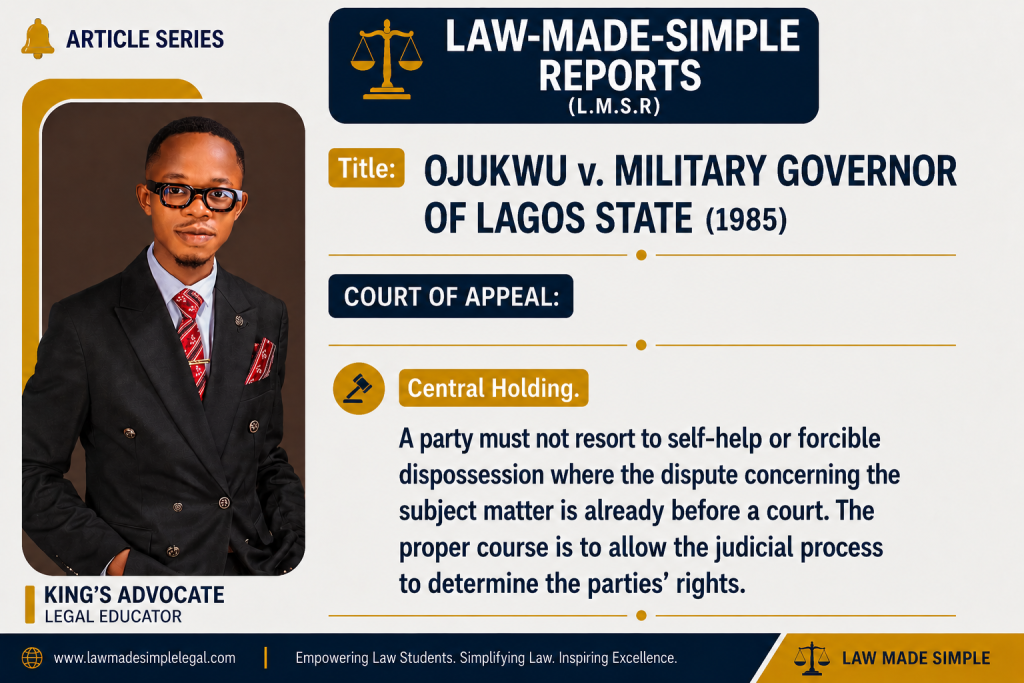
CONSTITUTIONAL LAW — RULE OF LAW — SELF-HELP — FORCIBLE EJECTMENT — INTERLOCUTORY INJUNCTION — SEPARATION OF POWERS — POSSESSION — ABANDONED PROPERTY — LEAVE TO APPEAL
WHEN THE GOVERNMENT USES FORCE WHILE THE MATTER IS ALREADY IN COURT
Imagine this:
You are in possession of a property. You believe you have a legal right to remain there. The Government says otherwise and gives you notice to leave.
You refuse.
So you go to court.
The court is now seized of the dispute.
But before the court can finally determine who is right, the Government uses force and removes you from the property.
Can a party do that?
Can a person who believes he has a better legal right simply take the law into his own hands because the court has not yet decided the case?
And what happens when the party using that force is the Government itself?
These were some of the difficult questions confronting the Court of Appeal, Lagos Division, in Ojukwu v. Military Governor of Lagos State & Ors (1985).
The case became a powerful Nigerian authority on self-help and the rule of law.
Its message was clear:
Once a dispute has been placed before the court, parties must allow the court to determine it. They cannot use force to determine the dispute for themselves.
CASE DETAILS
Case: Chief Emeka Odumegwu Ojukwu v. Military Governor of Lagos State & Ors
Court: Court of Appeal, Lagos Division
Suit No.: CA/L/195/85
Date: Wednesday, 13 November 1985
Lead Judgment: Philip Nnaemeka-Agu, J.C.A.
Panel
- Philip Nnaemeka-Agu, J.C.A. — Presided and delivered the lead judgment
- Uthman Mohammed, J.C.A.
- Idris Legbo Kutigi, J.C.A.
PARTIES
Applicant/Appellant:
Chief Emeka Odumegwu Ojukwu
Respondents:
- Military Governor of Lagos State
- Commissioner of Police, Lagos State
- Attorney-General of Lagos State
Party Interested: Ojukwu Transport Limited
THE PROPERTY AT THE CENTRE OF THE DISPUTE
The dispute concerned No. 29 Queen’s Drive, Ikoyi, Lagos.
The Court accepted that the property belonged to Ojukwu Transport Limited, the Party Interested.
The respondents, however, regarded the property as abandoned property, the management of which was vested in the Lagos State Abandoned Property Committee.
The actual letting of the property was being handled by estate agents.
Chief Emeka Odumegwu Ojukwu moved into the property with his family on 16 November 1984.
He remained in peaceful occupation for several months.
THE GOVERNMENT’S EVICTION THREAT
On 12 August 1985, the Lagos State Government wrote to Ojukwu requiring him to vacate the property by 28 August 1985, failing which he would be ejected.
Ojukwu did not leave.
Then, on 4 September 1985, the Commissioner of Police, Lagos State, informed him that he was required to hand over the keys to Government agents by 11 September 1985, failing which he would be ejected by force.
Ojukwu did not surrender possession.
Instead, he went to court.
OJUKWU GOES TO COURT
On 5 September 1985, Ojukwu commenced proceedings at the Lagos State High Court.
He sought, among other reliefs:
- a declaration that the Government’s proposed eviction was unlawful, illegal and ultra vires;
- an injunction restraining the Government and its agents from ejecting him and his family from the property.
On an ex-parte application, the High Court granted an interim injunction restraining the respondents from ejecting Ojukwu and his family pending further proceedings.
However, after hearing arguments on the substantive application for interlocutory injunction, the High Court refused the interlocutory injunction and discharged the earlier interim order.
The High Court’s reasoning included the view that Ojukwu had failed to establish a sufficient legal right requiring protection by interlocutory injunction and that the property was abandoned property vested in the relevant Committee.
HE GOVERNMENT THEN FORCIBLY EJECTED OJUKWU
Following the High Court’s ruling, the respondents forcibly removed Ojukwu from No. 29 Queen’s Drive.
But there was still an important problem.
The dispute had not finally ended.
Ojukwu had appealed.
His challenge to the Government’s right to eject him was still before the judicial system.
This raised the central question that would dominate the Court of Appeal’s reasoning:
Could the Government use force to determine the question of possession while that question was still before the courts?
THE APPLICATION BEFORE THE COURT OF APPEAL
Ojukwu and Ojukwu Transport Limited approached the Court of Appeal for important reliefs.
Ojukwu sought an order restoring him to possession of No. 29 Queen’s Drive pending the determination of his appeal.
Ojukwu Transport Limited, as the owner of the property, sought leave to appeal against the High Court’s decision as a party interested.
ISSUES BEFORE THE COURT
The application raised several important legal questions, including:
- Whether Ojukwu Transport Limited had sufficient interest in the proceedings to obtain leave to appeal.
- Whether the Government could forcibly dispossess Ojukwu while the dispute concerning the property was pending before the courts.
- Whether a party could resort to self-help instead of waiting for the court to determine the dispute.
- Whether the Court of Appeal could order the reinstatement of Ojukwu into possession pending the determination of the appeal.
- Whether the principles governing interlocutory injunction permitted the court to restore the applicant to the position he occupied before the forcible eviction.
- Whether the conduct of the Government amounted to an interference with the judicial process and the constitutional role of the courts.
THE COURT’S APPROACH TO SELF-HELP
The most important aspect of the decision was the Court’s rejection of self-help.
The respondents argued, in substance, that Ojukwu was a trespasser and that they were therefore entitled to use reasonable force to remove him.
The Court did not accept that approach.
Nnaemeka-Agu J.C.A. examined the legal history and principles surrounding forcible dispossession and reached an important conclusion concerning the effect of bringing a dispute before the court.
Once the dispute had been submitted to the court, the parties were expected to allow the judicial process to determine their respective rights.
The court, not force, was to determine the dispute.
LAW-MADE-SIMPLE: WHAT IS SELF-HELP?
Self-help in this context means taking the law into one’s own hands instead of using the lawful judicial process available for resolving the dispute.
For example, where two parties are disputing possession of land and the matter is before a court, one party cannot simply use force to remove the other merely because he believes that he has the better right.
The proper course is to obtain and enforce the appropriate court order.
In simple terms:
If the matter is already before the court, don’t turn the dispute into a contest of physical power.
Let the court decide.
SEPARATION OF POWERS
The case also has constitutional significance.
The Court was dealing with conduct by the State Government which had the potential to interfere with the judicial determination of a matter pending before the courts.
This brings the case within the broader principle of separation of powers.
The Executive has powers assigned to it by law, while the Judiciary has the responsibility of determining disputes according to law.
The Executive cannot assume the role of the Judiciary by using force to determine a question that has already been placed before the courts.
The Government cannot become both a party to a dispute and the institution that determines the dispute.
University of Lagos v Olaniyan (1985) Explained
INTERLOCUTORY INJUNCTION AND RESTORATION OF POSSESSION
Another important procedural issue was whether the Court could order the applicant’s reinstatement into possession.
The respondents argued against restoration, while Ojukwu contended that he had been forcibly removed after he had already approached the court challenging the Government’s right to eject him.
The Court considered the circumstances in which interlocutory relief may be granted and the need to preserve the subject matter of litigation pending the determination of the substantive dispute.
The important point is that an interlocutory order is not necessarily about finally deciding who owns the property.
Its purpose may be to preserve the relevant position and prevent one party from using the situation on the ground to defeat the effectiveness of the judicial process.
THE DECISION OF THE COURT OF APPEAL
The Court of Appeal granted the application.
It granted Ojukwu Transport Limited leave to appeal against the decision of the Lagos State High Court.
More importantly, the Court ordered the reinstatement of Chief Emeka Odumegwu Ojukwu into No. 29 Queen’s Drive, Ikoyi, pending the determination of the appeal.
The respondents and their officers, servants, agents and functionaries were restrained from evicting him or taking steps to evict him pending the determination of the appeal.
The Court’s approach was based on the need to prevent the use of force from defeating the judicial process.
THE CORE PRINCIPLE
The central lesson from Ojukwu v. Military Governor of Lagos State is:
A party must not resort to self-help or forcible dispossession where the dispute concerning the subject matter is already before a court. The proper course is to allow the judicial process to determine the parties’ rights.
WHY THIS CASE IS IMPORTANT
1. Constitutional Law
The case illustrates the rule of law and the need for governmental power to operate within legal limits.
2. Separation of Powers
It demonstrates that the Executive should not interfere with the judicial determination of disputes by taking matters into its own hands.
3. Land Law
The case is important for the law relating to possession, forcible ejectment and the limits of self-help in disputes concerning land.
4. Civil Procedure
It is relevant to interlocutory injunctions, preservation of the subject matter of litigation and restoration of possession pending an appeal.
5. Legal System and Rule of Law
The case demonstrates the importance of courts as institutions for resolving disputes peacefully and according to established legal rules.
6. Legal Method
For first-year students, the case provides an excellent practical example of how law operates to restrain arbitrary exercise of power.
It can be used when discussing:
- the functions of law;
- the importance of law;
- the rule of law;
- generality of law;
- the role of courts;
- the relationship between law and power; and
- the need for peaceful dispute resolution through legal institutions.
EXAM FOCUS
If a problem question presents a situation where a person or government authority forcibly removes someone from property while litigation concerning that property is pending, think immediately of:
Ojukwu v. Military Governor of Lagos State (1985).
The case can support the proposition that self-help is not permissible as a substitute for judicial determination where the dispute has already been submitted to the court.
A strong examination answer should go beyond simply stating that “self-help is not allowed.” Explain why.
The reason is that allowing parties to determine disputes by force would undermine the authority of the courts and replace the rule of law with the rule of force.
IMPORTANT DISTINCTION FROM THE SUPREME COURT DECISION
This decision should not be confused with the subsequent Supreme Court proceedings.
The Court of Appeal decision of 13 November 1985 dealt principally with the application for reinstatement, the application by Ojukwu Transport Limited for leave to appeal, and the Government’s resort to self-help.
The Lagos State Government subsequently challenged the Court of Appeal’s decision before the Supreme Court of Nigeria.
That later proceeding produced the famous Supreme Court decision in Military Governor of Lagos State & Ors v. Ojukwu & Anor (1986).
The Supreme Court ultimately dismissed the Government’s application for a stay of execution and strongly condemned the continued disobedience of the Court of Appeal’s order. 1
Therefore, the two decisions should be studied together but reported separately.
THE CASE IN ONE SENTENCE
Once a dispute has been submitted to the court, a party cannot use force to determine the dispute for itself; the rule of law requires the parties to submit to the judicial process.
CASE SUMMARY AT A GLANCE
| Element | Summary |
|---|---|
| Case | Ojukwu v. Military Governor of Lagos State & Ors |
| Court | Court of Appeal, Lagos Division |
| Date | 13 November 1985 |
| Suit No. | CA/L/195/85 |
| Lead Judge | Nnaemeka-Agu, J.C.A. |
| Property | No. 29 Queen’s Drive, Ikoyi, Lagos |
| Main Issue | Whether the Government could resort to self-help and forcibly dispossess Ojukwu while the dispute was before the courts. |
| Decision | Ojukwu was ordered to be reinstated pending determination of the appeal; Ojukwu Transport Limited was granted leave to appeal. |
| Core Principle | Self-help is deprecated where a dispute has been submitted to the court; parties must allow the judicial process to determine their rights. |
LAW-MADE-SIMPLE FINAL LESSON
The real lesson of this case is bigger than one house in Ikoyi.
It is about what happens when legal power meets physical power.
The Government may have the machinery to enforce its will. But the existence of physical power does not automatically create legal authority.
Once the dispute entered the courtroom, the parties were expected to respect the judicial process.
The court must decide the dispute—not the strongest party.
That is the essence of the rule of law demonstrated by Ojukwu v. Military Governor of Lagos State (1985).
And that is precisely why this case remains an important authority for students studying Legal Method, Legal System, Constitutional Law, Land Law and Civil Procedure.
LAW-MADE-SIMPLE
Making complex legal principles easier to understand, remember and apply.
Published by KING’S ADVOCATE
Contact the Publisher: Contact Kingsley Omenyi