What exactly must a litigant place before an appellate court when asking for an extension of time to appeal? Can a court validly exercise its discretion to extend time merely by looking at proposed grounds of appeal and an affidavit explaining delay, without seeing the actual judgment or ruling being challenged?
These questions formed the constitutional and procedural backbone of the landmark Supreme Court decision in University of Lagos v. Olaniyan (1985) a case that remains one of Nigeria’s leading authorities on appellate procedure, judicial discretion, and the interpretation of procedural rules governing applications for extension of time.
The decision is particularly important because it clarified a recurring practical issue in Nigerian litigation: whether courts should adopt a purely literal interpretation of procedural rules or whether they must insist on all materials necessary to properly exercise judicial discretion.
At the heart of the dispute was the interpretation of Order 3 Rule 4(2) of the Court of Appeal Rules 1981, which required that applications for extension of time to appeal be supported by:
an affidavit showing good and substantial reasons for delay; and
grounds of appeal which prima facie show good cause why the appeal should be heard.
The controversy arose because the respondents failed to attach the ruling they intended to appeal against. Yet, the Court of Appeal still granted them extension of time.
Dissatisfied, the appellants approached the Supreme Court, arguing that no appellate court could properly determine whether proposed grounds of appeal disclosed “good cause” without first examining the decision being challenged.
The Supreme Court agreed and in doing so delivered one of the most authoritative pronouncements on the materials required in applications seeking enlargement of time within Nigerian appellate practice.
Full Facts of the Case UNIVERSITY OF LAGOS v. OLANIYAN (1985).
The respondents had initially obtained judgment in the High Court against the appellants, including the University of Lagos and other parties.Following the judgment, the appellants filed an application seeking a stay of execution pending appeal.
The High Court granted the stay application on 22 February 1982.
The respondents became dissatisfied with that interlocutory ruling and instructed their counsel, Chief G.O.K. Ajayi, SAN, to file an appeal against it.According to the affidavit filed before the Court of Appeal:
counsel prepared the notice and grounds of appeal within time;
instructions were allegedly given for immediate filing;
however, due to an administrative omission, the notice was never filed within the prescribed period.
Upon discovering the omission, the respondents brought an application before the Court of Appeal seeking extension of time within which to appeal.
The application was brought under Order 3 Rule 4(2) of the Court of Appeal Rules 1981.
However, a critical procedural issue arose.Although the respondents attached:an affidavit explaining the delay; andproposed grounds of appeal,they failed to attach the ruling of the High Court which they sought to challenge.
The appellants strongly opposed the application, arguing that the Court of Appeal could not determine whether the proposed grounds disclosed “good cause” without examining the actual ruling appealed against.
Despite the objection, the Court of Appeal granted the extension of time.The appellants thereafter appealed to the Supreme Court.
Issues Before the Supreme Court in University Of Lagos V. Olaniyan (1985)
The central issue before the Supreme Court was:
Whether the Court of Appeal could properly exercise its discretion to grant extension of time to appeal without seeing the judgment, order, or ruling sought to be appealed against.
Another related issue was:
Whether the Court of Appeal was right in refusing to follow the earlier Supreme Court authority in Ibodo v. Enarofia (1980) 5–7 SC 42.
Arguments of Counsel:Appellants’ Argument
Learned Senior Advocate, Chief F.R.A. Williams, SAN, argued that:the Court of Appeal wrongly interpreted Order 3 Rule 4(2);i
t was impossible to determine whether proposed grounds of appeal disclosed “good cause” without examining the ruling appealed against;
the Court of Appeal was bound by the Supreme Court’s earlier decision in Ibodo v. Enarofia;procedural rules merely prescribe minimum requirements and not exhaustive requirements;judicial discretion must be exercised on sufficient materials.
He submitted that failure to attach the ruling deprived the appellate court of the necessary basis for proper judicial evaluation.
Respondents’ Argument
Chief G.O.K. Ajayi, SAN, argued for the respondents that:the wording of Order 3 Rule 4(2) was clear and unambiguous;the Rule only required:
an affidavit explaining delay; andgrounds of appeal showing prima facie good cause;nowhere did the Rule expressly require attachment of the judgment or ruling appealed against;
the Court of Appeal therefore acted correctly in granting the application.
He further argued that the Supreme Court decision in Ibodo v. Enarofia was wrongly decided to the extent that it imported additional requirements not expressly stated in the Rule.
Decision of the Supreme Court in University Of Lagos V. Olaniyan (1985)
The Supreme Court allowed the appeal.The Court held that the Court of Appeal was wrong to grant extension of time without first seeing the ruling sought to be appealed against.
The Supreme Court emphasized that judicial discretion cannot be properly exercised in a vacuum.
The Court held that although Order 3 Rule 4(2) did not expressly state that the ruling appealed against must be attached, such attachment was necessarily implied because the court could not intelligently determine whether the proposed grounds disclosed “good cause” without examining the decision complained of.
The Court further held that the Court of Appeal erred in refusing to follow Ibodo v. Enarofia, since the provisions interpreted in that case were substantially identical to those under consideration.
Ratio Decidendi University Of Lagos V. Olaniyan (1985)
The Supreme Court established that:
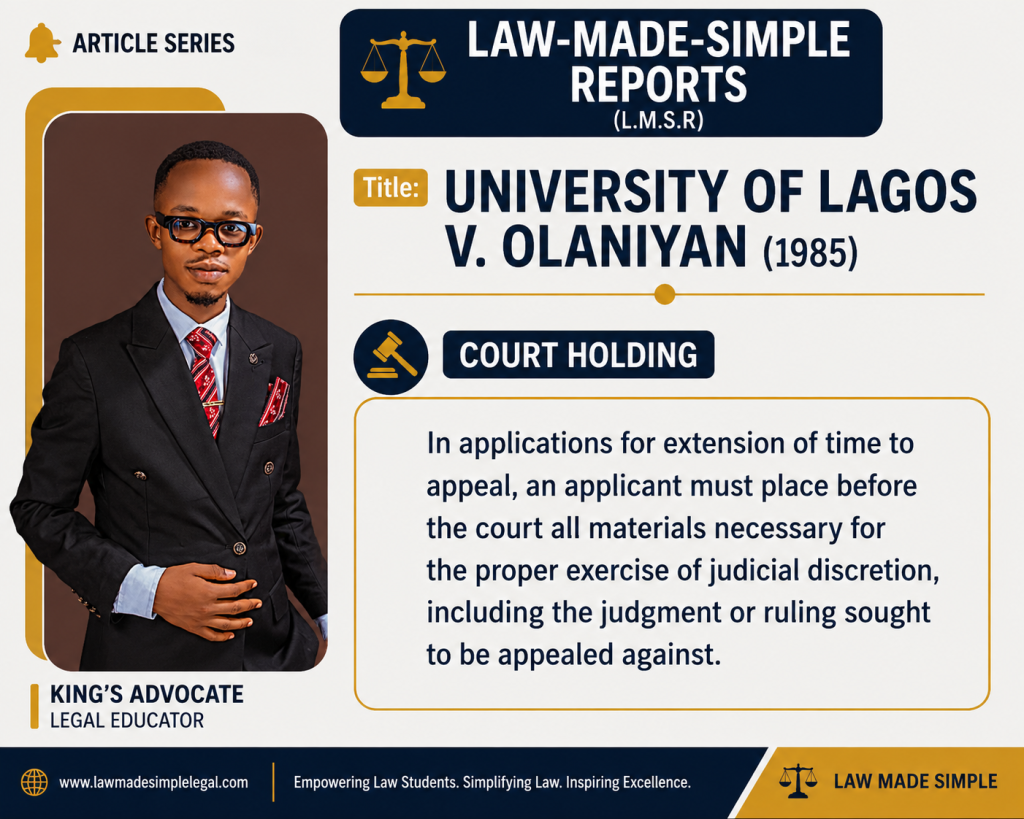
In applications for extension of time to appeal, an applicant must place before the court all materials necessary for the proper exercise of judicial discretion, including the judgment or ruling sought to be appealed against.
The Court made it clear that proposed grounds of appeal cannot be evaluated in isolation from the judgment being challenged.
Notable Dicta
“Whether this has been done must be seen against the background of the facts of the case in respect of which the grounds have been filed.”
“All the documents which it will be necessary for the court to see in order to decide on the application must be exhibited.”
“The judgment of the High Court was not exhibited by the applicants. It cannot be over-emphasised that where an applicant requires the court to exercise its discretion for a grant of extension of time within which to appeal… all the documents necessary for the court to see must be exhibited.”
Supreme Court’s Reasoning
The Supreme Court rejected the narrow literal interpretation adopted by the Court of Appeal. According to the Court, procedural rules governing applications for extension of time must be interpreted in a manner that enables courts to properly perform judicial functions.
The Court reasoned that:discretion must be exercised judicially and judiciously;
judicial discretion requires adequate materials;without seeing the ruling appealed against, the court could not meaningfully assess whether the grounds disclosed arguable issues.
The Court therefore reaffirmed the principle from Ibodo v. Enarofia that all relevant documents necessary for determination of such applications must accompany the motion.
Legal Principle Established in University Of Lagos V. Olaniyan (1985)
A court cannot properly exercise discretion to extend time for appeal unless all relevant materials especially the judgment or ruling appealed against are placed before it.
IFEZUE V. MBADUGHA & ANOR (1984) FULL SUMMARY
Golok v Diyalpwan (1990) Case Summary – Customary Law & Right of Appeal Explained