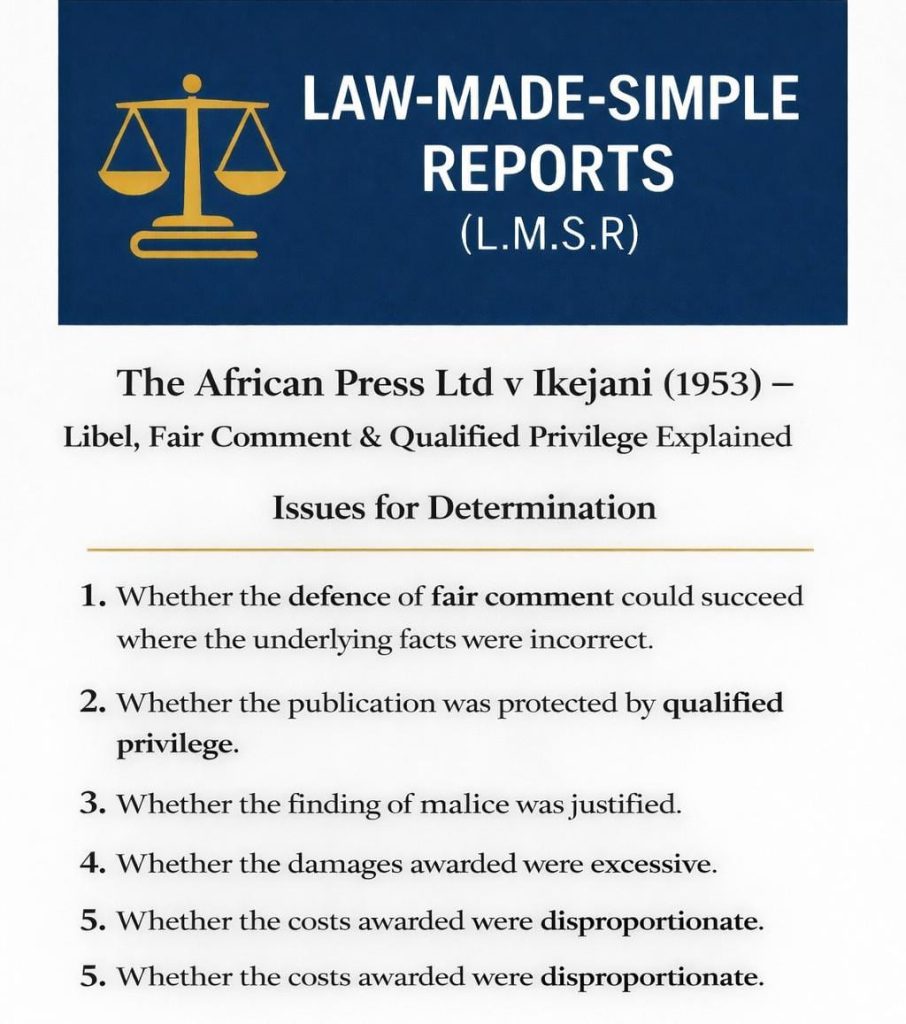
Facts of the Case of The African Press Ltd v Ikejani (1953)
The respondent, a medical practitioner, sued the appellants in libel over a newspaper publication titled “The Fraudulent Saints of Africa.”The article alleged, among other things, that:
The respondent claimed to have a doctorate in medicine which was “fake.”He was a “quack expert.”He was a “fraudulent nationalist” and had enriched himself at the expense of the public.
He was among “dishonest followers” of a political figure.
IN REALITY:
The respondent held a valid medical degree (M.D.) from the University of Toronto.
However, he had falsely claimed to possess a Doctor of Science degree, which led to his resignation from an academic appointment.
The trial court held the publication to be a gross libel and awarded damages and costs to the respondent.The defendants appealed.
Issues for Determination
1.Whether the defence of fair comment could succeed where the underlying facts were incorrect.
2.Whether the publication was protected by qualified privilege.
3.Whether the finding of malice was justified.
4.Whether the damages awarded were excessive.
5.Whether the costs awarded were disproportionate.
Arguments of the Appellants in The African Press Ltd v Ikejani (1953)
The article was justified as fair comment based on the respondent’s false claim to a doctorate in science.
The publication was made in the public interest to expose dishonesty.
The damages awarded were excessive.The costs were unreasonably high.
Decision of the Court The African Press Ltd v Ikejani (1953)
The West African Court of Appeal dismissed the appeal on liability but varied the costs awarded.
Held
1. Fair Comment Fails Where Facts Are False
The defence of fair comment failed because:The article was based on the false allegation that the respondent’s medical degree was fake.Since the foundational fact was untrue, any comment built on it could not be fair.
2. Qualified Privilege Defeated by Malice.
Although there may have been a public interest in exposing professional dishonesty, the Court held:
The language used (“quack,” “fraudulent,” “dishonest”) was reckless and violent.The publication showed lack of honest purpose.Therefore, malice was established, defeating qualified privilege.
3.Damages Upheld
The Court refused to interfere with the damages because:The trial judge applied correct principles.The award was not so excessive as to show a wrong estimate of injury.Libel affecting professional reputation justified substantial damages.
Costs Reduced
The Court held:The costs awarded at trial were excessive and disproportionate.There should be uniformity in awarding legal costs in similar cases.Costs were reduced to promote consistency in judicial practice.
Legal Principles Established
1.Fair comment must be based on true facts – false foundations invalidate the defence.
2.Qualified privilege is defeated by malice.Words imputing professional dishonesty are highly defamatory.
3.Appellate courts are reluctant to interfere with damages unless wrongly assessed.
Costs in civil litigation should be reasonable and consistent with similar cases.
Ratio Decidendi The African Press Ltd v Ikejani (1953)
A defamatory publication cannot rely on fair comment where the underlying facts are untrue, and qualified privilege will be destroyed where malice shown through reckless and abusive language is established.
Key Authorities Cited The African Press Ltd v Ikejani (1953)
Mangena v Wright (1939) 2 KB 988
Hobbs v Tinling (1929) 2 KB 17Scott v Sampson (1882) 8 QBD 491
Nkoku v Zik’s Press Ltd
Obaseki v Osagie (WACA, 1953)
AFRICAN PRESS LTD V. THE QUEEN (1952) WACA 57–Sedition in Nigerian Law
R v Zik’s Press Ltd (1947) Attorney-General Consent & Sedition Law Explained
YOU CAN also SEARCH FOR MORE SIMPLIFIED CASE USING THE WEBSITE SEARCH BAR ABOVE or downwards.