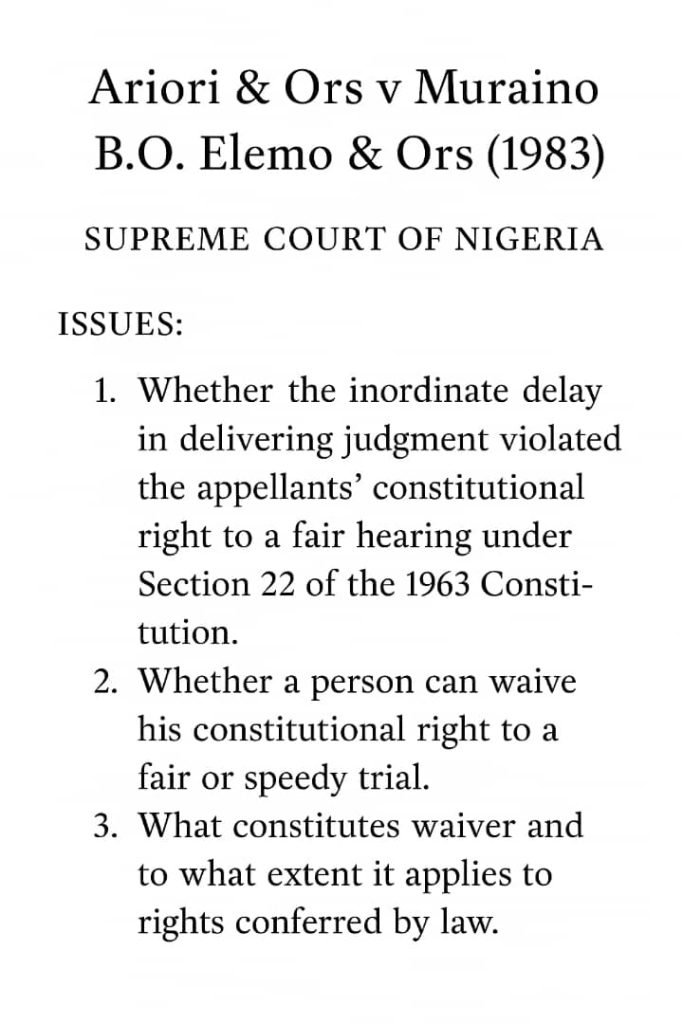
The landmark case of Ariori and Others v. Muraino B.O. Elemo and Others (SC 80/1981), decided by the Supreme Court of Nigeria, stands as one of the most important decisions on the constitutional right to a fair and speedy trial, the concept of waiver of fundamental rights, and the proper course for an appellate court when a trial judge delays judgment for an inordinate period.
Delivered by ESO, J.S.C., the judgment interrogates not just the facts of the case but broader questions of constitutional principle, procedural fairness, and judicial duty.
FACT OF THE CASE OF ARIORI V ELEMO 1983
The dispute originated in the High Court of Lagos State on 15th October 1960, concerning a family land claim. Over the years, the case became protracted, beset with endless adjournments, amended pleadings, and substitution of parties due to deaths of original litigants. The case was first heard before Kester, J. (as he then was) in 1964, but was later transferred and commenced de novo before Beckley, J. in 1968.
Between 1966 and 1972, the case dragged on through several applications, adjournments, and interruptions largely caused by counsel on both sides. The defence eventually concluded its case on 3rd July 1974, and final addresses were taken between 12th and 18th July 1974. However, judgment was not delivered until 3rd October 1975—a staggering 15 months later.In that judgment, Beckley, J. dismissed the plaintiffs’ claim.
The plaintiffs appealed to the Federal Court of Appeal, contending that the unreasonable delay in delivering judgment had gravely impaired the trial judge’s memory and appreciation of the issues and witnesses, leading to misdirection and miscarriage of justice.
FINDINGS OF THE FEDERAL COURT OF APPEAL in ARIORI V ELEMO 1983
The Federal Court of Appeal, in a judgment delivered by Coker, J.C.A., agreed that the delay was inordinate and detrimental. The Court found that the trial judge had lost the thread of the evidence due to the passage of time, resulting in several misdirections and non-directions on vital issues.
The appellate court observed that:
“On the whole, it is quite clear that the learned trial Judge, with the lapse of time, lost the trend of the evidence before him. In the first place, he lost sight of the fact that the onus of proving the grant was on the defendants and not the plaintiffs’ family…”
The Court listed six specific areas of error by the trial court, including failure to properly evaluate documentary exhibits, rejection of expert evidence, and a general misapprehension of the burden of proof. It concluded that these misdirections arose from the judge’s inordinate delay, which deprived him of the advantage of observing witnesses and properly evaluating their credibility.
Despite this finding, the Federal Court of Appeal went further than expected—it evaluated the evidence afresh and entered judgment for the plaintiffs, instead of ordering a retrial.
Appeal to the Supreme Court
The defendants, now appellants before the Supreme Court of Nigeria, challenged the appellate court’s decision on several grounds. Chief among their grievances was that, after finding the trial judge guilty of inordinate delay, the Court of Appeal should have ordered a retrial rather than entering judgment on cold, printed records.
The appellants contended that the appellate court could not have the same advantage as the trial court in assessing credibility, demeanor, and factual nuances especially in a case that involved twenty witnesses and complex customary land issues.Counsel for the appellants Mr. Molajo, S.A.N., Mr. Awopeju, and Mr. Lardner, S.A.N. unanimously argued that the case should be remitted to the High Court for retrial.
In contrast, Chief F.R.A. Williams, S.A.N., for the respondents, raised a constitutional issue: that the appellants, by their conduct, had waived their right to a speedy trial under Section 22 of the 1963 Constitution.
ISSUES BEFORE THE SUPREME COURT ARIORI V ELEMO 1983
The Supreme Court distilled the appeal into the following critical issues:
1.Whether the inordinate delay in delivering judgment violated the appellants’ constitutional right to a fair hearing under Section 22 of the 1963 Constitution.
2.Whether a person can waive his constitutional right to a fair or speedy trial.
3.What constitutes waiver and to what extent it applies to rights conferred by law.
4.What is the proper order for an appellate court where a trial judge delays judgment inordinately.
Arguments on Waiver of Fundamental Rights
Chief F.R.A. Williams, S.A.N.argued that the right to a speedy trial is a personal right, capable of being waived by a party’s conduct. He drew parallels from American and Indian jurisprudence, where courts have held that constitutional guarantees of fair hearing can, in certain cases, be waived.
However, Mr. Molajo, S.A.N., and Mr. Awopeju maintained that the right to a fair trial is a matter of public policy, which cannot be waived. They argued that the integrity of the judicial process is paramount and that no party can consent to a procedure that offends public justice or undermines confidence in the administration of law.
Mr. Lardner, S.A.N. emphasized that the issue of waiver did not arise at all in this case. He submitted that the proper focus should be the denial of fair hearing resulting from the trial judge’s excessive delay, which by itself vitiated the entire proceedings.
JUDGMENT OF THE SUPREME COURT ARIORI V ELEMO.
Delivering the leading judgment, ESO, J.S.C. held that while certain rights can be waived, fundamental rights touching the fairness of judicial proceedings cannot be waived, as they are matters of public policy.
The Supreme Court emphasized that the constitutional right to a fair hearing and speedy trial is not merely for the benefit of an individual but serves the integrity of the entire justice system.
“The concept of waiver must presuppose that the person who is to enjoy a benefit is fully aware of his right, yet chooses not to exercise it. But in matters of fair hearing, the duty of the court transcends the wishes of parties. Justice must not only be done, it must manifestly be seen to be done.”
The Court condemned the inordinate delay of 15 months in delivering judgment after conclusion of evidence, describing it as a miscarriage of justice. It held that such delay rendered the judgment unsafe, as the trial judge had clearly lost the advantage of assessing witnesses’ demeanor and properly evaluating evidence.
The Supreme Court criticized the Federal Court of Appeal for substituting its own evaluation of the evidence instead of ordering a retrial. The Justices unanimously agreed that, once a finding of miscarriage of justice is made due to such delay, the proper order is a retrial.
Accordingly, the Supreme Court set aside the judgment of the Federal Court of Appeal and ordered a retrial before another judge of the High Court of Lagos State.
Key Legal Principles from Ariori v. Elemo
Delay and Fair Trial
An inordinate delay between conclusion of trial and delivery of judgment can amount to a denial of fair hearing, rendering the proceedings a nullity.
Waiver of Fundamental Rights
While procedural rights may be waived, fundamental rights affecting the integrity of justice cannot be waived, as they are rooted in public policy.
Appellate Interference
Where an appellate court finds that a trial judge’s delay has affected his evaluation of evidence, the proper order is a retrial, not substitution of findings.
Judicial Duty
Trial judges have a duty to deliver judgment within a reasonable time, as prolonged delays undermine confidence in the judiciary and contravene constitutional guarantees.
YOU CAN CHECK MORE CASE USING THE WEBSITE SEARCH BAR
Egbe v. Adefarasin & Anor (1985) FULL SUMMARY
Permitted Clauses in a Hire Purchase Agreement (Nigeria) – Section 4 Hire Purchase Act Explained
Prohibited Clauses in a Hire Purchase Agreement – Nigerian Law
Termination of Offer in Contract Law: Comprehensive Guide with Case Authorities