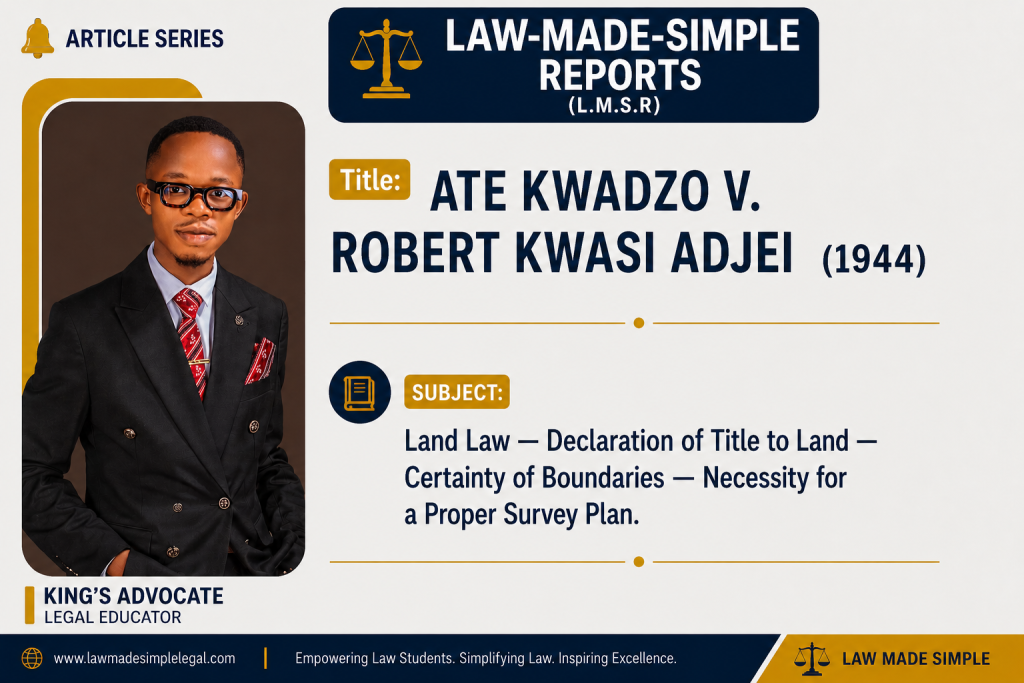
CASE INFORMATION ATE KWADZO V. ROBERT KWASI ADJEI (1944)
COURT: West African Court of Appeal
DATE: 14th November, 1944
JUDGES: Kingdon and Harragin, C.JJ., and Coussey, J.
APPEAL FROM: Provincial Commissioner’s Court, on appeal from the Avatime State Council, on appeal from the Akome Native Tribunal.
SUBJECT: Land Law — Declaration of Title to Land — Certainty of Boundaries — Necessity for a Proper Survey Plan.
FACTS OF THE CASE
The respondent, Robert Kwasi Adjei, instituted proceedings claiming a declaration of title to a parcel of land.
The matter had already been heard twice before the Native Court and had passed through two intermediate appeals before eventually reaching the West African Court of Appeal.
Despite the several hearings and appeals, the boundaries of the land in dispute remained uncertain. The description of the land was insufficiently precise to enable the exact area to which the declaration of title related to be identified.
The central issue before the appellate court was therefore whether a court could properly grant a declaration of title to land when the boundaries and extent of that land could not be determined with certainty.
ISSUE
Whether a court can properly grant a declaration of title to land where the boundaries and extent of the land cannot be ascertained with sufficient certainty.
DECISION OF THE COURT
The appeal was allowed.
The West African Court of Appeal held that before a declaration of title to land is granted, the land to which the declaration relates must be identified with sufficient certainty.
The court formulated an important practical test: whether a surveyor, using the record of the proceedings, could prepare a plan accurately showing the land to which title had been declared.
In this case, the court was satisfied that no surveyor could accurately identify and plot the land from the existing record.
The judgment of the Provincial Commissioner’s Court, including the order as to costs, was therefore set aside.
The case was remitted to the Provincial Commissioner’s Court for a complete rehearing de novo, with a proper plan showing the land in dispute.
RATIO DECIDENDI
Before a court grants a declaration of title to land, the land must be identified with sufficient certainty. The boundaries and extent of the land must be ascertainable so that a surveyor can accurately produce a plan showing the property to which the declaration relates.
THE SURVEYOR TEST
The case establishes a useful practical test for determining whether land has been sufficiently identified.
The question is:
“Can a surveyor, taking the record of the proceedings, produce a plan accurately showing the land to which title has been given?”
If the answer is no, the court should not make a declaration of title in respect of the uncertain land.
WHY THE CASE MATTERS
This case is important in land law because a declaration of title must relate to an identifiable parcel of land.
A court should not make a declaration that leaves uncertainty as to the precise property covered by the judgment. Clear identification protects both the successful claimant and other persons who may have interests in adjoining or overlapping land.
EXAM FOCUS
For examination purposes, remember this case under the following principles:
- Declaration of title to land
- Certainty of boundaries
- Identification of the subject matter of a land claim
- Necessity for a proper survey plan
- The surveyor test
- Effect of uncertainty in the land claimed
SIMPLIFIED EXPLANATION
Imagine that a person asks a court to declare that a particular piece of land belongs to him, but the description of the land is so unclear that nobody can tell exactly where the land begins or ends.
The court should not simply declare that the person owns it.
The land must first be identified clearly enough that a surveyor can look at the court record and draw an accurate plan showing the exact property involved.
That is the central lesson from Ate Kwadzo v. Robert Kwasi Adjei.
CONCLUSION
Ate Kwadzo v. Robert Kwasi Adjei establishes that a declaration of title to land must relate to land that can be identified with certainty.
Where the boundaries remain uncertain and a surveyor cannot produce an accurate plan from the record, the court should not allow the declaration to stand. The proper course is to have the matter reheard with a proper plan identifying the land in dispute.
Key principle: Before a declaration of title to land is made, the land must be ascertainable with sufficient certainty to enable a surveyor to identify and accurately plot it.
ABOUT THE PUBLISHER
LAW-MADE-SIMPLE is a growing African academic resource network and a centre for academic growth, dedicated to making complex academic and legal knowledge easier to understand, access and apply.
Founded and published by Kingsley Omenyi, popularly known as KING’S ADVOCATE, the platform provides simplified case analysis, legal principles, statutes, academic resources and student-focused learning materials for learners across Nigeria, Africa and the wider Common Law community.
Through LAW-MADE-SIMPLE, Kingsley Omenyi seeks to bridge the gap between complex legal materials and practical understanding by presenting Nigerian and African legal materials in a clear, accessible and academically useful manner, while connecting them with broader principles of the Common Law tradition.
As a finalist law student, legal educator and digital content creator, Kingsley Omenyi has a strong interest in legal education, legal research, advocacy and the use of technology to make academic knowledge more accessible. LAW-MADE-SIMPLE is being developed as a central digital resource for teachers, students, learners and every legal person seeking reliable, simplified and practical academic materials, with Nigerian legal education at its core and a growing focus on African legal education and the wider Common Law tradition.
Published by:
KINGSLEY OMENYI — KING’S ADVOCATE
Founder & Publisher, King’s Advocate Network
Making Law Made Simple.
