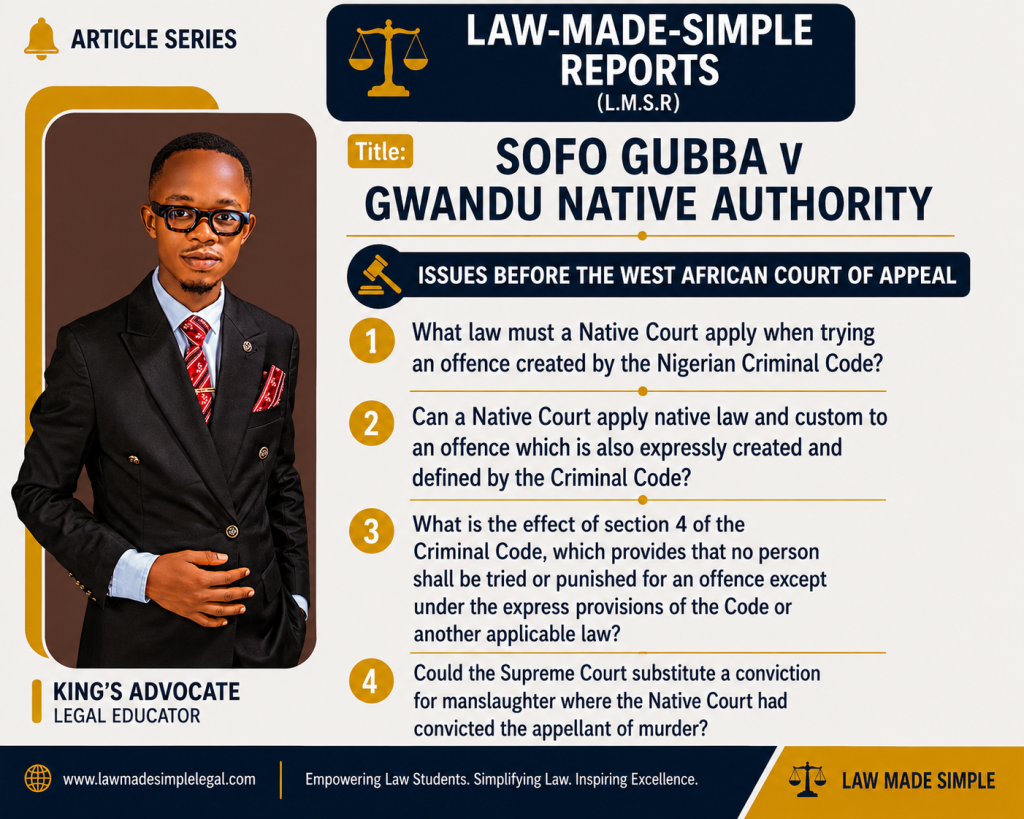
Sofo Gubba v. Gwandu Native Authority is an important Nigerian criminal law and customary law decision concerning the jurisdiction of Native Courts, the relationship between native law and custom and the Criminal Code, and the limits placed upon Native Courts when trying offences created by legislation.
The case is particularly important because it examines whether a Native Court, while exercising jurisdiction over a criminal charge such as murder, could apply principles of native law or Mohammedan Law instead of the substantive provisions of the Nigerian Criminal Code.
The West African Court of Appeal made it clear that where an act constitutes an offence under the Criminal Code, a Native Court exercising jurisdiction over that offence must apply the Criminal Code. Native law and custom cannot be used to replace or contradict the statutory definition of the offence or the punishment prescribed by legislation.
The decision also considered the powers of the Supreme Court and the West African Court of Appeal when hearing appeals from Native Courts and whether an appellate court could substitute a different conviction for the verdict reached by the Native Court.
Native Courts, Criminal Law and the Limits of Customary Law in Nigeria
CASE INFORMATION
Case: Sofo Gubba v. Gwandu Native Authority
Court: West African Court of Appeal
Date: 5 May 1947
Coram: Harragin, C.J. (Gold Coast), Verity, C.J. (Nigeria), and Lucie-Smith, C.J. (Sierra Leone)
Originating Court: Grade “A” Native Court of the Emir of Gwandu
Appeal: From the Supreme Court of Nigeria
Area of Law: Criminal Law, Criminal Procedure, Native Courts, Customary Law, Statutory Interpretation and Appellate Jurisdiction
Key Legislation:
- Native Courts Ordinance, particularly sections 10, 30 and 36
- Criminal Code, particularly sections 2(1), 4, 316, 317 and 318
- West African Court of Appeal Ordinance, particularly sections 10, 11 and 12(2)
Parties:
- Appellant: Sofo Gubba
- Respondent: Gwandu Native Authority
FACTS OF THE CASE
Sofo Gubba was tried before a Grade “A” Native Court, being the Court of the Emir of Gwandu, on a charge of murder.
The Native Court convicted him of murder and sentenced him to death.
The appellant appealed to the Supreme Court of Nigeria.
The Supreme Court was satisfied that the evidence did not establish murder under the Nigerian Criminal Code. In the view of the appellate Judge, the evidence established no more than manslaughter as defined under sections 317 and 318 of the Criminal Code.
However, the Supreme Court did not interfere with the conviction and sentence imposed by the Native Court.
The reason was that the Judge considered himself bound by the earlier majority decision in Bornu Native Authority v. Magudama Abatcha, which was regarded as authority for the proposition that a Native Court’s conviction for murder according to the native law and custom administered by that Court could be upheld even where the same facts would have amounted only to manslaughter if the accused had been tried in the Supreme Court.
Sofo Gubba therefore appealed to the West African Court of Appeal.
The central question became whether a Native Court trying an offence created by the Criminal Code was required to apply the Criminal Code or could instead apply native law and custom in determining the offence and punishment.
Parties to an Offence under Section 7 of Nigerian Criminal Law with Judicial Pronouncements
ISSUES BEFORE THE WEST AFRICAN COURT OF APPEAL
The case raised several important legal questions:
1.What law must a Native Court apply when trying an offence created by the Nigerian Criminal Code?
2.Can a Native Court apply native law and custom to an offence which is also expressly created and defined by the Criminal Code?
3.Does section 10 of the Native Courts Ordinance permit a Native Court to punish an offence according to native law and custom where the same conduct constitutes an offence under the Criminal Code?
4.What is the effect of section 4 of the Criminal Code, which provides that no person shall be tried or punished for an offence except under the express provisions of the Code or another applicable law?
5.Could the Supreme Court substitute a conviction for manslaughter where the Native Court had convicted the appellant of murder?
6.Did the West African Court of Appeal itself possess the power to substitute another verdict for the verdict of the Native Court?
DECISION OF THE WEST AFRICAN COURT OF APPEAL
The appeal was allowed.
The Court held that where a Native Court exercises jurisdiction over an act which constitutes an offence under the Criminal Code, the Native Court must exercise that jurisdiction in accordance with the Criminal Code.
The Native Court was therefore wrong to apply principles of Mohammedan Law or native law and custom in determining the appellant’s guilt for an offence created by the Criminal Code.
The Court further held that the appellate courts did not possess the power of substitution in the circumstances contemplated by the relevant legislation.
The earlier decision in Bornu Native Authority v. Magudama Abatcha was not followed.
THE LAW ON NATIVE COURTS AND CRIMINAL OFFENCES
One of the most important aspects of Sofo Gubba v. Gwandu Native Authority is the distinction between:
- an offence created by native law and custom; and
- an offence created by the Criminal Code or another written law.
This distinction is essential.
Section 10 of the Native Courts Ordinance permitted Native Courts to administer native law and custom prevailing within their jurisdiction, subject to important limitations.
Native law and custom could not be applied where it was inconsistent with the provisions of another Ordinance.
The Court therefore considered the relationship between section 10 of the Native Courts Ordinance and sections 2 and 4 of the Criminal Code.
SECTION 2 OF THE CRIMINAL CODE
Section 2(1) provided, in substance, that the provisions contained in the Criminal Code constituted the law of Nigeria with respect to the matters dealt with by the Code.
This meant that criminal offences falling within the Code were governed by the Code.
A Native Court could not disregard the statutory definition of an offence merely because the conduct might also be regarded as an offence under local customary law.
SECTION 4 OF THE CRIMINAL CODE
Section 4 was particularly important.
It provided that no person could be tried or punished in any Court in Nigeria for an offence except under the express provisions of the Criminal Code, another Ordinance, an Order in Council or applicable Imperial legislation.
The West African Court of Appeal regarded this provision as applicable to proceedings before Native Courts.
This was crucial.
The Court rejected the idea that a Native Court could rely upon native law and custom to impose a punishment for an offence which was already created and governed by the Criminal Code.
The Criminal Code therefore controlled the trial and punishment of an offence such as murder.
NATIVE LAW AND CUSTOM IS NOT ABOVE STATUTE
The decision demonstrates an important principle of statutory supremacy.
Native law and custom could be administered by a Native Court, but only within the limits imposed by legislation.
Where customary law conflicted with an Ordinance, the statutory provision prevailed.
The Court reasoned that to permit a Native Court to apply native law and custom to offences created by the Criminal Code would effectively undermine section 4 of the Criminal Code.
The Court therefore adopted a harmonious interpretation of the legislation.
The Native Courts Ordinance did not give Native Courts unlimited authority to determine criminal offences according to customary principles.
THE MEANING OF SECTION 10(2) OF THE NATIVE COURTS ORDINANCE
Section 10(2) permitted a Native Court, in relation to offences against native law or custom, to impose certain punishments authorised by native law or custom, subject to statutory restrictions.
The Court carefully limited the scope of this provision.
It held that the provision applied where an act constituted an offence against native law and custom but did not constitute an offence under the Criminal Code or another Nigerian Ordinance.
It did not authorise a Native Court to use native law and custom to determine the punishment for an offence expressly created by the Criminal Code.
This distinction is extremely important for understanding the relationship between customary law and statutory criminal law.
MURDER AND MANSLAUGHTER UNDER THE CRIMINAL CODE
The appellant had been convicted of murder.
The West African Court of Appeal agreed with the Supreme Court that the evidence established no more than manslaughter under the Criminal Code.
Under the Criminal Code, murder and manslaughter are distinct offences.
The statutory provisions governing murder and manslaughter therefore had to be applied by the Native Court once the charge was one created under the Criminal Code.
The Court consequently rejected the proposition that a Native Court could uphold a murder conviction simply because the conduct amounted to wilful homicide according to native law and custom.
THE IMPORTANCE OF STATUTORY INTERPRETATION
Sofo Gubba v. Gwandu Native Authority is also an important case on statutory interpretation.
The Court examined several legislative provisions together instead of interpreting one provision in isolation.
The relevant provisions included:
- section 10 of the Native Courts Ordinance;
- sections 2 and 4 of the Criminal Code; and
- provisions governing the appellate powers of the Supreme Court and West African Court of Appeal.
The Court reasoned that an interpretation of section 10 of the Native Courts Ordinance which permitted Native Courts to apply customary criminal law to offences created by the Criminal Code would deprive section 4 of the Criminal Code of its intended effect.
This would be contrary to established principles of statutory interpretation.
A court should therefore interpret related statutory provisions in a manner that allows each provision to operate effectively.
THE EFFECT OF THE REPEAL OF THE EARLIER EXCLUSION
The Court also considered an important historical point.
The earlier Criminal Code Ordinance had contained an exclusion relating to Native Tribunals.
That exclusion was subsequently repealed by an amending Ordinance.
The Court regarded the repeal as significant evidence of legislative intention.
The effect was that section 4 of the Criminal Code was intended to operate in proceedings before Native Courts.
Therefore, the Native Court could not claim an exemption from the statutory criminal law merely because it was exercising customary jurisdiction.
MOHAMMEDAN LAW AND THE NATIVE COURT
The Native Court had applied principles of Mohammedan Law in arriving at its verdict.
The West African Court of Appeal held that this was legally erroneous in the circumstances.
The charge before the Native Court was murder under the Criminal Code.
Consequently, the Court was required to determine the offence according to the Criminal Code.
The existence of Mohammedan Law or native law and custom within the jurisdiction of the Native Court did not permit the Court to replace the statutory criminal law governing the offence.
APPELLATE JURISDICTION AND THE POWER OF SUBSTITUTION
Another major aspect of the case concerned appellate jurisdiction.
The Court considered whether the Supreme Court could simply substitute a manslaughter conviction for the murder conviction entered by the Native Court.
The Court concluded that the Native Courts Ordinance did not give the Supreme Court the power to substitute another verdict which the Native Court could have given at first instance.
The wording of the West African Court of Appeal Ordinance did not change that conclusion.
The Court therefore examined sections 11(1) and 12(2) of the West African Court of Appeal Ordinance.
It concluded that section 12(2) did not confer a general power of substitution in this situation because the reference to a “Judge or Jury” did not include a Native Court.
Section 11(1) therefore had to be applied.
This illustrates an important distinction between an appellate court’s power to review a decision and its power to substitute a completely different verdict.
THE COURT’S TREATMENT OF BORNU NATIVE AUTHORITY v. MAGUDAMA ABATCHA
A significant feature of the decision is the treatment of the earlier case of Bornu Native Authority v. Magudama Abatcha.
The Supreme Court Judge had relied upon that decision in refusing to interfere with the Native Court’s conviction.
The West African Court of Appeal reconsidered the legal position.
The Court concluded that the earlier decision could not govern the present case in the manner suggested.
Bornu Native Authority v. Magudama Abatcha was therefore not followed.
This demonstrates an important principle of judicial precedent: an earlier decision must be understood within the precise legal and factual context in which it was decided.
Where a later court determines that the earlier reasoning is inconsistent with the governing statutory provisions, it may distinguish or decline to follow that earlier decision in an appropriate case.
RATIO DECIDENDI
The principal legal propositions emerging from Sofo Gubba v. Gwandu Native Authority include the following:
A Native Court exercising criminal jurisdiction over an offence created by the Criminal Code must apply the Criminal Code.
Native law and custom cannot override or contradict the provisions of the Criminal Code.
Section 4 of the Criminal Code applies to proceedings before Native Courts.
Section 10(2) of the Native Courts Ordinance concerns offences against native law and custom which are not offences under the Criminal Code or another Nigerian Ordinance...
Where an act constitutes an offence under the Criminal Code, the Native Court must exercise its jurisdiction consistently with the Code.
A Native Court cannot impose a punishment authorised only by native law or custom for an offence governed by the Criminal Code..
The appellate jurisdiction of the Supreme Court and West African Court of Appeal must be exercised within the powers conferred by statute.
An appellate court cannot assume a power of substitution merely because it considers another conviction more appropriate.
WHY THIS CASE IS IMPORTANT
Sofo Gubba v. Gwandu Native Authority is important because it illustrates the relationship between three sources of law:
Statutory law
Native law and custom
Judicial precedent
The case demonstrates that customary law has an important place within the Nigerian legal system, but that its application is subject to statutory limitations.
Where Parliament or the legislature has expressly created an offence and prescribed the applicable punishment, a court exercising jurisdiction over that offence must apply the statutory law.
This principle remains valuable when studying the interaction between customary law and written law.
EXAM FOCUS
Students should remember Sofo Gubba v. Gwandu Native Authority for the following principles:
1. Criminal offences created by statute must be tried under the statute
Where an offence is expressly created by the Criminal Code, the court must apply the provisions of the Criminal Code.
A Native Court does not acquire the power to substitute customary criminal principles for statutory criminal law merely because customary law is ordinarily administered within its jurisdiction.
2. Customary law is subject to statutory law
Native law and custom may be recognised and administered by the appropriate court, but it cannot operate inconsistently with legislation.
This is especially important in criminal law.
3. Section 4 of the Criminal Code
Section 4 is a key provision.
It establishes the principle that a person cannot be tried or punished for a criminal offence except under an applicable statutory or legally recognised provision.
4. Jurisdiction is not the same as substantive law
A Native Court may possess jurisdiction to hear a matter without having unlimited freedom to determine the substantive criminal law applicable to that matter.
This distinction is extremely important.
Jurisdiction asks: “Does the court have authority to hear this matter?”
Substantive law asks: “What law governs the conduct and determines guilt or liability?”
Sofo Gubba demonstrates that the existence of jurisdiction does not mean that a court may apply whatever substantive law it chooses.
5. Appellate courts are creatures of statute
An appellate court does not possess unlimited powers.
Its powers to affirm, reverse, quash, substitute or order a retrial must derive from the legislation establishing its appellate jurisdiction.
BROADER LESSON: JURISDICTION IN LAW
Jurisdiction is one of the foundational concepts in legal procedure.
In simple terms, jurisdiction means the legal authority of a court to hear and determine a particular matter.
A court may lack jurisdiction because of several factors, including:
- the subject matter of the dispute;
- the geographical or territorial location;
- the status or identity of the parties;
- the monetary value of the claim;
- the nature of the offence;
- the stage of proceedings; or
- statutory limitations on the court’s powers.
A court may therefore have general judicial authority but lack jurisdiction over a particular matter.
This is why students should never treat jurisdiction as merely a technical objection.
Jurisdiction goes to the competence of the court itself.
JURISDICTION AND STATUTORY LIMITATIONS
Where legislation defines the jurisdiction of a court, the court must operate within those limits.
The principle can be stated simply:
A court cannot confer jurisdiction upon itself where the law has not given it jurisdiction.
Similarly, parties cannot create jurisdiction merely by agreement where the law does not provide it.
This principle connects closely with the reasoning in Sofo Gubba.
The Native Court’s authority was statutory. Its jurisdiction therefore had to be exercised consistently with the legislation governing that jurisdiction.
JURISDICTION AND THE EFFECT OF ERROR
An important examination question is whether an error made by a court automatically makes proceedings void.
The answer depends upon the nature of the error.
A fundamental absence of jurisdiction may render proceedings a nullity.
However, not every procedural mistake amounts to a jurisdictional defect.
Students should therefore distinguish between:
Lack of jurisdiction
and
Error committed within jurisdiction.
This distinction is frequently tested in Nigerian procedural law.
LOCUS CLASSICUS ON JURISDICTION
When studying jurisdiction, students should become familiar with leading authorities such as:
Madukolu v. Nkemdilim
This is one of the leading Nigerian authorities on jurisdiction.
The case is commonly relied upon for the principle that a court is competent to exercise jurisdiction where:
- it is properly constituted as regards numbers and qualifications of its members;
- the subject matter is within its jurisdiction;
- there is no feature preventing the court from exercising its jurisdiction; and
- the case comes before the court through due process.
This case should be regarded as a foundational authority when discussing jurisdiction in Nigerian civil procedure.
Skenconsult (Nig.) Ltd. v. Ukey
This authority is also important in Nigerian procedural law for demonstrating the consequences of proceedings instituted without proper jurisdiction or in breach of fundamental procedural requirements.
Tukur v. Government of Gongola State
The case is useful when discussing jurisdiction and the constitutional/statutory boundaries of judicial power.
BRONIK MOTORS LTD. v. WEMA BANK LTD. (1983) .
This is another important Nigerian authority when discussing jurisdiction and the consequences of proceedings brought before an incompetent forum.
Students should not merely memorise the names of jurisdiction cases. They should understand the principle each authority establishes.
HOW TO ANSWER A JURISDICTION QUESTION IN AN EXAMINATION
When a problem question raises jurisdiction, a good answer should proceed systematically.
Step 1: Identify the court
Ask:
Which court is being approached?
Step 2: Identify the subject matter
Ask:
What is the dispute or offence about?
Step 3: Find the enabling law
Ask:
Which Constitution, Act, Ordinance or other legislation gives the court jurisdiction?
Step 4: Consider territorial jurisdiction
Ask:
Where did the cause of action or offence occur?
Step 5: Consider procedural requirements
Ask:
Were the proceedings commenced in the manner required by law?
Step 6: Consider the consequence of the defect
Ask:
Does the defect go to jurisdiction or is it merely an irregularity?
Step 7: Apply the leading authority
Use the appropriate locus classicus and then apply the principle to the facts.
This approach produces a much stronger examination answer than simply stating:
“The court has no jurisdiction.”
LESSON FROM SOFO GUBBA FOR LAW STUDENTS
The deeper lesson from this case is that jurisdiction, substantive law and customary law must not be confused.
A court may have jurisdiction over a matter but still be required to apply a particular statutory regime.
Likewise, the existence of customary law within a community does not automatically displace legislation governing the same subject.
The court must determine:
- What is the source of jurisdiction?
- What law governs the offence?
- What powers has the legislature given the court?
- What limits has the legislature placed on those powers?
- What remedy is available on appeal?
That method of analysis is useful far beyond this particular case.
CONCLUSION
Sofo Gubba v. Gwandu Native Authority remains an important authority for understanding the relationship between Native Courts, customary law and statutory criminal law in Nigeria.
The central principle is straightforward:
Where a Native Court exercises jurisdiction over an offence created by the Criminal Code, it must apply the Criminal Code and cannot substitute native law or custom for the statutory law governing the offence.
The case also teaches an important lesson about appellate jurisdiction: courts exercising appellate powers must remain within the limits established by the legislation conferring those powers.
For examination purposes, the case should therefore be remembered under the themes of:
Native Courts + Criminal Code + Customary Law + Statutory Interpretation + Jurisdiction + Appellate Powers.
ABOUT THE PUBLISHER
LAW-MADE-SIMPLE is a growing African academic resource network and a centre for academic growth, dedicated to making complex academic and legal knowledge easier to understand, access and apply.
Founded and published by Kingsley Omenyi, popularly known as KING’S ADVOCATE, the platform provides simplified case analysis, legal principles, statutes, academic resources and student-focused learning materials for learners across Nigeria, Africa and the wider Common Law community.
Through LAW-MADE-SIMPLE, Kingsley Omenyi seeks to bridge the gap between complex legal materials and practical understanding by presenting Nigerian and African legal materials in a clear, accessible and academically useful manner, while connecting them with broader principles of the Common Law tradition.
As a finalist law student, legal educator and digital content creator, Kingsley Omenyi has a strong interest in legal education, legal research, advocacy and the use of technology to make academic knowledge more accessible. LAW-MADE-SIMPLE is being developed as a central digital resource for teachers, students, learners and every legal person seeking reliable, simplified and practical academic materials, with Nigerian legal education at its core and a growing focus on African legal education and the wider Common Law tradition..
Published by:
KINGSLEY OMENYI — KING’S ADVOCATE
Founder & Publisher, King’s Advocate Network
Making Law Made Simple.
Contact the Publisher: Contact Kingsley Omenyi