Understanding Section 24 of the Criminal Code Nigeria.
Section 24 of the Criminal Code Nigeria is the heartbeat of the mens rea principle — the mental element of crime. It governs when a person is criminally responsible for an act or omission and when they are not.
Section 24 – Intention and Motive: Subject to the express provisions of this Code relating to negligent acts and omissions, a person is not criminally responsible for an act or omission which occurs independently of the exercise of his will, or for an event which occurs by accident.Unless the intention to cause a particular result is expressly declared to be an element of the offence constituted, in whole or part, by an act or omission, the result intended to be caused by an act or omission is immaterial.Unless otherwise expressly declared, the motive by which a person is induced to do or omit to do an act, or to form an intention, is immaterial so far as regards criminal responsibility.
This provision lays the foundation of criminal liability under Nigerian law establishing voluntariness, accident, and motive as the three pillars of intention in mens rea.
THE PURPOSE AND IMPORTANCE OF SECTION 24 CRIMINAL CODE
Section 24 of the Criminal Code Nigeria protects innocent minds from punishment and ensures that only voluntary and intentional conduct attracts criminal liability. It also limits the use of motive as a defence.
The Nigerian courts, following English principles, have continually struggled to balance two competing goals:
Ensuring innocent persons are not punished for accidental acts; and
Preventing guilty offenders from escaping liability.
Historically, Section 24 was often ignored until it gained prominence in Audu Umaru’s Case, after which Nigerian courts began applying it more rigorously.
THE THREE CARDINAL PRINCIPLES OF CRIMINAL LIABILITY
For an act to amount to a crime, three key elements must coexist:
1.Physical Element (Actus Reus)
2.Mental Element (Mens Rea)
3.Absence of Valid Defence
Our focus here is on the mental element (intention) under Section 24 Criminal Code Nigeria
INTENTION AS AN ASPECT OF MENS REA
The word “mens rea” means a guilty mind. In Abeke v State (2007), the court defined it as the state of mind the accused must possess at the time of committing a criminal act.
In Ibikunle v State, mens rea was described as malice aforethought — a predetermined intention to commit an unlawful act without justification.
Similarly, in Amofa v R, the court held that to determine whether mens rea is an essential element, one must refer to the specific statute creating the offence.
As Lord Webber J. in R v Efana noted, “Whether the absence of mens rea is an excuse or defence depends on the wording of each particular enactment.”
THE THREE LIMBS OF SECTION 24 CRIMINAL CODE NIGERIA
VOLUNTARINESS The Act Must Be Done Willingly
A person is not criminally responsible for an act or omission which occurs independently of the exercise of his will.
This means that criminal liability only arises when an act is voluntary. A person cannot be guilty of a crime for something beyond their control, such as an involuntary reflex or unconscious movement.
However, Section 24 will not absolve liability in offences expressly punishing negligence or omission.
Case Reference:
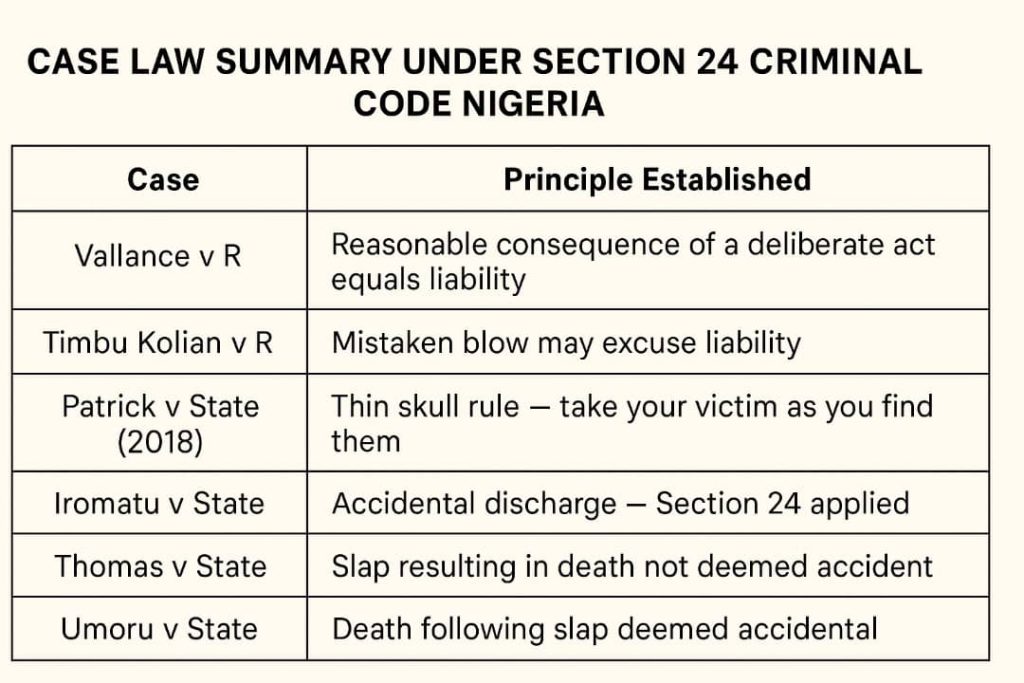
Timbu Kolian v R:
Husband in the dark aimed a blow at his wife but hit his child instead. Held — Not guilty of murder because the act was unintentional. This was English court view in r-v-timbukolian
Vallance v R:
Accused shot at children claiming it was to scare them. Held — Liable; his act was deliberate and reasonably foreseeable.
Doctrine of the Thin Skull Rule.
Although mainly a civil law principle, Nigerian courts have adapted it into criminal jurisprudence.
Patrick v State (2018) 16 NWLR (PT 1645) 263 SC:
The accused beat a man who later died. Court held that the defendant must take the victim as he finds him.
R v Eyo (1943) WACA:
The accused’s assault caused death due to the victim’s weak heart. Held — Still guilty; the victim’s condition does not excuse liability.
R v Blaue (1975)
The defendant stabbed a Jehovah’s Witness who refused blood transfusion. Held — Guilty; refusal did not break causation.
This reinforces that under Section 24 Criminal Code Nigeria, the voluntary act remains central, regardless of the victim’s condition.
ACCIDENT — NO GUILT FOR EVENTS THAT OCCUR BY ACCIDENT
This limb protects persons who commit lawful acts without intention or foresight of harm.If an event happens unexpectedly and without negligence, it is considered an accident under Section 24.
Illustrations of this can be seen in a situation whereby A hunter lawfully shoots an animal, but the bullet accidentally hits someone hidden in the bush — this is no doubt is Purley unintentional thus an act occurring by an accident.
In Agbo v State
The Supreme Court held that an event is accidental if it is neither intended nor reasonably foreseeable by a prudent person.
Iromatu v State (1964):
The accused’s gun discharged accidentally during a struggle. Held — Section 24 applied; firing was unintentional.
Conflicting Case Applications of the Accident Principle.
Thomas v. State (1994).
The accused slapped a man who fell and died.Per Belgore JSC, the death was not accidental, as the act (slap) was intentional.
However, legal critics argue that foreseeability, not moral judgment, should be the true test of accident.
Ademola v. State (1988) NWLR
The accused threw a burning stove at the deceased, leading to death. Court held it was foreseeable, hence not accidental (per Oputa JSC).
Critics contend that accident should be tested by reasonable foresight, not fault.
Umoru v. State (1990) 3 NWLR (Pt. 133).
The appellant slapped the deceased, who fell and died. The Court of Appeal held it was an accident, as the death was surprising and unforeseeable.
This case remains controversial as the Supreme Court has yet to reconcile conflicting decisions under this limb.
3.Motive Irrelevance of Motive in Criminal Responsibility
The last part of Section 24 states that motive is immaterial.Whether a person acted out of anger, love, or revenge does not affect guilt.Only intention and voluntariness matter in determining criminal responsibility.
Section 24 of the Criminal Code Nigeria remains the cornerstone of mens rea. It distinguishes between voluntary acts, accidents, and irrelevant motives, ensuring fairness and justice in criminal law.
While Nigerian courts continue to interpret this section differently, understanding its three limbs voluntariness, accident, and motive is essential for both students and practitioners of law.
For More Notes and Legal Analysis
You can explore related posts on this website, including:
HISTORY & SOURCES OF CRIMINAL LAW IN NIGERIA
Relationship Between the Penal Code and Criminal Code in Nigeria
PARTIES TO AN OFFENCE UNDER NIGERIAN CRIMINAL LAW (section 7)
R v Bangaza (1960) 5 FSC 1 Key Facts, Legal Principles & Nigerian Case Analysis