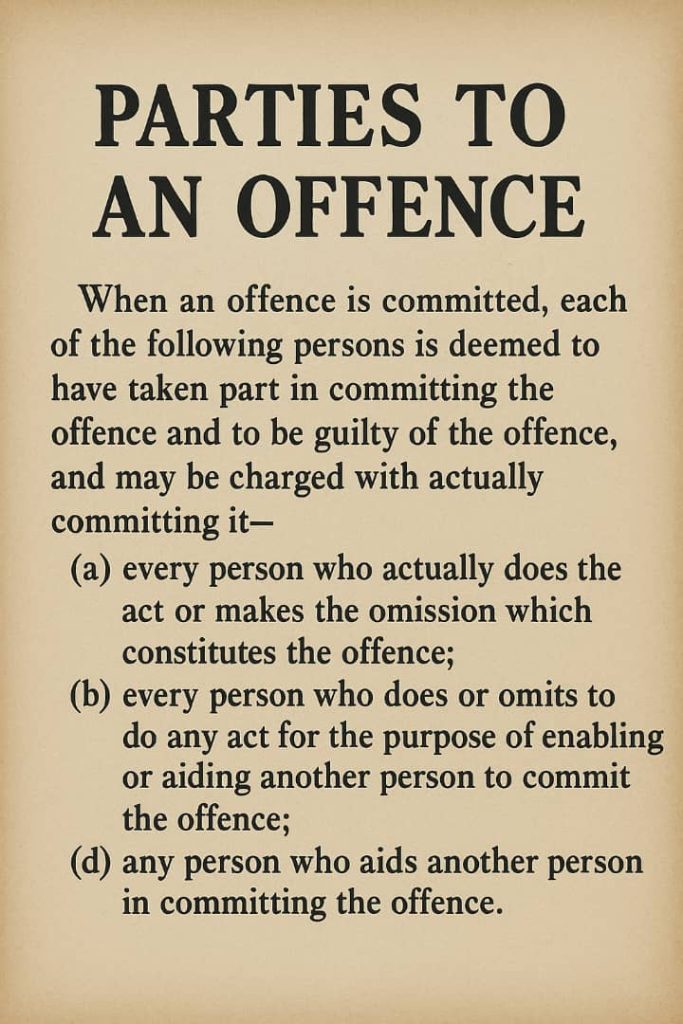
Section 7 of the Criminal Code Act made an elaborate provision to parties to an offence, when an offence is committed in Nigeria. it provides that:
“When an offence is committed, each of the following persons is deemed to have taken part in committing the offence and to be guilty of the offence, and may be charged with actually committing it.”
This provision identifies the modes of participation in a crime, forming the basis of criminal liability in Nigeria.
Subsections of Section 7 Criminal Code
(a) Every person who actually does the act or makes the omission which constitutes the offence.
(b) Every person who does or omits to do any act for the purpose of enabling or aiding another person to commit the offence;
(c) Every person who aids another person in committing the offence;
(d) any person who counsels or procures any other person to commit the offence.
In the fourth case, he may be charged either with himself committing the offence or with counselling or procuring its commission.
The beautiful point to note about this section is that any participation in the commission of an offence within the provisions of paragraph (a), (b), (c) and (d) makes the person a principal offender and such a person liable for criminal responsibility.
What are the ELEMENTS OF CRIME: Meaning, Definition, and Full Criminal Law Notes in Nigeria
Special Note on the Use of Innocent Agents
A notable principle under criminal law is that:
If an adult uses a child (innocent agent) to commit a crime, the child will not be held criminally liable.Instead, the adult who instigated or directed the child will be held responsible, even if he or she did not physically take part in the act.
Constant Terms under Parties to an Offence in Criminal Law
1. Principal Offender:
A person who actually commits the offence. They are the main actor in carrying out the act. Example: Someone who physically steals an item.
2. Aiding
A person who helps the principal offender by providing support, assistance or resources.This support may come before, during, or after the commission of the offence.
3. Abetting.
Abetting means encouraging or inciting the principal offender to commit the crime.It implies urging or motivating the offender to carry out the act.Example: Standing by and cheering someone on in a fight may be considered abetting if it encourages the violence.
4. Counselling
Advising, instructing, or persuading another person to commit a crime.This is more direct than mere encouragement.Example: Advising another person on how to commit fraud.
5. Accessory Before the Fact
A person who helps plan or prepare for the offence before it happens but is not present during the commission of the crime.
Example: Providing inside information for a planned robbery but not participating directly.
6. Accessory After the Fact
A person who assists the offender after the crime has been committed, with the aim of helping them escape detention, capture, or punishment.
Example: Hiding the principal offender, destroying evidence, or providing a getaway vehicle.
Note: What the statute recognizes by virtue of Section 10 of the Criminal Code is Accessory After the Fact, , not accessory before the fact.However, by analogy, since there is “after,” there is also “before,” and this concept is implied in the concerned statutory provisions.
for full Judicial analysis of this section 7 on parties of the offence check out this post Parties to an Offence under Section 7 of Nigerian Criminal Law with Judicial Pronouncements
What are the ELEMENTS OF CRIME: Meaning, Definition, and Full Criminal Law Notes in Nigeria
SECTION 24 OF THE CRIMINAL CODE NIGERIA FULL ANALYSIS OF INTENTION AS AN ASPECT OF MENS REA
Section 419 – Obtaining by False Pretence under Nigerian Law