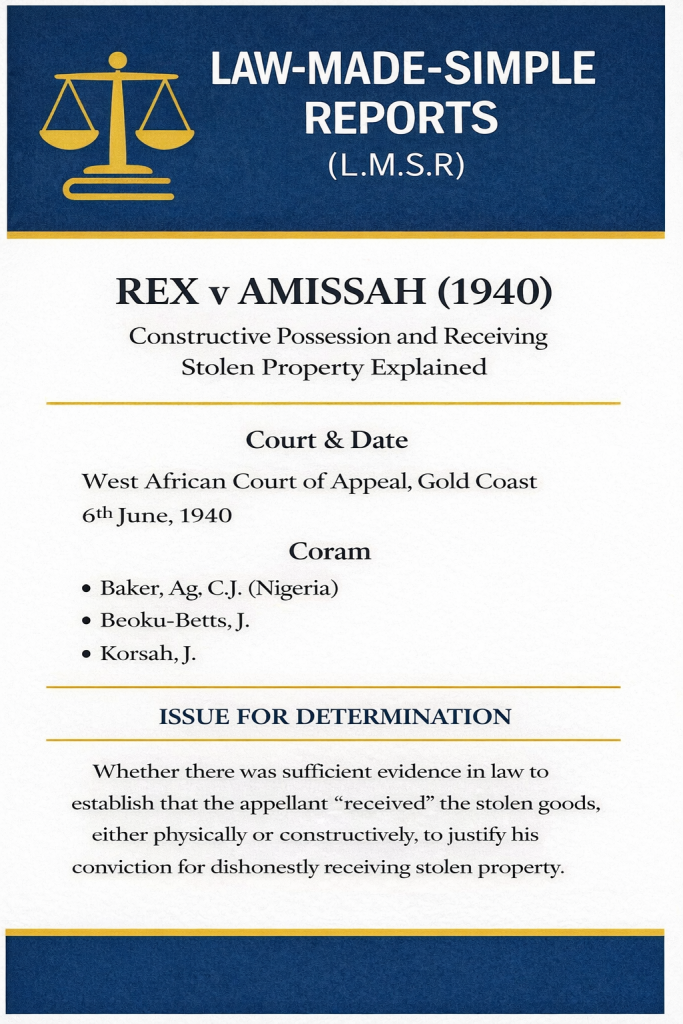
The case of R v Amissah (1940) is a leading authority in West African criminal law on the offence of dishonestly receiving stolen property, particularly on the meaning and requirement of possession. The West African Court of Appeal clarified that a conviction for receiving stolen goods cannot stand unless there is proof of either physical possession or constructive possession of the stolen items.
This case remains important in understanding how courts interpret “receipt” under criminal law, especially in situations where the accused never physically handled the stolen property.
Facts of the Case R v Amissah (1940)
The appellant, Amissah, was charged alongside one Ebenezer Oseku Afful at the Supreme Court of the Gold Coast. They were accused of dishonestly receiving 10 drums of aviation petrol, knowing same to have been stolen, contrary to section 284(1) of the Criminal Code.
At trial, Afful was discharged and acquitted, while Amissah was convicted and sentenced to one and a half years imprisonment.
Dissatisfied with the decision, Amissah appealed to the West African Court of Appeal, challenging the conviction on several grounds, the major one being that there was no proof that he ever received the stolen goods.
Issue for Determination R v Amissah (1940).
The central issue before the Court was:
Whether there was sufficient evidence in law to establish that the appellant “received” the stolen goods, either physically or constructively, to justify his conviction for dishonestly receiving stolen property.
Decision of the Court R v Amissah (1940).
The Court of Appeal allowed the appeal and quashed the conviction, discharging the appellant.The Court held that the prosecution failed to establish that Amissah had received the 10 drums of aviation petrol in any legally recognized form of possession.
Judgment and Legal Principle Established
In delivering the judgment, Beoku-Betts J. explained the legal requirement for possession in receiving stolen property cases.The Court emphasized that:A person cannot be convicted of receiving stolen property unless there is proof of either:
Physical possession, or Constructive possession
The Court further clarified the meaning of constructive possession as follows:
Constructive possession exists only where the goods are in the control of a person whose relationship with the accused is such that the goods would be available at the accused’s request.
The Court relied on earlier authorities such as:
R v Freedman (1923) & R v Hill (1841)
The Court stressed that mere claiming, seeing, or intending to collect goods is not enough. There must be actual delivery or control sufficient to amount to possession in law.
The Court concluded that:There was no evidence that the appellant physically received the goods.There was also no proof of constructive possession, as no person holding the goods was under his control in law.Therefore, the conviction for receiving stolen property was unsafe and unsupported by evidence.
In summary, this case Rex v Amissah (1940) remains a foundational case in criminal law, reinforcing the principle that mere involvement or expectation is not enough to establish receipt of stolen property. The prosecution must prove clear possession either physical or constructive before a conviction can be sustained.
The Offence of Stealing/Theft in Nigerian Legal Jurisprudence
Ingredients or Elements of the Offence of Stealing in Nigeria.