Suit No.: SC 59/1984 | Date: 25th January, 1985 Coram: OBASEKI, J.S.C.; ESO, J.S.C.; NNAMANI, J.S.C.; KAZEEM, J.S.C.; OPUTA, J.S.C.
The landmark case of Josiah v. The State (1985) stands as a cornerstone decision of the Supreme Court of Nigeria on the constitutional right to fair hearing and representation by counsel, especially in capital offences. The case highlights the grave implications of non-compliance with statutory provisions meant to protect accused persons during criminal trials.
The decision underscores the judiciary’s constitutional duty to ensure that an accused person — particularly one facing a capital offence — is afforded every procedural safeguard, including being informed of his rights and provided with legal representation. The Supreme Court’s judgment reinforced the principle that procedural irregularity in a capital case vitiates the entire proceedings, no matter how overwhelming the evidence may appear.
FACTS OF THE CASE OF JOSIAH V. STATE
The appellant, Godwin Josiah,was charged and convicted for murder by a High Court in Bendel State. During the trial, the appellant was not represented by a legal practitioner, and the trial judge failed to inform him of his rights under Section 287 of the Criminal Procedure Law (CPL) of Bendel State, which mandates that an unrepresented accused must be informed of the three options open to him when called upon to make his defence — to give sworn evidence, make an unsworn statement, or remain silent.
Upon conviction and subsequent sentencing to death, Josiah appealed to the Court of Appeal, which dismissed his appeal and affirmed the judgment of the trial court. Dissatisfied, he appealed further to the Supreme Court, contending that his trial was fundamentally defective and unconstitutional due to the trial court’s failure to comply with statutory and procedural safeguards.
ISSUES FOR DETERMINATION IN JOSIAH V STATE (1985)
The Supreme Court was invited to determine the following key issues:
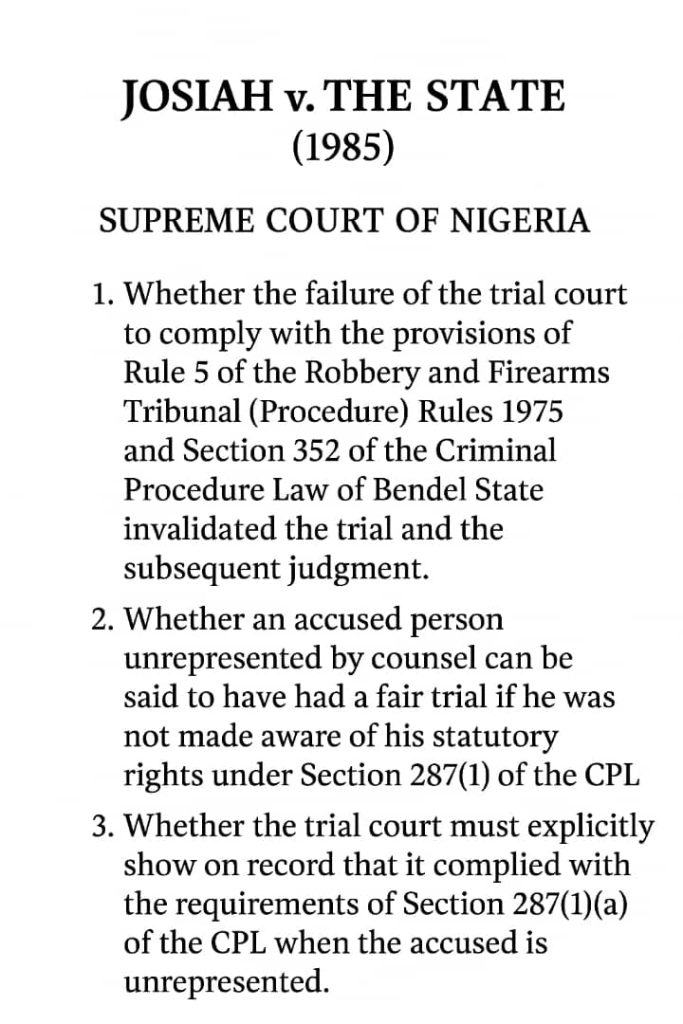
1.Whether the failure of the trial court to comply with the provisions of Rule 5 of the Robbery and Firearms Tribunal (Procedure) Rules 1975 and Section 352 of the Criminal Procedure Law of Bendel State invalidated the trial and the subsequent judgment.
2.Whether an accused person unrepresented by counsel can be said to have had a fair trial if he was not made aware of his statutory rights under Section 287(1) of the CPL.
3.Whether the trial court must explicitly show on record that it complied with the requirements of Section 287(1)(a) of the CPL when the accused is unrepresented.
Judgment and Reasoning of the Supreme Court
The Supreme Court allowed the appeal and set aside both the conviction and sentence of the appellant.
The Court held that failure to comply with Rule 5 of the Robbery and Firearms Tribunal Rules and Section 287 of the Criminal Procedure Law rendered the entire proceedings null and void, as such omissions constituted a denial of fair hearing under Section 33(1) of the 1979 Constitution.
“The duty imposed by Section 287(1)(a) of the Criminal Procedure Law on the trial court is of a fundamental nature. It is not a mere formality but an essential condition for the validity of the trial of an unrepresented accused person.”
The Court stressed that the duty of the court to explain the options available to an unrepresented accused person is not a matter of discretion but a mandatory constitutional safeguard.
“An unrepresented accused person cannot be expected to appreciate the implications of the choice he makes out of the three options available to him. The court must ensure that he fully understands the consequences of each choice before proceeding.”
Furthermore, the Supreme Court ruled that the record of proceedings must explicitly show that the trial judge explained these alternatives to the accused. A mere assumption or omission cannot amount to compliance.
“The requirements of Section 287(1)(a) cannot be satisfied by a mere record of compliance. It must be shown affirmatively in the record of proceedings that the trial court indeed informed the accused of his rights.”
Order of the Court
In consequence, the Supreme Court set aside the conviction and sentence of the appellant. The case was remitted to the High Court for a retrial, with the directive that due compliance be ensured with the relevant statutory provisions.
Significance of the Decision & principles established in Josiah v State
The decision in Josiah v. The State (1985) remains a precedent of high constitutional and procedural value in Nigerian criminal jurisprudence. It reaffirms that:
1.Every accused person is entitled to legal representation, particularly in capital offences.
2.Failure to assign counsel or to inform the accused of his statutory rights vitiates the entire proceedings.
3.The record of trial must reflect actual compliance with procedural safeguards.
4.Any irregularity that leads to the denial of fair hearing renders the judgment null and void, irrespective of the strength of evidence.
Supporting Authorities and Referencing these principles.
This decision of Nigeria supreme court in this above case aligns with the spirit of the 1979 Constitution (now Section 36(1) of the 1999 Constitution), which guarantees fair hearing to all accused persons.Similar principles have been upheld in the following cases:
Kajola v. Police (1974) 4 U.I.L.R. (Pt. II) 156Anya v. The State (1965) N.M.L.R. 62Guri v. Hadejia N.A. (1959) 4 F.S.C. 44Mai Rai v. Bauchi N.A. (1957) N.R.N.I.
“The irregularity resulting from failure to comply with Section 287(1)(a) of the CPL is not a mere technical defect; it amounts to a breach of the constitutional right to a fair hearing.”
The Supreme Court in Josiah v. The State established a solid judicial stance that justice must not only be done but must manifestly be seen to have been done, especially in trials involving capital offences. The judgment serves as a judicial reminder that procedural compliance is not a matter of convenience but a constitutional duty aimed at safeguarding the sanctity of human life and the integrity of the Nigerian judicial process.

