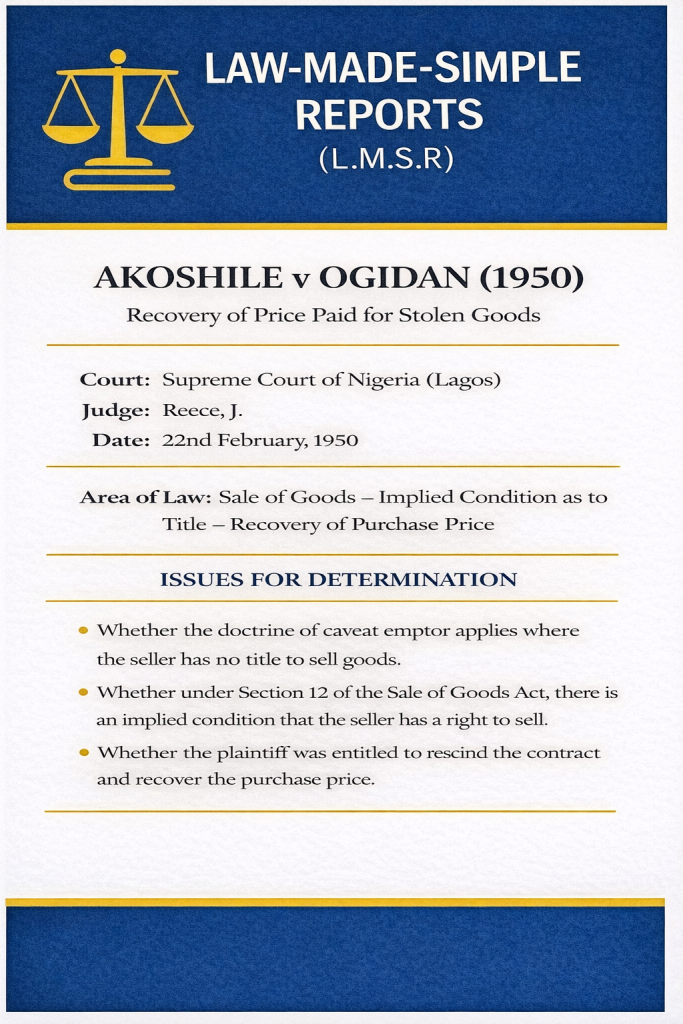
The case of Akoshile v Ogidan is a classic authority in Nigerian sale of goods law dealing with the buyer’s right to recover money paid where the seller had no title to pass. It reinforces the principle that a buyer is entitled to a valid title in goods purchased, and where such title fails completely, the contract can be rescinded and the purchase price recovered.
Facts of the Case of Akoshile v Ogidan
The plaintiff purchased a Vauxhall saloon car from the defendant for the sum of £340 and took immediate possession of the vehicle.The defendant represented that he had lawfully purchased the car from a European vendor. However, it later emerged that the car had in fact been stolen by that European seller.
The defendant argued that the doctrine of caveat emptor (buyer beware) applied, and that the loss should lie where it fell.
Issues for Determination
1.Whether the doctrine of caveat emptor applies where the seller has no title to sell goods.
2.Whether under Section 12 of the Sale of Goods Act, there is an implied condition that the seller has a right to sell.
3.Whether the plaintiff was entitled to rescind the contract and recover the purchase price.
Arguments of Counsel Akoshile v Ogidan
Plaintiff’s Counsel: Argued that under Section 12 of the Sale of Goods Act, there is an implied condition that the seller has title to sell. Since the defendant had no title, the plaintiff was entitled to rescind the contract and recover the price. Reliance was placed on Rowland v Divall (1923).
Defendant’s Counsel: Contended that the principle of caveat emptor applied and that at the time of sale the defendant believed he had a valid right to sell.
Decision of the Court in Akoshile v Ogidan
The court entered judgment in favour of the plaintiff and awarded the sum of £340 plus costs.
Held:
1.There is an implied condition under Section 12 of the Sale of Goods Act that the seller has a right to sell the goods.
2.Where the seller has no title, the buyer is entitled to rescind the contract and recover the purchase price in full.
3.The doctrine of caveat emptor does not apply in cases involving failure of title.
Here are the Reasoning of the Court in Akoshile v Ogidan
Reece, J. held that the central issue was not the quality or fitness of the goods, but the validity of title. Since the seller had no ownership rights, nothing valid could be transferred to the buyer.
The court relied heavily on the English case of Rowland v Divall (1923), where it was established that a buyer who is deprived of goods due to lack of title is entitled to recover the full purchase price, even if he had used the goods for some time.
The judge emphasized that the Sale of Goods Act imposes an absolute implied condition of title, and breach of this condition entitles the buyer to rescind.
The Ratio Decidendi here is very simple:
Where a seller has no title to goods sold, there is a total failure of consideration, and the buyer is entitled to rescind the contract and recover the full purchase price under Section 12 of the Sale of Goods Act.
Permitted Clauses in a Hire Purchase Agreement (Nigeria) – Section 4 Hire Purchase Act Explained
Prohibited Clauses in a Hire Purchase Agreement – Nigerian Law

