Key Legal Issues:
Definition of “instrument” under the Land Registration Ordinance
Admissibility of a cash payment receipt as evidence of land transfer
Application of Regulations under section 28 of the Land Registration Ordinance
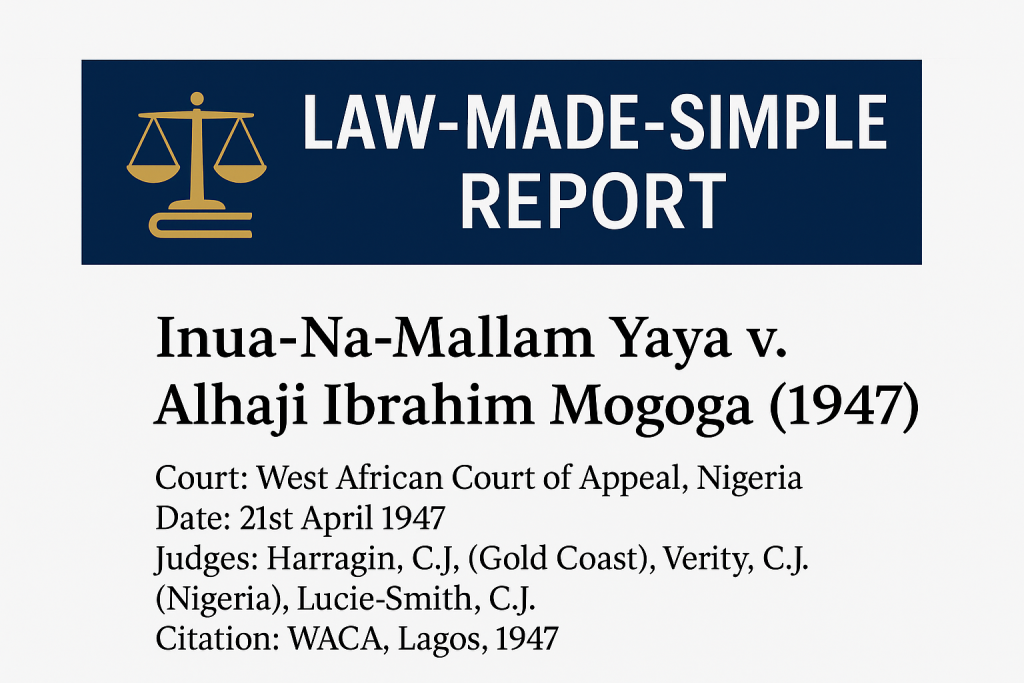
Full Facts of the case of Inua-Na-Mallam Yaya v Ibrahim Mogoga (1947) LAW-MADE-SIMPLE REPORT
The dispute arose between Inua-Na-Mallam Yaya (Appellant) and Alhaji Ibrahim Mogoga (Respondent) regarding the sale of a house in Agege, Lagos. The key facts are:
The parties had previous commercial dealings involving cattle, which left the appellant indebted to the respondent.Subsequently, the appellant handed over the title deeds of his Agege property to the respondent.The appellant sued for
An account of rents collected by the respondent from the propertyPayment of any excess over his indebtednessReturn of the title documents
In response, the respondent claimed that he had purchased the property and requested that the appellant execute a conveyance.
At trial, the judge found that neither party succeeded and dismissed both claims without costs. The appellant appealed on the ground that Exhibit “G”, a cash payment receipt, was improperly accepted as evidence.
Accra Perfumery Co. Ltd. v. Alan Radlay Thomas & Anor (1947) Full Summary | L.M.S.R
Legal Issue Inua-Na-Mallam Yaya v Ibrahim Mogoga (1947)
The central issue before the West African Court of Appeal was:
Whether a cash payment receipt for the purchase of land qualifies as an “instrument” under Section 2 of the Land Registration Ordinance, thereby requiring registration under Section 15.
Judgment Inua-Na-Mallam Yaya v Ibrahim Mogoga (1947)
The Court unanimously dismissed the appeal. Key points from the judgment include:
Definition of “Instrument”:Section 2 of the Land Registration Ordinance defines an instrument as a document affecting land in Nigeria, wherein one party transfers or confers rights, title, or interest in land to another.
Nature of Exhibit “G”:Exhibit “G” was a cash payment receipt acknowledging the payment of £160 for the purchase of a house.
The Court held that:The receipt did not transfer any right, title, or interest in the property.It merely evidenced an agreement to sell and the payment of the purchase price.No future purchaser could accept it as a valid title.
Yesufu Esan v. Faro (Chief Ojora)-1947 Full Summary L.M.S.R
Regulatory Exemption:Regulation 5 of the Land Registration (Agreements Exemption No. 2) Regulations, 1944, exempts such receipts from registration under the Land Registration Ordinance.
Illustrative Example by the Court:The Court clarified its reasoning with an example:
If A sells a house to B for £5,000 and B pays £2,000 as part payment, a receipt acknowledging this payment does not require registration, as it does not effect transfer of title.
Only a formal conveyance that transfers ownership rights would qualify as an instrument
YOU CAN ACCESS MORE CASES AND LECTURE NOTES USING THE WEBSITE BAR.