FULL FACT OF British South Africa Company v. Companhia de Moçambique (1893)
In 1893, the House of Lords decided the landmark case of British South Africa Company v. Companhia de Moçambique. The appellant, the British South Africa Company, claimed that the respondent, Companhia de Moçambique, through its agents, had wrongfully entered certain lands, mines, and mining rights located in South Africa. According to the appellant, the respondent had ejected its servants, tenants, and agents from these properties, thereby interfering with the appellant’s lawful possession.
The appellant sought three forms of relief:
1.A declaration that it was lawfully in possession and occupation of the lands, mines, and mining rights;
2. An injunction restraining the respondent from asserting any title or occupation over the lands; and
3.Damages totaling £250,000 for trespass, malicious injury, and wrongful ejection from the property.
The respondent’s defense was based on the contention that the properties in question were situated abroad, in South Africa, and therefore the English courts had no jurisdiction to adjudicate claims regarding foreign land. The appellant countered this argument by asserting that no other competent tribunal existed and that the English courts should entertain the case.
MUSTAPHA RUFAI OJIKUTU v. FELLA(1954) Full Report L.M.S.R
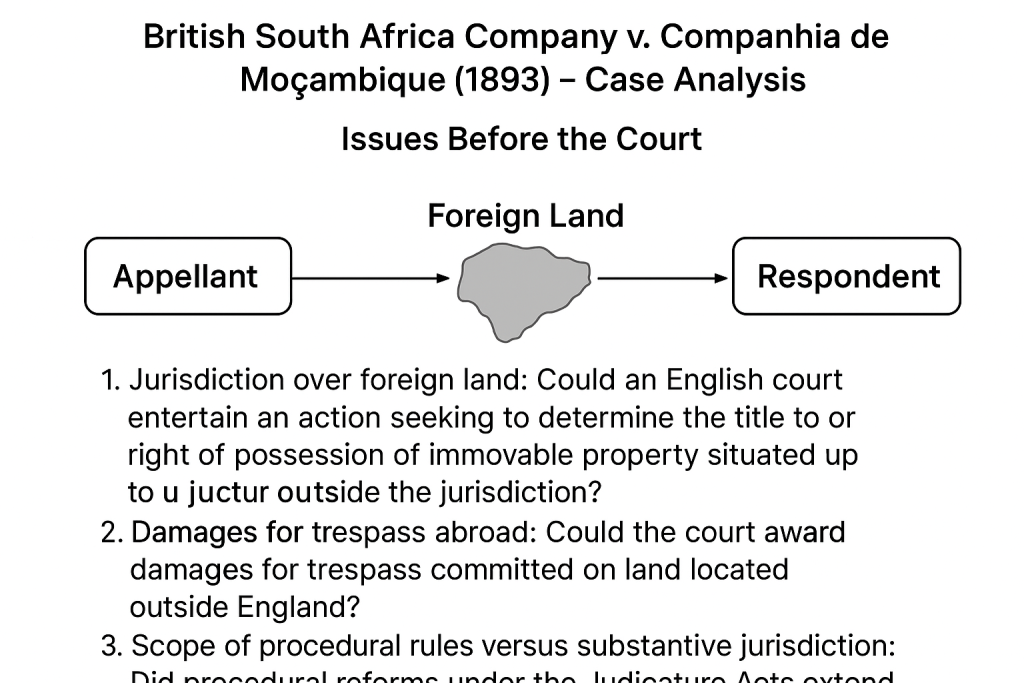
Issues Before the Court in British South Africa Company v. Companhia de Moçambique (1893)
The central issues that arose before the House of Lords were:
1.Jurisdiction over foreign land: Could an English court entertain an action seeking to determine the title to or right of possession of immovable property situated outside the jurisdiction?
2.Damages for trespass abroad: Could the court award damages for trespass committed on land located outside England?
3.Scope of procedural rules versus substantive jurisdiction: Did procedural reforms under the Judicature Acts extend the English courts’ substantive jurisdiction to foreign land?
Essentially, the court was required to determine whether English law permitted an action in rem concerning immovable property abroad or whether such claims were barred by the limits of the court’s jurisdiction.
Judgment of court in British South Africa Company v. Companhia de Moçambique (1893)
The House of Lords, led by Lord Herschell L.C., delivered a clear and authoritative judgment. The court held:
1.No jurisdiction over foreign land:
English courts do not have the authority to adjudicate claims regarding the title to, possession of, or rights over immovable property situated outside England. Any claim seeking a declaration or injunction over foreign land is beyond the substantive jurisdiction of the courts.
2.No damages for trespass abroad:
Similarly, claims for damages arising from trespass committed on foreign land are not justiciable in England. The mere presence of a procedural avenue under the Judicature Acts did not extend substantive jurisdiction into matters concerning foreign land.
3.Limitation of procedural reforms:
Procedural changes, such as rules relating to venue or the form of action, could not override the fundamental principle that English courts’ substantive jurisdiction is territorially limited.
As a result, the appellant’s claim was dismissed for want of jurisdiction. The court emphasized that the action was essentially in rem, and the location of the property outside England precluded the court from entertaining the suit.
Significance and Legal Principle British South Africa Company v. Companhia de Moçambique (1893)
The judgment gave rise to the now-famous Moçambique rule, which remains a cornerstone of private international law. This rule establishes that:
English courts cannot determine title to, possession of, or rights in immovable property situated abroad.
Claims for trespass to foreign land are not justiciable in England.
Exceptions exist only for personal obligations relating to foreign land, such as contractual obligations enforceable in personam or equitable claims with sufficient personal nexus.
The Moçambique rule is significant in highlighting the territorial limits of court jurisdiction and serves as a guiding principle in modern conflict-of-law situations, particularly where property, torts, or contractual disputes involve foreign jurisdictions.
BRITISH BATA SHOE CO. LTD v. MELIKAN (1956) Full SUMMARY
British South Africa Company v. Companhia de Moçambique is a landmark case demonstrating the limits of judicial reach in matters involving foreign immovable property. The House of Lords’ judgment clarified that procedural mechanisms cannot expand the courts’ substantive jurisdiction. The case underscores the importance of assessing jurisdiction before pursuing claims in foreign matters and provides a foundational principle in private international law.
In essence, the Moçambique case teaches that while English courts may assert jurisdiction over personal claims or contractual disputes, they will not adjudicate claims seeking to determine ownership or possession of land beyond their territorial reach. This principle continues to inform both common law jurisdictions and comparative discussions in countries such as Nigeria, where similar jurisdictional issues arise in cross-border disputes.
Duke Kuntu v Adontenhene Kweku Afilfa(1946)FULL REPORT
USE WEBSITE SEARCH BAR FOR MORE CASE SUMMARISES.