COURT:West African Court of Appeal (WACA)
Appellant: The African Press Ltd.
Respondent: The Queen.
The case of The African Press Ltd. v. The Queen (1952) 14 WACA 57 is one of the leading Nigerian decisions on sedition under the Criminal Code. It is particularly important for law students and legal researchers because it clarifies the boundary between legitimate criticism of government and a seditious publication.
In this article, we break down the facts, issues, court reasoning, and guiding principles, while highlighting key judicial pronouncements that continue to shape Nigerian criminal law.
Facts of the Case The African Press Ltd. v. The Queen (1951)
The African Press Ltd. and its editor were charged under Section 51(c) of the Criminal Code for publishing an article in their newspaper.The prosecution argued that the article:
1. Brought into hatred or contempt the Governor and the Government of Nigeria.
2. Raised discontent and disaffection among Nigerians.
At trial, the editor withdrew his appeal, leaving only the company, African Press Ltd., to contest the conviction. The company argued that:
The publication did not amount to sedition.It merely criticized the Constitution and administration.It fell within the exceptions in Section 50(2) Criminal Code, which permit lawful criticism of government.
Criminal Law: Official corruption — Section 98 Of The Criminal Code
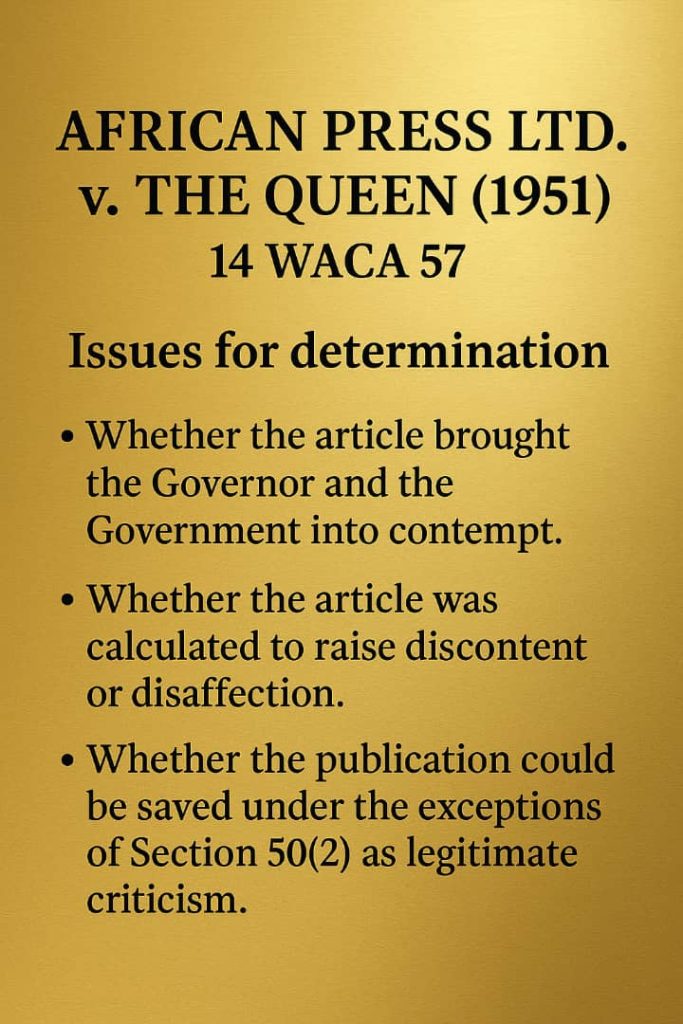
Issues for Determination in The African Press Ltd. v. The Queen (1951) 14 WACA 57
The West African Court of Appeal was called upon to decide:
Whether the article brought the Governor and the Government into contempt.
Whether the article was calculated to raise discontent or disaffection.
Whether the publication could be saved under the exceptions of Section 50(2) as legitimate criticism.
The Court examined the language of the publication carefully.
1. On the Governor:The Court held that merely calling the MacPherson Constitution “obnoxious” or linking it with the Governor did not bring the Governor personally into contempt.
“It is going too far… to hold that his person is brought into contempt and ridicule merely by the fact that his name is coupled with a critical expression of a Bill which he presents to the country.”
2. On the Government:The Court ruled that criticising administrative officers does not automatically mean contempt for the government.
3. On Raising Discontent:However, the Court agreed with the trial judge that the article was deliberately designed to stir up hostile feelings against administrative officers. By describing them as “incompetent, arrogant and contemptuous,” the publication went beyond pointing out errors and amounted to incitement of disaffection.
“The article is clearly designed to whip up hostile feeling against Administrative Officers. In our opinion, therefore, it comes clearly within the definition of section 50(2)(c).”
4. On Exceptions (Section 50(2)): Legitimate criticism must identify specific errors and suggest remedies. Since the publication failed to do this and only vilified officers, the exception did not apply.
Final Decision of the Court in The African Press Ltd. v. The Queen (1951) 14 WACA 57 on Nigerian Law of Sedition
The Court dismissed the appeal. The conviction for sedition under Section 51(c) stood.Justice Bairamian (then of the Supreme Court, cited with approval):
“He who writes an article with a seditious intention as defined… cannot by including in the article criticism which is legitimate be excused from a charge of writing a seditious article.” (Inspector-General of Police v. Michael Anagbogu (1953) 21 NLR 26).
Justice Coleridge in Rex v. Aldred (applied in Rex v. Val-Vannis (12 WACA 414)):
“The test is not either the truth of the language or the innocence of the motive… but whether the language used was calculated to promote public disorder or discontent.”
This case remains a cornerstone of Nigerian sedition law.
The Offence of Stealing/Theft in Nigerian Legal Jurisprudence
Ingredients or Elements of the Offence of Stealing in Nigeria.
Criminal Law: Burglary and Housebreaking – Meaning and Differences Under Nigerian Law
