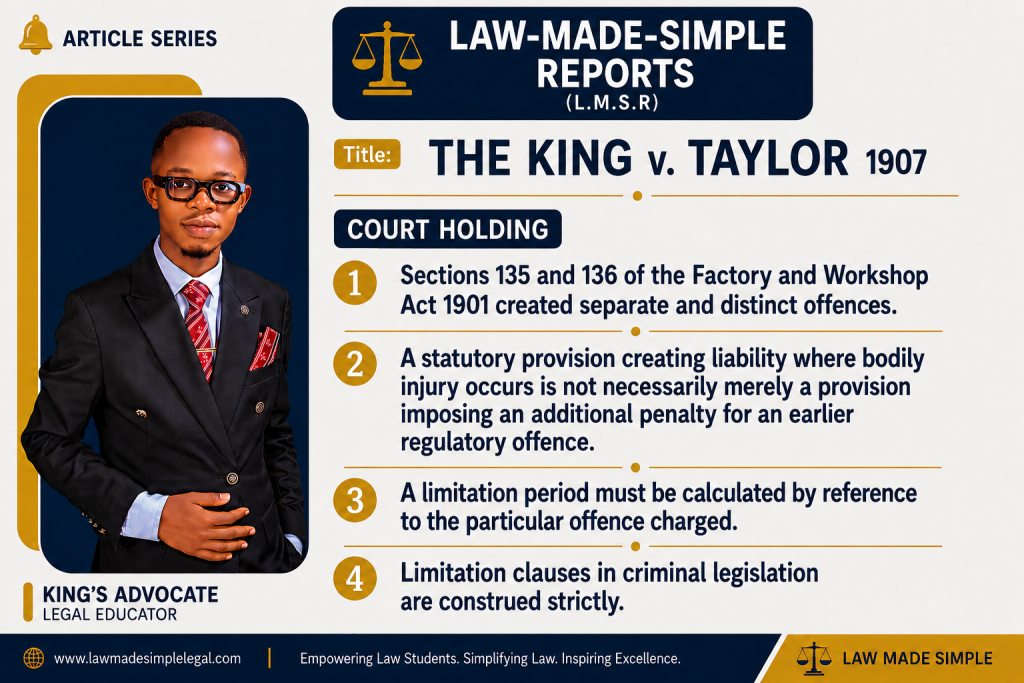
The King v. Taylor is an important authority on the interpretation of statutory offences and limitation periods in regulatory legislation. The case concerned an unfenced machine in a factory, a subsequent bodily injury, and the question whether proceedings were commenced within the statutory three-month limitation period.
The case is particularly useful for understanding the distinction between separate statutory offences arising from the same underlying conduct. It demonstrates that where legislation creates one offence for failure to comply with a statutory requirement and another offence where that failure results in bodily injury, the two offences may have different dates of commission and therefore different limitation periods.
For students of Criminal Law, Criminal Procedure and Statutory Interpretation,
The King v. Taylor is also useful in understanding how courts determine the true nature of an offence by examining the language and structure of the legislation rather than simply treating two provisions as different penalties for the same wrong.
CASE INFORMATION
Case: The King v. Taylor
Court: King’s Bench Division
Area of Law: Criminal Law; Criminal Procedure; Statutory Interpretation; Factory and Workplace Regulation
Legislation: Factory and Workshop Act 1901. Relevant Sections: Sections 10, 135, 136
NATURE OF PROCEEDINGS: Rule nisi concerning a refusal by a magistrate to state a case for the opinion of the CourtDate of Relevant
Events: 21 January 1907; 31 July 1907; 24 October 1907
Judge: Lord Alverstone C.J.KEY
LEGAL ISSUE IN THE KING v. TAYLOR
The central question was whether an information alleging that a factory was not kept in conformity with the Factory and Workshop Act, and that a person suffered bodily injury as a result, was brought within the statutory period of three months.The answer depended upon whether sections 135 and 136 of the Act created:
1. The same offence, with section 136 merely imposing a heavier penalty where injury occurred; or2. Separate and distinct offences, each having its own date of commission and therefore its own limitation period.
FACTS OF THE CASE THE KING v. TAYLOR
The defendants, Hugh Stevenson & Sons, Limited, were occupiers of a factory.The Factory and Workshop Act 1901 contained provisions requiring machinery in factories to be properly fenced for the protection of persons working around it.Section 10 dealt with the fencing of machinery.
Where there was a contravention of the requirements concerning fencing, the factory was deemed not to be kept in conformity with the Act.Section 135 provided a penalty where a factory was not kept in conformity with the Act.
Section 136 dealt with a different situation. It provided for liability where a person suffered bodily injury as a consequence of the occupier having neglected to observe a provision of the Act.The important events occurred on different dates.
On 21 January 1907, an inspector visited the defendants’ factory and discovered that certain machinery was unfenced in contravention of section 10.The inspector therefore knew at that time that the machinery was not properly fenced.
However, the machinery remained unfenced.On 31 July 1907, a person suffered bodily injury in consequence of the machinery still being unfenced.An information was subsequently laid on 24 October 1907.The information alleged, in substance, that on 31 July 1907 the defendants’ factory was not kept in conformity with the Act and that a person suffered bodily injury.The defendants argued that the proceedings were out of time.
Their argument was based on section 146, which required an information for an offence under the Act to be laid within three months after the date on which the offence came to the knowledge of the inspector for the district. Since the inspector had discovered the unfenced machinery on 21 January, the defendants contended that the three-month period began running from that date.If that argument were correct, the proceedings commenced on would have been too late.
THE STATUTORY PROVISIONS SECTION 10
Section 10 concerned the fencing of machinery.The purpose of the provision was essentially protective: machinery in factories was required to be properly fenced so as to protect persons from bodily injury.A breach of the fencing requirement meant that the factory was deemed not to be kept in conformity with the Act.
SECTION 135 Section 135 imposed liability where a factory was not kept in conformity with the Act.The provision therefore addressed the failure of the occupier to maintain the factory in the condition required by the legislation.
SECTION 136
Section 136 addressed a different circumstance.Where a person suffered bodily injury as a consequence of the occupier having neglected to observe a provision of the Act, the occupier could become liable to a penalty.The presence of actual bodily injury was therefore important to the operation of section 136.
SECTION 146
Section 146 contained the limitation period.It provided that an information for an offence under the Act had to be laid within three months after the date on which the offence came to the knowledge of the inspector for the district.The interpretation of this provision became decisive.
THE ISSUE BEFORE THE COURT THE KING v. TAYLOR 1907
The main issue was:
When did the offence for which the defendants were prosecuted occur for the purpose of section 146?
Was it on 21 January, when the inspector discovered that the machinery was unfenced?
Or
was it on 31 July, when bodily injury occurred as a consequence of the continued failure to fence the machinery?
THE ARGUMENT OF THE DEFENDANTS IN THE KING v. TAYLOR 1907
The defendants’ position was essentially that the failure to fence the machinery was already known to the inspector on 21 January.Therefore, if sections 135 and 136 concerned the same offence, the limitation period would have begun on that date.Since the information was not laid until 24 October, more than three months later, the proceedings would have been statute-barred.
THE ARGUMENT AGAINST THE LIMITATION OBJECTION IN THE KING v. TAYLOR 1907
The opposing argument was that sections 135 and 136 created separate offences.Section 135 concerned the failure to keep the factory in conformity with the Act.Section 136, however, dealt with the additional circumstance of bodily injury resulting from the occupier’s failure to observe a statutory requirement.
Accordingly, the offence under section 136 was not complete merely because the machinery was unfenced.The relevant offence arose when the statutory consequence contemplated by section 136 occurred, namely, bodily injury.On that interpretation, the offence occurred on 31 July.The information was filed on 24 October, which was within three months of 31 July.
DECISION OF THE COURT IN THE KING v. TAYLOR 1907
The King’s Bench Division held that sections 135 and 136 created separate and distinct offences.The offence charged was the offence under section 136.Since the bodily injury occurred on 31 July, the proceedings commenced on 24 October were within the statutory limitation period.The objection based on the earlier date of 21 January therefore failed.
THE REASONING OF LORD ALVERSTONE C.J. IN THE KING v. TAYLOR 1907
Lord Alverstone C.J. began by emphasizing the importance of section 146. A statutory limitation clause must be construed strictly.The Court therefore had to identify precisely when the particular offence charged came into existence and when that offence came to the knowledge of the inspector.The defendants argued that the offence came to the inspector’s knowledge on 21 January because that was when he discovered that the machinery was unfenced.
The Court, however, distinguished between the offence of merely failing to maintain the factory in conformity with the Act and the distinct offence arising where a person actually suffered bodily injury as a consequence of that failure.This distinction was important.If sections 135 and 136 were treated as creating only one offence, section 136 would effectively operate merely as an additional penalty where an injury subsequently occurred.The Court was reluctant to adopt that interpretation.
Lord Alverstone C.J. considered the practical consequences of such an interpretation.If a factory occupier had already been prosecuted and dealt with under section 135 for failing to fence machinery, and a person was subsequently injured because the machinery remained unfenced, treating section 136 as merely a heavier penalty for the same offence would create serious procedural difficulties.The Court therefore regarded sections 135 and 136 as addressing separate offences.
SECTION 135 AND SECTION 136:
THE DISTINCTIONT
his distinction is one of the most important lessons from the case.
SECTION135
The wrong under section 135 is essentially regulatory.The occupier fails to keep the factory in conformity with the statutory requirements.The offence can therefore exist independently of any actual bodily injury.
SECTION 136
The offence under section 136 contains an additional element: bodily injury resulting from the occupier’s failure to observe a provision of the Act.Thus, while the two offences may arise from the same underlying failure, they are legally distinct.This distinction is important in statutory interpretation because courts do not simply look at the factual background. They examine the legal ingredients of each offence.
WHY THE DATE OF INJURY MATTERED
The defendants were attempting to start the limitation period from 21 January.But the Court regarded the offence charged under section 136 as an offence connected with the later occurrence of bodily injury.The relevant date was therefore 31 July, when the injury occurred.The information was filed on 24 October.That was within three months of 31 July.Consequently, the prosecution was not out of time.
LIMITATION PERIODS IN CRIMINAL PROCEDURE
The case provides an important lesson on statutory limitation periods.A limitation period determines the period within which a prosecution must be commenced.Where legislation provides a specific period, the prosecution must comply with it.However, before calculating the limitation period, the court must identify the particular offence with which the accused is charged.This is crucial.A prosecutor cannot simply take the earliest date on which some aspect of the conduct became known and automatically treat that date as the beginning of the limitation period.The court must ask:
What offence was actually charged?What are the legal ingredients of that offence?When was that offence committed?When did the relevant facts constituting that offence come to the knowledge of the person specified by the statute?Only after answering those questions can the limitation period properly be calculated.
STATUTORY INTERPRETATION LESSON
The King v. Taylor is also a useful authority on purposive and structural statutory interpretation.The Court examined the wording of sections 135 and 136 and considered the consequences of treating them as creating the same offence.The Court’s approach demonstrates that provisions appearing in the same statute should be read in a manner that gives meaningful effect to each provision.Where two provisions contain materially different language and address different circumstances, the court should be slow to assume that one merely creates an additional penalty for the other unless the statutory scheme clearly indicates that intention.The Court therefore treated:”not kept in conformity with the Act”and”having neglected to observe any provision of the Act” resulting in bodily injuryas addressing different legal situations.
THE PRINCIPLE AGAINST REDUNDANCY
One useful lesson from the reasoning is the principle that legislation should, where reasonably possible, be interpreted so that its different provisions have meaningful work to do.If section 136 were treated merely as an extension of section 135, its independent wording and reference to bodily injury could lose much of its significance.Courts generally avoid interpretations that make statutory provisions redundant or practically meaningless.This connects The King v. Taylor with the broader principle of statutory interpretation that every part of legislation should, where possible, be given effect.
CRIMINAL LIABILITY AND THE CONSEQUENCE OF CONDUCT
Another important lesson is the distinction between an offence based upon conduct and an offence which incorporates a consequence.Some statutory offences are complete once a prohibited act or omission occurs.Other offences require an additional consequence before the offence is complete.For example, where legislation criminalises conduct “causing” a specified consequence, the consequence may form part of the legal ingredients of the offence.
In The King v. Taylor, the occurrence of bodily injury was significant to the offence under section 136.This explains why the date of injury mattered to the limitation period.
EXAM FOCUS The King v. Taylor
Students should remember The King v. Taylor for these principles:
1. Sections 135 and 136 of the Factory and Workshop Act 1901 created separate and distinct offences.
2. A statutory provision creating liability where bodily injury occurs is not necessarily merely a provision imposing an additional penalty for an earlier regulatory offence.
3. A limitation period must be calculated by reference to the particular offence charged.
4. Limitation clauses in criminal legislation are construed strictly.
5. The court must determine when the particular offence was committed before determining when the limitation period began.
6. Statutes should, where possible, be interpreted so that different provisions are given meaningful effect.
7. The factual discovery of an earlier regulatory breach does not necessarily begin the limitation period for a distinct offence that requires a later consequence.
8. The date on which an offence comes to the knowledge of the relevant inspector must be considered in relation to the particular offence charged.9. The legal ingredients of an offence, rather than merely the general factual background, determine when the offence is complete.
WHY THIS CASE MATTERS
At first glance, The King v. Taylor may appear to be a narrow case concerning factory machinery.Its wider importance is much greater.The case teaches a fundamental lesson in criminal law: the court must identify the precise offence created by legislation before determining whether a person can be prosecuted and whether the prosecution was commenced within time.It also demonstrates the importance of carefully distinguishing:
A regulatory breach;
An offence resulting from that breach;The ingredients of each offence;
The date on which each offence is complete; and
The date from which the statutory limitation period runs.
PRACTICAL EXAMPLE
Suppose a statute provides:”A factory must maintain its machinery in a safe condition.”Another provision provides:”Where a person suffers bodily injury because the occupier failed to observe a safety requirement, the occupier commits an offence.”If an inspector discovers the unsafe machinery in January but an injury occurs in July, the two provisions may potentially give rise to different offences.The King v. Taylor teaches that the court must examine the wording and structure of the statute rather than automatically treating July as merely a later consequence of the January offence or, conversely, automatically treating January as the commencement date for every possible offence arising from the same facts.
COMMON EXAMINATION TRAP
A common mistake is to assume that because two statutory provisions arise from the same factual conduct, they necessarily create the same offence.That is not necessarily correct.In an examination, identify the ingredients of each provision separately.Ask:”What must the prosecution prove under section A?”Then ask:”What additional element must be proved under section B?”If section B contains an additional consequence, such as bodily injury, death, damage or another specified result, that consequence may be legally significant in determining when the offence was committed.
HOW TO USE THE CASE IN AN EXAMINATIONS
The King v. Taylor illustrates that where a statute creates separate offences arising from related conduct, the court must identify the precise offence charged before determining the applicable limitation period. Sections 135 and 136 of the Factory and Workshop Act 1901 were treated as creating separate and distinct offences. Since the offence under section 136 depended upon bodily injury resulting from the occupier’s neglect, the relevant offence was committed when the injury occurred, rather than when the inspector had earlier discovered the unfenced machinery.”The student should then explain the application of section 146 and conclude that the information was filed within the prescribed period.
BROADER LEGAL LESSON
The case demonstrates the importance of reading statutes as a whole.A court should not isolate a single phrase and immediately determine its meaning.
Instead, the court considers:-
The language used by the legislature;- The relationship between neighbouring provisions;-
The ingredients of the offence;-
The consequences contemplated by the legislation;- The purpose of the statutory scheme; and- The practical effect of the proposed interpretation.The King v. Taylor is therefore valuable beyond factory legislation. It provides a useful framework for analysing legislation that creates several offences arising from related conduct.
KEY TAKEAWAYS IN THE KING V. TAYLOR
The simplest way to remember the case is:
SECTION 135 = failure to keep the factory in conformity with the Act.
SECTION 136 = neglect of a statutory requirement resulting in bodily injury.
SECTION 146 = limitation period for bringing proceedings.
The major lesson is that the existence of an earlier regulatory breach does not automatically mean that every later offence arising from the same circumstances must be treated as having been committed on the earlier date.
In recapitulation,
The King v. Taylor demonstrates how apparently similar statutory provisions may create separate offences with different legal consequences.The Court’s decision was particularly significant because it prevented the limitation provision from being applied mechanically without first identifying the precise offence charged.The case therefore remains useful for students studying criminal procedure, statutory interpretation, regulatory offences and limitation periods.It teaches a broader principle that applies far beyond factory legislation: before asking whether a prosecution is out of time, the court must first determine exactly what offence the prosecution alleges, what ingredients constitute that offence, and when those ingredients came together to complete the offence.
CASE PRINCIPLE IN ONE SENTENCE IN THE KING V. TAYLOR
The King v. Taylor establishes that where statutory provisions create separate offences, including an offence dependent upon a subsequent consequence such as bodily injury, the limitation period must be determined by reference to the particular offence charged and the date on which that offence was committed.
FOR MORE HELPFUL CONTENTS CLICK THE CATEGORIES Criminal Law| Law of Torts
ABOUT THE PUBLISHER
LAW-MADE-SIMPLE is a growing African academic resource network and a centre for academic growth, dedicated to making complex academic and legal knowledge easier to understand, access and apply.
Founded and published by Kingsley Omenyi, popularly known as KING’S ADVOCATE, the platform provides simplified case analysis, legal principles, statutes, academic resources and student-focused learning materials for learners across Nigeria, Africa and the wider Common Law community.
Through LAW-MADE-SIMPLE, Kingsley Omenyi seeks to bridge the gap between complex legal materials and practical understanding by presenting Nigerian and African legal materials in a clear, accessible and academically useful manner, while connecting them with broader principles of the Common Law tradition.
As a finalist law student, legal educator and digital content creator, Kingsley Omenyi has a strong interest in legal education, legal research, advocacy and the use of technology to make academic knowledge more accessible.LAW-MADE-SIMPLE is being developed as a central digital resource for teachers ,students,learners and every legal person seeking reliable, simplified and practical academic materials, with Nigerian law legal education at its core and a growing focus on African legal education and the wider Common Law tradition.
Published by:
KINGSLEY OMENYI -KING’S ADVOCATE
Founder & Publisher, King’s Advocate network
Making Law Made Simple.
Contact the Publisher: Contact Kingsley Omenyi