The decision of the Supreme Court in Idundun & Ors. v. Okumagba & Ors. (1976) stands as a locus classicus on the law governing proof of ownership of land in Nigeria. The case authoritatively laid down the recognized methods by which a claimant may establish title to land, a principle that has since been consistently applied by Nigerian courts.
This case is particularly important because it clarifies that ownership of land is a question of fact to be proved by credible evidence, and not merely by assertions of history or unsupported claims of overlordship.
FACTS OF THE CASE DUNDUN v. OKUMAGBA (1976)
The plaintiffs, representing the Ogitsi family of Okere, Warri, instituted an action against the defendants, who represented the Olodi, Oki and Ighogbadu families of Idimisobo, claiming:
A declaration of title to a large expanse of land at Okere, Warri
Forfeiture of the defendants’ alleged rights of occupation
An injunction restraining the defendants from further entry or interferenceThe plaintiffs based their claim on:
Traditional evidence, tracing ownership of the land to ancient Itsekiri ancestors, particularly Ginuwa I, and
Acts of ownership, such as granting leases and exercising control over the land.
The defendants denied the plaintiffs’ traditional history, asserted that their ancestors founded and possesses the land, and led extensive evidence of long possession, farming, leasing, and litigation over the land. Notably, the defendants did not counterclaim for title, but defended the plaintiffs’ claim.
Decision of the Trial Court IDUNDUN v. OKUMAGBA (1976)
The trial judge dismissed the plaintiffs’ claims in their entirety, holding that:
The plaintiffs’ traditional evidence was unreliable, inconsistent, and unconvincing The genealogical links asserted by the plaintiffs were uncertain. The defendants’ evidence of possession and acts of ownership over parcels A and B was far more credible. The conduct of members of the plaintiffs’ family showed recognition of the defendants’ ownership
THE SUPREME COURT’S INTERVENTION ON IDUNDUN v. OKUMAGBA (1976
On appeal, the Supreme Court affirmed the dismissal of the plaintiffs’ claims. In doing so, Fatai-Williams J.S.C., delivering the leading judgment, took the opportunity to restate the settled principles governing proof of title to land in Nigeria.
This restatement is what elevated the case to the status of a locus classicus.
The Enumerated Methods of Proving Ownership of Land Per Fatai-Williams J.S.C. as then was.
The Supreme Court stated as follows:
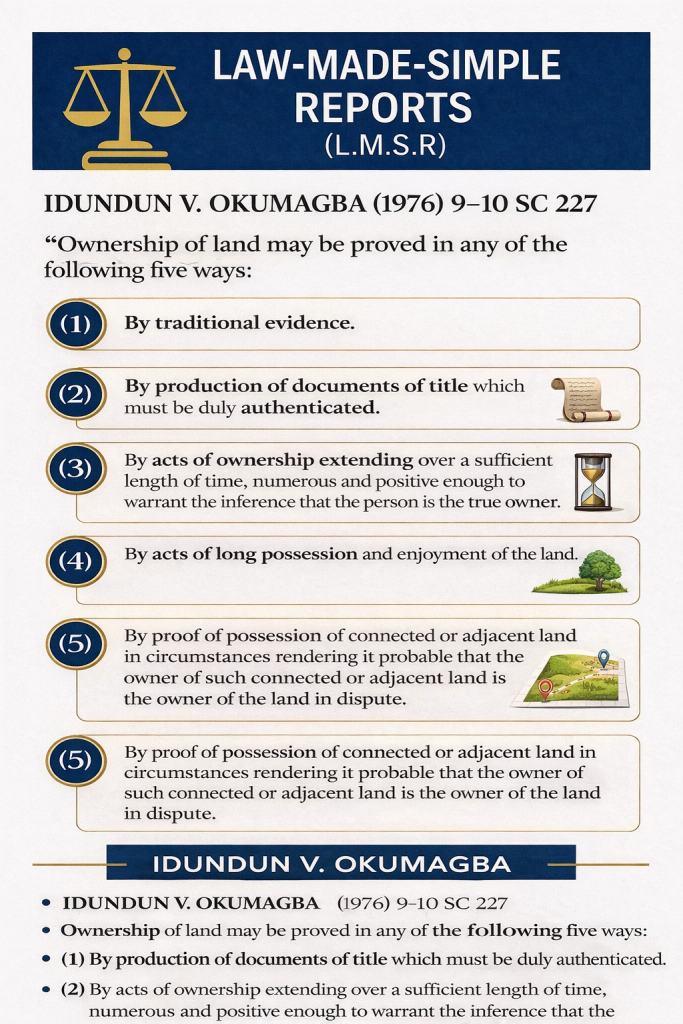
“Ownership of land may be proved in any of the following five ways:
(1) By traditional evidence;
(2) By production of documents of title which must be duly authenticated;
(3) By acts of ownership extending over a sufficient length of time, numerous and positive enough to warrant the inference that the person is the true owner;
(4) By acts of long possession and enjoyment of the land; and
(5) By proof of possession of connected or adjacent land in circumstances rendering it probable that the owner of such connected or adjacent land is the owner of the land in dispute.”
This statement has since become the definitive guide on proof of title in Nigerian land law.
Dissection of the Five Methods (Using the Case)
(a) Proof by Traditional Evidence.(Idundun v. Okumagba)
Traditional evidence involves tracing ownership to the original founder of the land and showing a clear, uninterrupted chain of devolution.
In Idundun v. Okumagba, the plaintiffs failed under this head because:
1. They could not prove that Ginuwa I’s kingdom extended to Okere
2.The alleged genealogy linking Ogitsi to later rulers was vague and uncertain
3.There were large historical gaps of over 300 years without credible explanation.
(b) Proof by Documents of Title.(Idundun v. Okumagba)
This method requires production of valid and authenticated documents such as grants, conveyances, or registered instruments.
In this case:
1.The plaintiffs did not rely on any decisive documentary title.
2.The defendants, however, relied on court judgments and plans evidencing earlier successful defenses of possession
3.The case reinforces that documents speak for themselves, but must relate clearly to the land in dispute.
(c) Proof by Acts of Ownership (Numerous and Positive Acts)-IDUNDUN v. OKUMAGBA (1976)
Acts of ownership include leasing land, granting rights, farming, litigating over land, or excluding trespassers.
The Supreme Court accepted the defendants’ evidence that they:
1.Granted leases to third parties
2.Controlled development on the landSuccessfully defended suits relating to the land.
Meanwhile, members of the plaintiffs’ family were found to have taken leases from the defendants, an act inconsistent with ownership.
(d) Proof by Long Possession and Enjoyment-IDUNDUN v. OKUMAGBA (1976)
Long possession raises a presumption of ownership where it is:
1.Peaceful
2.Continuous
3.Open and unchallenged
The defendants proved that their families had been in undisturbed possession for decades, farming and developing the land, with no credible challenge from the plaintiffs until much later.
(e) Proof by Possession of Adjacent or Connected Land-IDUNDUN v. OKUMAGBA (1976)
Where a person is shown to own adjoining land, the court may infer ownership of the disputed land if circumstances justify it.In this case:
1.Previous litigation (Suit No. W/111/71) confirmed the defendants’ possession of land falling within parcel A
2.Superimposition of survey plans showed clear physical connection
3.This reinforced the inference that the defendants were the true owners.
7. Key Lessons for Land Law Students from this ever Enduring land & property law case of -IDUNDUN v. OKUMAGBA (1976)
1.No single method is mandatory – any of the five may suffice
2.Traditional evidence is fragile and must be precise
3.Acts speak louder than history in modern land litigation
4.Conduct of parties can destroy a claim to ownership
4.Courts prefer probability, consistency, and credibility over sentiment.
In the end,Idundun v. Okumagba remains the cornerstone authority on proof of ownership of land in Nigeria. It harmonizes customary principles with evidentiary standards and provides a clear analytical framework for courts, practitioners, and students alike.
Every Nigerian land law problem on declaration of title ultimately finds its answer within the principles laid down in this case.
Amodu Tijani v. Secretary Southern Nigeria (1921)–Communal Land Rights
EKPENDU & ORS. v. ERIKA & ORS. (1959)Family Land Law Explained
AGHENGHEN & ORS. v. WAGHEROGHOR & ORS. (1974) Full Analysis.
LEWIS V. BANKOLE 1909 FULL REPORT LAW-MADE-SIMPLE
British South Africa Company v. Companhia de Moçambique (1893)
Inua-Na-Mallam Yaya case summary